
Holistic MTC Architecture for End-to-End Demands in Telecom Networks

As more industries and consumer applications start using IoT (Internet of Things) and massive Machine-Type Communication (MTC), telecom networks really need to adapt to handle millions of connected devices that all have different performance needs.
From autonomous vehicles and smart factories to remote healthcare and AR/VR applications, the real challenge is to provide solid end-to-end quality of service (QoS) across all sorts of environments and technologies.
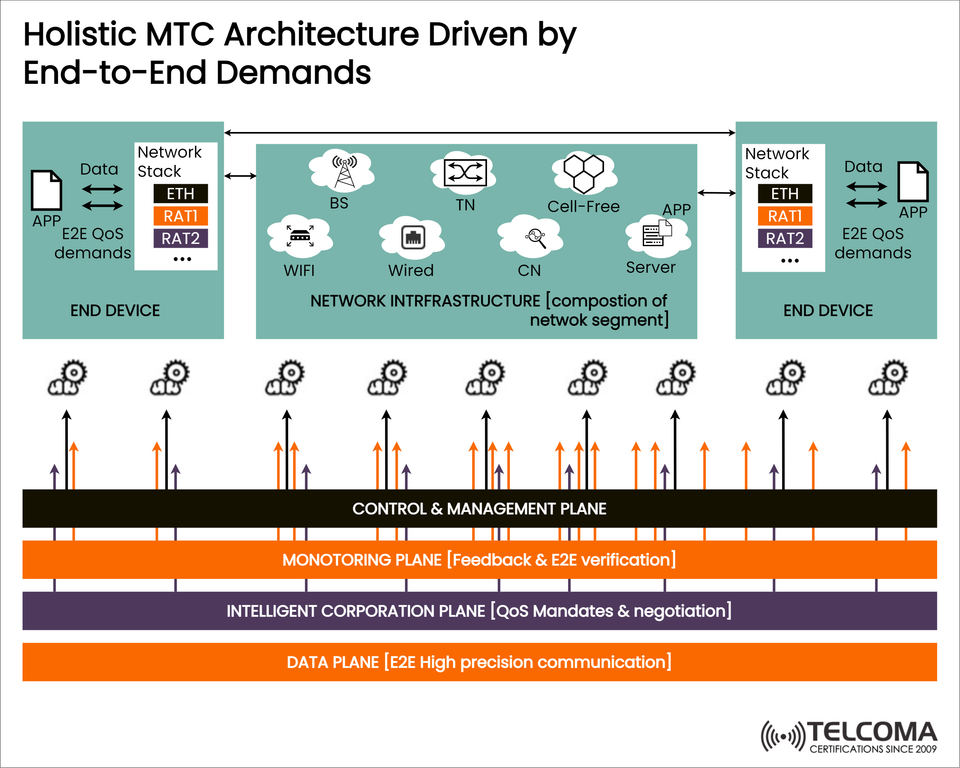
That's where the idea of a Holistic MTC Architecture, which is driven by end-to-end demands, comes into play. This architecture brings together multi-layered planes, smart infrastructure, and intelligent coordination methods to ensure high-precision communication, monitoring, and scalability.
In this article, we'll dive into the parts of this architecture and the benefits it offers, using insights from the accompanying diagram.
Understanding Holistic MTC Architecture
MTC stands for the automated communication of data between devices without needing human input. Traditional telecom networks are mainly set up for human-to-human (H2H) interactions, but MTC needs a completely different architecture because of:
Massive connectivity: We’re talking about millions of IoT devices all working at once.
Diverse QoS demands: Whether it’s ultra-low latency for self-driving cars or high reliability for industrial automation, the needs vary greatly.
Heterogeneous networks: You've got to blend Wi-Fi, cellular, wired, and next-gen cell-free architectures together.
The holistic MTC framework tackles these challenges by organizing the system into different planes that manage control, monitoring, coordination, and data communication.
Core Components of the Architecture
- End Devices with QoS Demands
End devices are applications powered by IoT that generate data and set out end-to-end QoS requirements. For example:
Smart sensors often prioritize reliability over bandwidth.
AR/VR apps need that ultra-low latency.
Industrial robots require both precision and stability.
Each of these devices connects to the network stack, which might involve Ethernet (ETH), various Radio Access Technologies (RAT1, RAT2, etc.), and the latest connectivity protocols.
- Network Infrastructure: A Composition of Segments
The infrastructure is made up of several segments:
BS (Base Stations): The heart of cellular connectivity.
TN (Transport Network): Responsible for moving data between endpoints.
CN (Core Network): Manages sessions, authentication, and routing.
Cell-Free Architectures: Spread antennas out for consistent coverage.
Wi-Fi/Wired: Facilitate local, high-capacity communication.
Servers & Applications: Provide content, analytics, and computing power.
Together, these components ensure smooth communication between end devices.
- Control & Management Plane
This part makes sure the network functions well overall. It handles device connections, resource distribution, and enforcement of QoS. Without it, keeping track of various devices and services would be next to impossible.
- Monitoring Plane
The monitoring plane offers feedback loops and checks on whether QoS is being met. For instance:
Measuring latency in a connected car.
Checking for packet loss in an industrial IoT scenario.
Ensuring security and reliability in healthcare applications.
This layer is key for continuous optimization and proactive troubleshooting.
- Intelligent Coordination Plane
This is basically the decision-making layer. It ensures:
Compliance with QoS demands
Dynamic negotiation between devices and network resources
Smart load balancing across different RATs and parts of the infrastructure
AI-driven management can forecast demand spikes, like when a big sports event is happening or during peak factory hours, and adjust resources accordingly.
- Data Plane
The data plane is the part where the actual communication takes place. It guarantees high-precision data transmission from end to end by sticking to the QoS standards agreed upon in the upper layers.
This plane is crucial for latency-sensitive and mission-critical tasks, like remote surgeries or controlling self-driving cars.
How the Layers Work Together
The four planes (Data, Monitoring, Intelligent Coordination, Control & Management) create a feedback loop:
QoS demands from end devices enter the network stack.
The Control & Management plane allocates resources based on RAT conditions and policies.
The Intelligent Coordination plane negotiates and dynamically fine-tunes network settings.
The Monitoring Plane checks how well QoS requirements are being met in real-time.
The Data Plane carries out precise end-to-end communication.
This process repeats, making sure that communication remains robust, adaptable, and reliable.
Advantages of Holistic MTC Architecture
Feature Benefit End-to-end QoS enforcement Reliable and predictable communication Multi-RAT integration Flexibility across different environments Monitoring feedback Continual validation and optimization Intelligent coordination AI-driven adaption to changing demands High-precision data plane Supports critical applications Cell-free infrastructure Provides consistent coverage and minimizes interference
Real-World Applications
Consumer Applications
Smart Homes: IoT devices working together smoothly with minimal delay.
AR/VR Entertainment: Immersive experiences requiring high bandwidth.
Connected Vehicles: Vehicle-to-everything (V2X) systems with strict latency requirements.
Industrial Applications
Industry 4.0: Precision robotics, predictive upkeep, and automation.
Healthcare IoT: Monitoring patients remotely and telesurgery.
Smart Energy: Real-time grid oversight and predictive load management.
Challenges in Deployment
Even though it's promising, deploying a holistic MTC architecture comes with its own set of challenges:
Complex interoperability among RATs and outdated infrastructure.
High computational demands for real-time monitoring and management.
Security risks in a large-scale IoT setup.
Scaling issues in super-dense environments.
Overcoming these hurdles will need efforts toward standardization, AI-driven organization, and secure network design.
Future Outlook
As we move toward 6G networks, the holistic MTC architecture is set to evolve with:
Built-in AI for predictive coordination.
Quantum-safe encryption for securely connecting IoT devices.
Eco-friendly practices that optimize energy use.
Holographic and tactile internet applications that require almost zero latency.
By combining data, monitoring, coordination, and management, telecom providers can rise to meet the diverse needs of next-gen MTC setups.
Conclusion
The Holistic MTC Architecture driven by end-to-end demands marks a significant change in how telecom networks manage massive IoT and machine-type communication.
By utilizing multi-plane orchestration, end-to-end QoS checks, and integration of various networks, this architecture guarantees that both consumer and industrial applications enjoy reliable, scalable, and adaptable connectivity.
For professionals in telecom and tech, this is more than just a strategy for optimization—it’s the foundation for resilient networks in the 5G and 6G future.