
How 3GPP Release 16 Enhances 5G Performance with NWDAF, MDT & SON
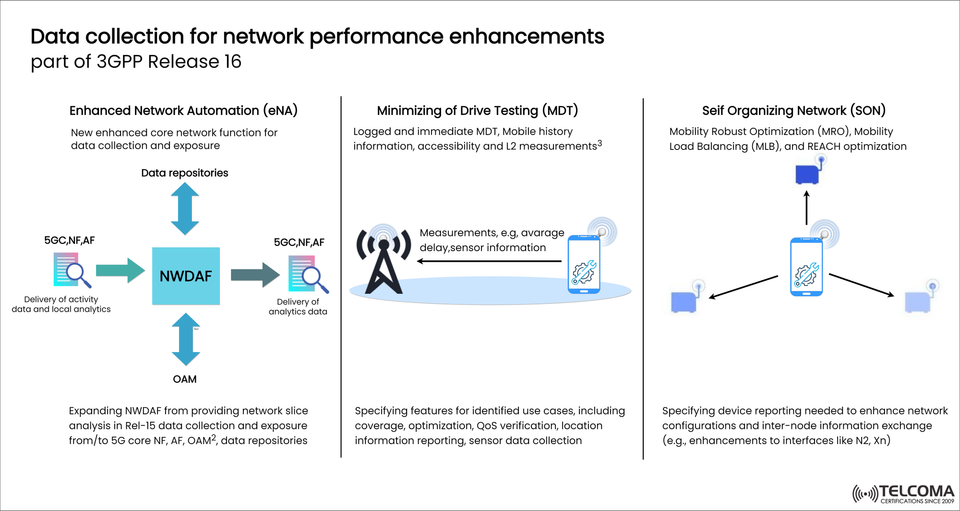

📊 Data Collection for Network Performance Improvement and 3GPP Release 16
The evolution of 5G networks is progressing rapidly to support more sophisticated use cases. This rapid evolution means intelligent automation and real-time visibility are critical. 3GPP Release 16 is meeting these needs with a comprehensive framework for network performance improvement that combines three new capabilities:
- NWDAF (Network Data Analytics Function)
- MDT (Minimization of Drive Testing)
- SON (Self-organizing network)
These capabilities allow for better and smarter decision-making, automatic network optimization, and lower operational costs.
🔍 Resting NWDAF for Network Automation
NWDAF establishes a foundation for data-driven decision-making with 5G networks. Although NWDAF was defined in Release 15 as a concept, Release 16 provides a much broader foundation.
What's new?
- Gathers data from 5G Core (5GC), Network Functions (NF) and Application Functions (AF).
- Can link to Operations, Administration and Maintenance (OAM) servers.
- Ability to interface to data repositories for rich historical analysis.
- Can expose analytics and operational data to external applications.
Benefits: - Real-time optimization of network slices.
- Predictive analysis of congestion, failure, and degradation in performance.
- Seamless integration into AI/ML tools for automated adjustments.
🛰️ Minimization of Drive Testing
Drive testing has been an expensive, labour intensive, limited coverage method of measuring and assessing network performance. With MDT new capabilities are now available:
- Logged MDT- Logged Data is collected and stored in the device for upload at a later time.
MDT Data Types:
Average Delay
L2 Layer Measurements
Sensor-based Data
Mobile History & Accessibility Information
Use Cases:
Network Coverage Mapping Without Physical Drive Testing
QoS Verification for Specific User Locations
Sensor based Data Collection in IoT Systems
🔁 Self-Organizing Networks (SON) for Real-Time Optimization
SON Streamlines the incredibly complicated task of managing ultra-dense 5G networks by enabling them to self-configure, self-optimize, and self-heal.
Core Functions Enhanced in Release 16:
Mobility Robust Optimization (MRO) - Assures reliable handovers
Mobility Load Balancing (MLB) - Efficiently distributes traffic
REACH Optimization - Enhances signal reach in edge zones
How it Works:
Devices Report Real-Time Conditions of the Network
The reported data is used to regularly adjust the parameters on the cell
The existing interfaces like N2, and Xn were improved to enhance inter-node communication.
📋 Summary Table:
Key Components in Release 16 of 3GPP
Feature Functionality Benefits
NWDAF Analytics & data exposure across 5G components Predictive automation & optimization
MDT mobile-based performance data collection eliminating costly drive testing
SON self-configuring & self-healing network behavior Real-time performance tuning
✅ Conclusion:
Building Smarter 5G Networks with Release 16!
With 3GPP Release 16, operators can turn raw data into intelligent action. All use cases described by operators can be done with NWDAF for the analysis activity, with MDT for the crowdsourcing of network measurements, or through enabling real-time response.
🔧 Technical Deep Dive:
Putting NWDAF, MDT and SON Together
To enable a future-ready, intelligent 5G network, it's important to understand how they all come together in practice.
📡 NWDAF in the 5G Core
The NWDAF acts as a centralized analytics engine within the 5G Core and it connects to:
- Control Plane Functions like AMF and SMF for user and session data
- Application Functions (AF) for service specific KPIs
- OAM Systems for operational oversight and diagnosis of issues.
This allows the NWDAF to:
- Make reports of performance trends
- Invoke policy change via the PCF
- Provide data into dynamic network slicing
🧭 MDT as a Crowdsourced Network Insight Engine
Minimization of Drive Testing leverages the data already present on user devices. This user equipment based reporting allows a better geographical spread of data to be collected as it reduces the reliance on manual tests.
MDT has two modes:
- Logged MDT: This is suitable for analysis offline and reporting at a later time.
- Immediate MDT: This is for real-time troubleshooting and optimization.
New MDT capabilities included in Release 16:
- Sensor data (e.g. temperature, acceleration)
- Location-based quality mapping
- Enhanced event triggers based on user mobility or loss of signal
🧠 SON: Self-healing and Adaptable Networks
Self-Organizing Networks are critical to accommodate the unpredictable nature of 5G especially in dense urban areas and heterogeneous networks (HetNets).
🌐Real-World Applications
Use Case How Release 16 Received Real-World Results
Autonomous Vehicles Ultra-low latency with NWDAF analytics and real-time MDT
Smart Cities Continuous capacity adaptation through SON and MDT
Industrial IoT and Smart Factories Predictive analytics through NWDAF dashboard vs. sensor based MDT.
Emergency Communications SON improvements in handover optimization & reliability
📣 Final Thoughts: Consequential Marks into the Next Intelligent 5G Era
3GPP Release 16 has paved the way for autonomous, 5G analytics-driven networks. As telecom operators rollout 5G with the following three core capabilities:
NWDAF for predictive analytics in production of services
MDT for mass, UE driven measurements across large areas
SON for real time, autonomous resource optimization
they can adapt networks to be resilient, responsive, and ready for the future.
As 5G matures towards 6G, we will continue to see these core technologies in greater frequency to manage, performance, cost, and customer satisfaction.
✅ Quick Recap
📊 NWDAF provides centralised intelligence for slice and resource optimisation.
📱 MDT provides an easier way to measure things without the overhead of a field trial, and by using intelligent UE's as your measurement devices.
🔁 SON enables networks to know themselves, to change themselves, to optimise themselves.
🛠 Implementation Roadmap: From Lab to Live Network
Phase Key Activities Recommended Tools / Specs
- Lab Validation
• Spin up a 5GC sandbox with NWDAF modules
• Emulate MDT traffic with test UEs
• Run SON algorithms on controlled cell clusters • 3GPP TS 23 288 reference implementation
• Open-source UE simulators (OAI, srsUE)
• SON test suites (TR 36 902)
- Field Trial / PoC
• Enable Logged + Immediate MDT in a limited geography
• Feed real KPIs into NWDAF and train basic ML Models
• Enable SON functions (MRO, MLB) on trial cells • KPI collectors (Prometheus + Grafana)
• Kubernetes-based NWDAF micro-services
• AI toolkits (TensorFlow Serving)
- Gradual Roll-Out
• Integrate NWDAF with PCF for closed-loop policy control
• Expand SON to multi-vendor clusters via O-RAN E2 interface
• Automate firmware updates for UE MDT Profiles • Service Management & Orchestration (SMO)
• O-RAN openness tests (PlugFest reports)
• CI/CD pipelines (GitLab CI, ArgoCD)
- Full Automation
• Deploy advanced ML Pipelines for anomaly prediction
• Implement intent-based APIs for slice QoS tuning
• Transition from manual dashboards to AIOps consoles • MLOps stacks (Kubeflow, MLflow)
• Intent frameworks (TM Forum ODA)
• AIOps (Moogsoft, IBM Watson AIOps)
- ⚠️ Challenges & Mitigation Strategies
Challenge Why it Matters Mitigation
Data Privacy & GDPR - UE-generated MDT can present subscriber location & behavior.
● Tokenization of IMSI/MSISDN
● MDT payloads should apply differential privacy
● PII should only Go into on-prem data lakes
Model Drift in NWDAF ML - Seasonal traffic or new applications can break model accuracy.
● Scheduled model re-training (whether weekly or only on spikes on the KPI)
● Standing models will monitor accuracy against true measurement with shadow predictions
Vendor SON Cross-interoperability - When SON goes x-vendor on shared cell layers, there may be conflict between proprietary SON logic.
● O-RAN E2-AP could offer defined interfaces and xApp portability.
● Use hierarchy of policies (global policy > vendor policy > cell policy)
MDT Battery Penalty - Frequent reports can drain UE power.
● Logged MDT used for low priority KPIs.
● Reporting timers can be tuned using NAS signaling.
🌍 Vendor & Open-Source Landscape
Function Commercial Vendors Open-Source / Community
NWDAF Ericsson, Nokia, Huawei, Samsung Free5GC-NWDAF, ONF SD-Core
SON Platforms AirHop, P.I. Works, Qualcomm U-SON Open-RAN SC (near-RT RIC)
MDT Agents Device OEM firmware (Qualcomm, Samsung) OAI NR-UE, srsUE
🔮 What's Next? – Preview of Releases 17 & 18
Road-map Item Release 17/18 Highlight Impact
Enhanced NWDAF Exposing "Analytics-as-a-Service" to 3rd party edge apps Enables new revenue opportunities through slice-level SLA APIs
MDT Phase 3 Integration with RedCap & NTN UEs Wider coverage including satellites and low-power IoT
Zero-Touch SON Fully intent-based RAN configuration Optimisation cycle with human out of the loop