
How 5G Core and LTE EPC Coexist: Architecture, Options, and Interworking
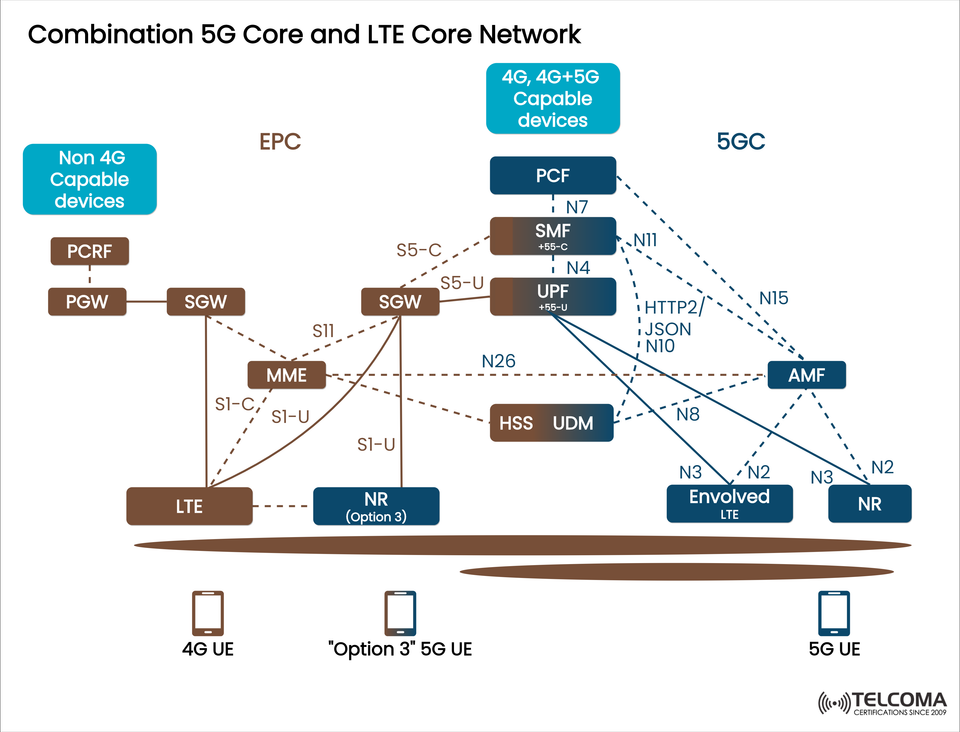

📶 The integrated 5G Core and LTE Core Network
Transitioning from LTE to 5G is not a complete rip and replace transition. It uses a gradual flexible migration approach that promotes utilizing existing EPC based infrastructure alongside 5G Core (5GC). In the combined scenario, you can support various types of user equipment (UE) as follows:
4G only device
Dual-connected 5G Option 3 device
Standalone 5G UEs
Let’s take a closer look at how the architectures come together and operate.
🧩 Components of the Combined Architecture
This diagram shows the two primary core networks:
- Evolved Packet Core (EPC) – 4G Core
Used to support LTE and EN-DC (option 3) UEs.
MME: Mobility Management Entity
SGW: Serving Gateway
PGW: Packet Data Network Gateway
PCRF: Policy and Charging Rules Function
- 5G Core (5GC)
Supports Standalone (SA) and Option 2 architectures.
AMF: Access and Mobility Management Function
SMF: Session Management Function
UPF: User Plane Function
PCF: Policy Control Function
UDM: Unified Data Management
🔗 Interface Reference Table
Interface Purpose Connects
S1-C/U User/Control Plane between LTE and MME/SGW LTE ↔ EPC
S5-C/U User/Control Plane between SGW and PGW/UPF SGW ↔ UPF
N2/N3 User/Control Plane between RAN and 5GC NR/EN-LTE ↔ AMF
⚙️ Multi-Generation Device Deployment Scenarios
Device Type Supported Network Core Network Used Notes
4G UE LTE only EPC Legacy only
Option 3 5G UE LTE + NR (EN-DC) EPC NSA, dual connectivity
5G SA UE NR only 5GC Pure 5G
🚀 Migration Path: Option 3, Option 2 and Interworking
✅ Option 3 (EN-DC):
Dual connectivity using LTE as master and NR as secondary node.
Using EPC as core network.
Fastest way to deliver 5G-like download speeds using LTE coverage.
✅ Option 2 (Standalone 5G):
Pure 5G deployment using 5G Core (5GC) and NR.
New core deployment required.
🔁 N26 Interface Interworking:
Mobility between EPC and 5GC.
Session continuity for user moving between coverage areas.
🔒 Interworking Advantages and Security Implications
📈 Advantages:
Phased and cost reducing 5G deployment.
More device compatibility.
Easier upgrade paths using existing infrastructure.
⚠️ Disadvantages:
CUPS complexity.
Session and identity management across EPC and 5GC.
Risk of increased signaling if not careful with traffic steering.
🔮 Conclusion: A Gradual 5G Evolution
The combination of 4G EPC and 5G Core will provide operators with a scalable and flexible means to deploy 5G without made obsolete there existing LTE services. By following NSA (as in Option 3) and using interworking functions (like N26), Operators can accommodate a blend of devices.
🔁 Detailed Examination of the Relationship Between EPC and 5GC
The hybrid architecture depicted in the figure not only addresses device compatibility, but it allows service continuity during the transition from 4G to 5G.
🔗 Importance of the N26 Interface
The N26 interface connects the MME in EPC to the AMF in 5GC, which allows session and mobility management to occur seamlessly between 4G and 5G.
This enables a UE to roam seamlessly across LTE (EPC) or NR (5GC) while maintaining the same authentication, policy and session context of the original network.
🧠 Context Transfer and User Identity
5G UEs that have registered in 4G and 5G core, both must ensure that user identities are maintained in their respective format (SUPI, IMSI, GUTI).
Interworking with UDM and HSS will be required to provide access to shared subscriber profiles between EPC and 5GC.
🛠️ Practical Implementation for Operators
Operators looking to deploy or expand 5G services while maintaining 4G coverage, should take a number of technical and operational aspects into account.
✅ Deployment Aspects
Operators should explore the option 3 (EN-DC) in order to take advantage of existing LTE coverage and EPC.
Deploy 5GC for new wider 5G SA use cases (URLLC, network slicing) in parallel with the existing EPC.
Dual-registration uses in UEs will allow access to both core when required.
🛡️ Security and Policy
EPC uses DIAMETER protocol, while 5GC starts to use HTTP/2 and JSON over Service-Based
📊 Overview of Deployment Options
Deployment Option RAN Used Core Used UE Support Notes
Option 1 LTE only EPC 4G UE traditional LTE
Option 2 NR only 5GC 5G SA UE full 5G SA
Option 3 (EN-DC) LTE + NR EPC 5G NSA UE widely deployed
Option 4 NR + LTE 5GC 5G SA UE dual access via NR anchor
Option 5 LTE + NR 5GC 5G SA UE LTE as anchor to 5GC
Option 7 NR + LTE 5GC 5G SA UE NR anchor, LTE secondary
🌐 Preparing for a 5G only world
Option 3 deploys eMBB quickly today but it is the hope of telco operators that they will establish a pure 5G solution as the network architecture (option 2).
📌 Migration Plan for the Future
Roll out first a NSA (EPC) deployment.
Plan and grow into more 5GC as the services and enterprises emerge.
Continue upgrading in UE and network to evolve into SA.
Pace out and decommission EPC and perhaps RAN too.
This provides the operator time to sunset the old and enable the emergence of new use cases associated with 5G such as ultra-low latency, massive IOT, and network slicing.
🔚 Conclusion:
Find some equilibrium between today and tomorrow with 5G
Using both 5GC and LTE Core (EPC) with RANs that also utilize LTE and NR is not only technically simple but crucial for telco operators to be able to realise innovative possibilities and not.
📈 Strategic Guidance for Professionals
To effectively manage the EPC and 5GC use cases, operators should approach the task as follows:
🧩 1. Create a Dual Core Strategy
Use EPC (4G) for legacy and NSA (non-standalone) devices for backward compatibility.
At the same time, stand up 5GC (for advanced use cases like network slicing, URLLC).
When possible, enable dual-registration mode on UEs to allow for simultaneous devices to register for parallel sessions in each core.
🛡️ 2. Invest in Policy and Data Convergence
Integrate policy control enforcement between standard policy repository in EPC (PCRF) and the policy control function in 5GC (PCF).
Integrate the subscriber and network profiles so subscribers can benefit from caching identity information from both UDM and HSS through common identity mappings in session management.
Using the N26 interface to accept requests while moving from one core to another that updates cache, but enables continuous service continuity.
⚙️ 3. Identify Vendor Interoperability Capabilities
Regardless of how many vendors you engage to supply the RAN and Core, for multi-vendor RAN/Core ecosystem or private edge compute environments, identify:
Compatibility (support of standard interfaces for the interfaces defined by 3GPP, ie. S1, N2, N26).
Compliance with 3GPP Release 15+ Features (5GC includes inline options, EPC is multi-vendor and legacy, and the framework accommodates holistic compliance).
Orchestration and management of analytics through the use of an ecosystem platform like ONAP (the industry standard).