
How 5G Integrates Low-Band and High-Band: Architecture and Use Cases Explained
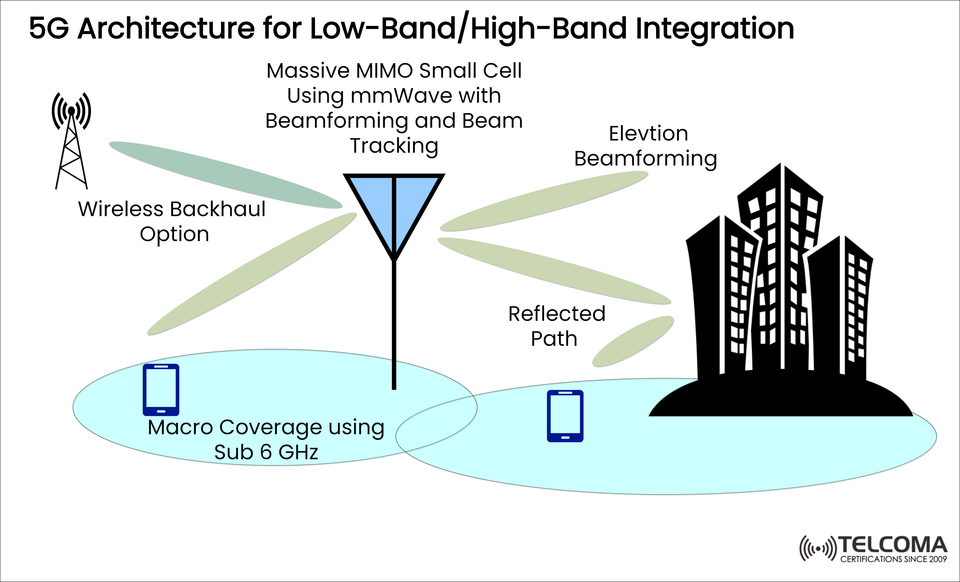

5G Architecture for Low-Band and High-Band Integration: A Technical Discussion
5G has presented the telecommunications industry with a number of innovations, including the ability for telecom service providers to combine and integrate low-band spectrum and high-band spectrum into a single, high-performance network. In this blog, we will discuss the 5G architecture supporting this ability — bringing together Sub-6 GHz macro coverage and mmWave small cells including Massive MIMO, beamforming, and beam tracking .
Whether you are a telecom engineering professional, a network planner or just a telecommunications enthusiast, this article will present a clear, technical, detailed breakdown of how 5G coverage is wide and data speeds are extreme at the same time.
Why Integrate Low-Band and High-Band in 5G?
Spectrum Positioning:
Low-Band (Sub-6GHz)
Enables wide-area coverage with penetration through walls and buildings but with lower top speeds. Complemented with a smaller footprint, denser and more impacted bandwidth.
High-Band (mmWave >24GHz)
Provides ultra-high data rates and low latency but has limited distance and poor penetration.
Benefits of Integration:
- Seamless user experience throughout all terrains
- Equilibrium of performance for urban and rural service
- Applications such as 4K streaming, VR, and autonomous navigation
Elements of Low-Band/high-Band 5G Architecture
- Macro Coverage via Sub-6 GHz
Provision of the base mobile user connectivity and coverage.
Essential in rural, suburban, with indoor penetration.
Anchoring layer for non-standalone 5G deployments. - Massive MIMO Small Cell (mmWave)
Deployed in urban hot zones to add high throughput and capacity.
Employs Massive MIMO with beamforming and beam tracking to steer signals directly towards users.
Assists with mmWave challenges with line-of-sight dependencies. - Beam Forming + elevation beam tracking
Dynamically steers narrow beams toward mobile devices to avoid any outage ensuring a reliable high speed link.
Elevation beamsteering compensates for user mobility in the vertical dimension (for example in buildings).
Reflected Paths are also used to reach devices that are blocked by other obstructions (i.e., buildings, walls). - Wireless Backhaul Option
Could even be deployed to wirelessly connect small cells to a core network versus fibre.
This is an important option to consider in urban areas for expandability when fibre is too costly and impractical.
5G Signal Flow in the Architecture
Component Function in the Architecture
Sub-6 GHz Base Station Wide-area macro coverage
mmWave Small Cell High speed, localized service
Beamforming Antennas Direct signal, improve signal quality and minimize latency
Wireless Backhaul Provides the connection from the small cells back to the network backbone
Reflected Beam Paths Provides coverage for non-line-of-sight situations
Practical Use Cases of This Architecture
🏙️ Urban Environments:
High capacity zones like sports stadiums, business districts and shopping malls.
Handling task density can utilize mmWave small cells while providing coverage via Sub-6 GHz.
🏢 Indoor/High-Rise Coverage:
Elevation beamforming allows connection to multiple floors.
Useful in smart buildings, enterprise campus.
📶 Flexible Deployment:
Wireless backhaul allows for a quicker deployment in cities that lack fiber availability.
Conclusion
The 5G Low-Band/High-Band Integration Architecture is a wonderful combination of range and capacity, coverage and speed. The integration of Sub-6 GHz macro layers to mmWave small cells with the advantages of beamforming, beam tracking, and wireless backhaul allows telecom operators deliver on the full value of 5G - gigabit speeds, low latency, and ubiquitous coverage.
Industry Adoption and Tactical Use of Low-Band/High-Band Integration
🔧 How Operators Are Using This Architecture
Many telecom operators globally are already adopting this integrated approach to 5G, incorporating licensed spectrum bands, intelligent radio planning, and cloud-native software infrastructure:
Verizon and AT&T utilize mmWave for dense urban 5G hotspots, and Sub-6 GHz is used as the lower layer for more rural access.
T-Mobile employs a balanced "layer cake" technique:
Low-band (600 MHz) for rural
Mid-band (2.5 GHz) for citywide access
High-band (mmWave) for very fast speeds in high-traffic areas
📍 Deployment Considerations
Site Placement: mmWave small cells need to be sited around 200-300 meters apart for effective coverage.
Line-of-Sight Optimization: Use paths that bounce off surfaces, and elevation beamforming with radio transmissions will allow for connectivity when there are obstacles.
Backhaul Planning: In areas without fiber, wireless backhaul enables faster deployment without a great deal of infrastructure upgrades.
Roadblocks and Solutions
Roadblock Solution
mmWave range constraints Using dense small cell grids and intelligent beam forming
Signal blockage (trees, buildings) Using reflection paths, elevationally tracked beams
High cost of deployment Using wireless back haul and phased deployments
Device compliance Using the variety of 5G capable, multi-band, consumer devices to entice rollout.
Interference & Spectrum Sharing Execute dynamic spectrum sharing and interference mitigation protocols.
Future Directions: Where are we Going?
The low-band/high-band integration for networks will continue to mature as AI-native networking and 6G developments come online. Some of the exciting trends will be:
🌐 AI Driven RAN Optimization
Real-time tuned beam patterns for handovers
Anticipating user mobility and making adjustments on signal paths dynamically with predictive analytics.
🛰️ Satellite-5G
Using new non-terrestrial networks (NTN) to complement terrestrial coverage, providing IoT access globally, and for remote areas.
🧠 Edge computing co-location
Placing compute nodes in conjunction with mmWave small cells to move compute to the edge and minimize latency for mission critical applications like AR/VR and autonomous vehicles.
Last Thought
The 5G Low-Band/High-Band Integration Architecture isn't simply an integration design; it represents a strategy for reliable, large-scale, high-performance mobile connectivity. With intelligent placement, advanced antenna capabilities, and flexible backhaul options, telecom networks can provide a gigabit experience - thus promising untold possibilities for the future - for either consumers or businesses.
As 5G use cases proliferate in healthcare, logistics, smart cities, etc., this architecture ensures that no matter the use case in question, performance and reliability will always be delivered to either consumers or businesses.
✅ Deployment Checklist:
Conduct detailed RF planning to layer Sub-6 GHz macro and mmWave small cell sites.
Utilize site surveys and simulation tools to classify LOS (line-of-sight) and NLOS (non-line-of-sight).
Deploy Massive MIMO and dynamic beamformers in high urban density areas.
Use wireless backhaul when fiber is not plausible or cost prohibitive.
Test for reflected beam paths in an urban layout and modify beam tracking algorithms.
Deploy with edge computing nodes when needing ultra-low latency service (i.e. industrial IoT, AR/VR).
Continue to monitor and optimize performance via AI-based Self-Organizing Network (SON) tools.