
How 5G Network Slicing Transforms Service Differentiation: From 4G to Intelligent Networks

Service Differentiation: How 5G is Changing the Game Beyond 4G
The jump from 4G to 5G isn’t just about getting faster speeds—it’s a complete overhaul of how networks provide varied services across different sectors. Sure, 4G set the stage for mobile internet and IoT, but 5G brings in a service-focused network model that tailors performance based on specific applications or industries.
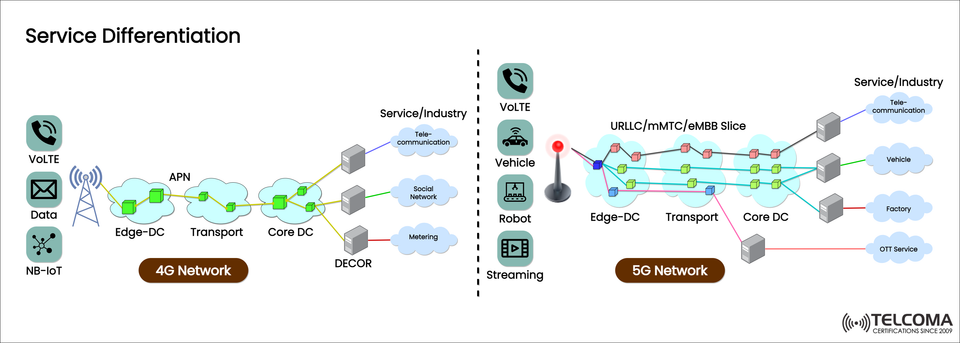
The image titled “Service Differentiation” highlights this shift, contrasting the APN-based approach in 4G with the slice-based structure in 5G. It shows how 5G can fine-tune its performance for a range of sectors—from telecom and social media to transportation, robotics, and streaming services.
What is Service Differentiation?
In the world of telecommunications, service differentiation means a network can provide customized performance criteria like speed, latency, reliability, and bandwidth based on what users or applications need.
For example:
A voice call needs low bandwidth but must be super reliable.
Streaming video calls for a steady high throughput.
Self-driving cars require ultra-low latency.
While 4G had limited options for service differentiation through simple APN (Access Point Name) settings, 5G takes it up a notch with network slicing, edge computing, and virtualized cores that allow for detailed, on-the-fly adjustments.
Service Differentiation in 4G Networks
On the left side of the image, you can see how 4G network architecture flows.
Core 4G Services:
VoLTE (Voice over LTE): Provides IP-based voice services.
Data: Standard mobile broadband for web browsing, social media, and streaming.
NB-IoT (Narrowband IoT): Connects low-power IoT devices like sensors and meters.
4G Network Setup:
Edge-DC (Edge Data Center): Hosts local applications and content delivery.
Transport Network: Links edge and core networks through backhaul connections.
Core DC (Core Data Center): Manages main functions like subscriber control, policy management, and traffic routing.
APN (Access Point Name): Specifies service types and directs traffic to particular gateways or servers.
Service Flow:
In a 4G setup, all services—VoLTE, data, NB-IoT—share the same core infrastructure and common network rules. Differentiation relies on directing traffic through various APNs or DE-COR (Dedicated Core) components, specially used for things like IoT or metering.
Challenges of 4G Service Differentiation:
It’s static and tied to hardware.
Limited scalability for different sectors.
High latency with real-time services.
Lacks support for ultra-reliable, low-latency (URLLC) services.
Basically, 4G’s one-size-fits-all approach works for general broadband but falls short for the complex performance needs of modern digital industries.
The 5G Shift: Smart Network Differentiation
The right side of the image illustrates the 5G network, where every service or sector connects through its own dedicated network slice. This setup allows the network to fulfill specific performance and reliability needs.
Core 5G Services:
VoLTE: Continues as a key communication service.
Vehicle Connectivity: Enables communication between vehicles and everything around them (V2X).
Robotics: Supports industrial automation and remote management.
Streaming: Provides ultra-HD, low-latency video services.
These services fall into three primary 5G categories:
eMBB (Enhanced Mobile Broadband): For speedy internet and streaming.
mMTC (Massive Machine-Type Communication): For IoT devices and sensors.
URLLC (Ultra-Reliable Low-Latency Communication): For critical applications like robotics and vehicles.
Understanding Network Slicing in 5G
What’s Network Slicing?
Network slicing means creating multiple virtual networks (slices) on a single physical 5G setup. Each slice runs independently, tailored with its own QoS, security, and latency standards for different services.
In the image, the URLLC/mMTC/eMBB slice connects various services like:
Telecom: For highly reliable communication.
Vehicle Networks: For swift real-time V2X data.
Factories: For robotic automation and precise control.
OTT Services: For smooth media streaming.
Perks of Network Slicing:
Service Isolation: Each industry gets a dedicated logical network.
Performance Tuning: Resources are aligned with specific use cases.
Dynamic Scaling: Slices can expand or contract based on immediate demand.
Cost Efficiency: Virtualization cuts down on hardware needs.
Example:
A factory automation slice prioritizes URLLC for controlling robots with super low latency, while a video streaming slice focuses on eMBB to provide high data speeds.
This level of customization was off the table in 4G, where all services depended on shared paths and fixed setups.
Edge Computing: Bringing Intelligence Closer
The Edge Data Center (Edge-DC) is crucial for 5G differentiation. Unlike centralized cores, edge nodes process data near the user, cutting down latency and boosting efficiency.
Key Benefits of Edge-DC:
Faster Response Time: Data doesn’t have to travel to far-off cores.
Local Processing: Perfect for real-time analytics and control.
Reduced Bandwidth Use: Only essential data makes its way to the core.
For example, in the robot control or autonomous vehicle slice, edge computing guarantees quick decision-making, which is vital for safety and performance.
Comparing 4G and 5G Network Differentiation
Feature | 4G Network | 5G Network
Core Structure | Centralized EPC | Cloud-native, distributed 5GC
Service Model | APN-based | Slice-based
Customization | Limited | Highly dynamic
Latency | ~50ms | As low as 1ms
Service Segmentation | By APN | By network slice
Industry Applications | Telecom, IoT | Telecom, Automotive, Industry, OTT
Edge Computing | Minimal | Integrated (Edge-DC)
Virtualization | Partial (EPC VNF) | Full (NFV + SDN)
This table illustrates how 5G’s adaptability and intelligence allow telecom operators to offer services that align perfectly with specific industry needs and performance targets.
The Impact of 5G Service Differentiation on Industries
Telecom:
Improved VoLTE and VoNR (Voice over New Radio) calls.
Centralized management for mobile and enterprise voice/data networks.
Automotive (V2X):
Instant communication between vehicles and infrastructure.
Safety-critical functions like collision avoidance and self-driving capabilities.
Manufacturing & Robotics:
Predictive maintenance, remote operations, and closed-loop automation.
Ultra-low latency control for precise robotic actions.
OTT & Media:
Seamless high-definition streaming experiences.
Cloud gaming and immersive AR/VR applications.
IoT and Smart Metering:
Ability to connect a multitude of devices with minimal power consumption.
Centralized data collection via mMTC slices.
These use cases all benefit from 5G’s capacity to differentiate, isolate, and optimize services on a larger scale.
Security and Quality of Service (QoS) in 5G Differentiation
Security and QoS are vital to 5G’s differentiation strategy.
Per-slice QoS control: Guarantees bandwidth and latency for each service.
Isolation: Avoids congestion or interference among slices.
End-to-end encryption: Keeps data secure across Edge, Transport, and Core areas.
Automated orchestration: AI-driven management ensures each slice stays in line with SLA standards.
This shifts 5G from just being about connectivity to becoming a service-oriented digital platform.
The Role of SDN and NFV
5G’s differentiation capabilities rely on:
SDN (Software-Defined Networking): Provides programmable control over how networks operate.
NFV (Network Function Virtualization): Lets network functions (like firewalls and gateways) run on cloud-based systems.
These technologies give operators flexibility and automation, making it easy to roll out new slices or adjust existing ones quickly.
Conclusion
Moving from 4G to 5G represents a massive leap in network intelligence and adaptability. While 4G connected individuals, 5G connects entire industries, offering customized connectivity for every single application.
By utilizing network slicing, edge computing, and cloud-native cores, telecom operators can provide services that are highly differentiated—supporting everything from self-driving cars to immersive entertainment and automated industries.