
How 6G Vision Aligns with UN SDGs: Building a Sustainable Digital Future

How 6G Vision Aligns with UN SDGs: Building a Sustainable Digital Future
As we gear up for 6G mobile networks, the emphasis is shifting beyond just pure connectivity. This sixth generation of wireless technology is set to weave itself into our societal goals, especially the United Nations Sustainable Development Goals (UN SDGs).
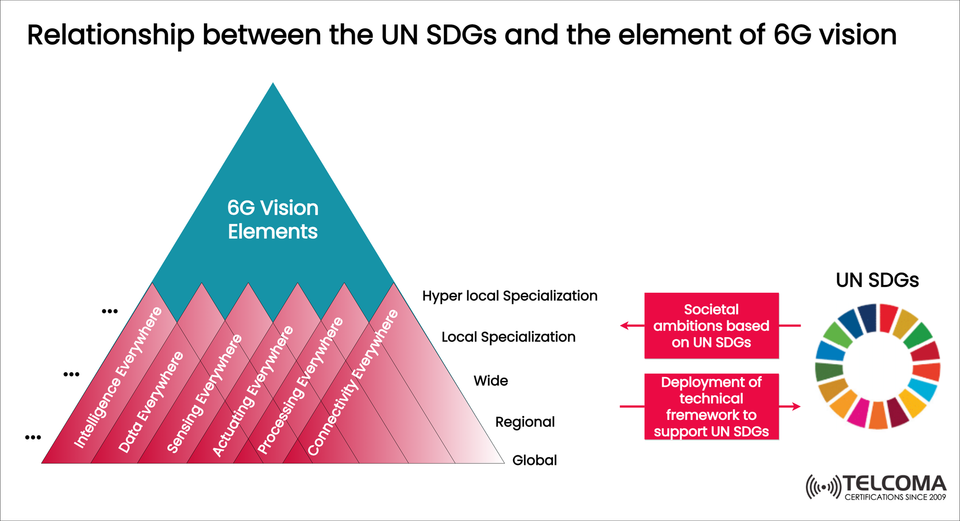
The image above illustrates how the elements of the 6G vision relate to the SDGs, showing that technical frameworks can play a significant role in meeting global sustainability goals. Unlike past generations that were mainly about speed and coverage, 6G aims to be a catalyst for societal growth, tackling issues like digital inclusion, climate change, and smart infrastructure.
Understanding the UN Sustainable Development Goals (SDGs)
The UN SDGs consist of 17 global objectives that were adopted in 2015. They’re designed to tackle major challenges by 2030, such as:
Putting an end to poverty and hunger.
Making quality education accessible to all.
Fostering gender equality.
Creating sustainable cities and communities.
Taking urgent action on climate.
Encouraging innovation and solid infrastructure.
These goals outline the path for sustainable development, and it’s expected that 6G technologies will play a key role in achieving them.
The 6G Vision: Intelligence, Data, and Connectivity Everywhere
The graphic shows that the 6G vision revolves around infusing intelligence and connectivity into every corner of our lives. Key elements include:
Intelligence Everywhere – Integrating AI and machine learning into networks for smarter decision-making.
Data Everywhere – Effortless collection, processing, and sharing of data across various devices and environments.
Sensing Everywhere – Utilizing advanced sensors for applications like environmental monitoring, health diagnostics, and self-driving technology.
Actuating Everywhere – Automation in real-time for smart factories, connected vehicles, and robots.
Processing Everywhere – Distributed computing across edge, cloud, and devices.
Connectivity Everywhere – Reliable, low-latency connectivity that reaches even the most remote areas.
All together, these elements form a comprehensive ecosystem that goes much further than traditional communication networks.
How 6G Vision Supports the UN SDGs
The link between the 6G vision and SDGs can be mapped out on several levels:
- Global Impact
Connectivity Everywhere works to bridge the digital divide, supporting SDG 9 (Industry, Innovation, and Infrastructure) and SDG 10 (Reduced Inequalities).
Expanding access to networks across the globe ties in with SDG 4 (Quality Education) by enabling e-learning opportunities for everyone.
- Regional Impact
Sensing Everywhere supports environmental monitoring at a regional level, aiding SDG 13 (Climate Action) and SDG 15 (Life on Land).
Processing Everywhere allows for better disaster management and smart agriculture initiatives on a regional scale.
- Wide-Scale Impact
Data Everywhere facilitates large-scale solutions, like smart grids, enhancing energy efficiency linked to SDG 7 (Affordable and Clean Energy).
Advances in healthcare through telemedicine contribute positively to SDG 3 (Good Health and Well-being).
- Local Specialization
Actuating Everywhere enhances automation in smart cities, aligning with SDG 11 (Sustainable Cities and Communities).
AI-driven traffic management systems help to alleviate congestion and lower emissions.
- Hyper-Local Specialization
Intelligence Everywhere offers tailored solutions for communities or individual households.
Think of AI-powered health monitoring, localized energy efficiency, and precision farming, which directly support SDG 2 (Zero Hunger) and SDG 12 (Responsible Consumption and Production).
Societal Ambitions Based on UN SDGs
The image clearly shows that societal ambitions guided by the UN SDGs lay the groundwork for the 6G vision. These ambitions include:
Digital Inclusion: Making sure no community is left behind in the digital landscape.
Environmental Sustainability: Lowering carbon footprints with efficient networks and smart energy systems.
Resilient Infrastructure: Promoting sustainable urbanization and strong digital economies.
Healthcare and Education: Empowering vital sectors with fast, intelligent, and reliable connectivity.
Deployment of Technical Frameworks for 6G
To turn this vision into reality, 6G needs technical frameworks that align with the UN SDGs. They involve:
AI-native networks that facilitate predictive maintenance, resource optimization, and personalized services.
Edge-cloud collaboration for real-time decision-making with low latency.
Sub-THz and optical wireless technologies for speedy and sustainable data transmission.
Integration with Non-Terrestrial Networks (NTNs), such as satellites, to provide global coverage.
Energy-efficient architectures to minimize the environmental impact of ICT.
Table: Mapping 6G Vision Elements to UN SDGs
6G Vision Element Example Use Case Related UN SDGs Intelligence Every where AI in healthcare & education SDG 3, SDG 4Data Everywhere Smart grids, data-sharing platforms SDG 7, SDG 9Sensing Everywhere Environmental & climate monitoring SDG 13, SDG 15Actuating Everywhere Automation in manufacturing & cities SDG 8, SDG 11Processing Everywhere Distributed computing for resilience SDG 12, SDG 17Connectivity Everywhere Universal access to internet SDG 10, SDG 16
Challenges in Aligning 6G with SDGs
Even with its potential, aligning the 6G vision with the UN SDGs comes with challenges:
Digital Divide: Bridging gaps in rural or low-income areas requires policy changes and investment.
Energy Consumption: Finding balance between ultra-fast networks and the goals for sustainability.
Privacy & Ethics: The concept of data everywhere brings up security concerns and the need for responsible AI.
Standardization: Global collaboration is key to making sure networks are beneficial for society as a whole.
6G as a Catalyst for Sustainable Development
Integrating 6G with the UN SDGs goes beyond just setting a technical roadmap. It’s about a strategy for societal transformation. By enabling impacts that range from hyper-local to global, 6G will help foster smarter cities, greener industries, and wider digital access.
In a nutshell, 6G isn’t just about faster networks—it’s about creating a sustainable digital future in line with our collective goals.
Conclusion
The connection between the elements of the 6G vision and the UN SDGs highlights a significant shift in mobile communications. From intelligence and data everywhere to comprehensive sensing and connectivity, 6G is built to empower societies, safeguard the environment, and promote global progress.
By aligning its framework with the UN’s ambitious aims, 6G becomes more than just tech—it emerges as a vital enabler of sustainable development. For professionals in telecom and tech enthusiasts, grasping this alignment is crucial to shaping the future of digital connectivity.