
How Digital Twins Power Smart Cities: Architecture, Real-Time Data, and Cyber-Physical Integration

How Digital Twins are Shaping Smart Cities: Structure, Real-Time Insights, and Integration
The future of smart cities hinges on the merging of physical and digital realms. Right at the heart of this evolution is one groundbreaking concept—Digital Twins (DTs). These act as virtual replicas of physical systems and allow for real-time monitoring, simulation, and optimization across all layers of urban environments—from traffic signals to the entire infrastructure.
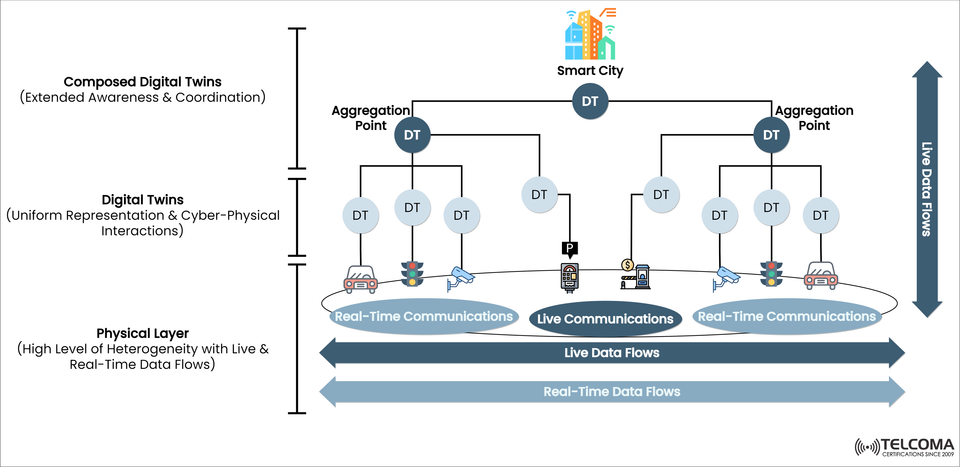
The image provided illustrates a layered structure of Digital Twins within a smart city ecosystem, showcasing how real-time communications, live data exchanges, and cyber-physical alignment enhance urban intelligence. Let’s dive into this structure and see how it’s transforming city management, IoT frameworks, and telecommunications.
What Are Digital Twins in Smart Cities?
A Digital Twin is essentially a digital version of a physical object, process, or system. Within smart cities, Digital Twins represent elements such as vehicles, sensors, cameras, and infrastructure components, ensuring ongoing synchronization between real-world data and virtual models.
For every connected traffic signal, parking meter, or surveillance camera, there’s a digital counterpart that mirrors its behavior and reacts in real-time.
Key Advantages of Digital Twins in Smart Cities:
Improved situational awareness via real-time analytics.
Predictive maintenance and increased operational efficiency.
Cyber-physical integration for smarter automation.
Data-driven decision-making based on real urban metrics.
Scalability to handle complex city systems.
Layered Structure of Digital Twins in Smart Cities
The diagram breaks down the smart city framework into three main layers, each with specific functions that facilitate real-time interaction and coordination.
A. Physical Layer: The Base of Real-Time Data Exchange
At the foundation of this architecture is the Physical Layer, which consists of all tangible city assets—vehicles, sensors, cameras, traffic signals, and payment systems. This layer is marked by a diverse range of devices, protocols, and data types.
Main Functions:
Captures live, real-time data from urban devices.
Allows for two-way data exchange between physical and digital realms.
Utilizes wireless communication technologies (like 5G, Wi-Fi 6, LPWAN, and optical backhaul) for information transmission.
Examples:
A smart traffic light gauges congestion levels.
Cameras transmit live feeds to urban analytics hubs.
Parking meters relay occupancy data to centralized systems.
This layer provides the real-time data framework that empowers the higher layers of digital intelligence.
B. Digital Twin Layer: Cyber-Physical Representation
The middle layer, known as “Digital Twins (DTs),” serves as the bridge between the real and digital worlds. Here, every physical asset from the previous layer is mirrored as a virtual entity—its Digital Twin.
These DTs aren’t just static models; they’re dynamic, data-driven replicas continuously updated with live sensor data.
Functions of the Digital Twin Layer:
Provides a consistent representation of physical entities, ensuring interoperability.
Enables real-time updates based on actual physical conditions.
Aggregates data and performs preliminary analytics before passing it to the composed twin layer.
Facilitates cyber-physical interactions, allowing virtual changes to impact the physical world (like adjusting traffic signals).
Example:
If a parking area’s Digital Twin identifies that all spots are occupied, it can trigger automatic updates in the navigation systems of nearby cars—redirecting them to other available parking.
This layer is where the core digital intelligence of the smart city lies, turning raw sensor data into actionable insights.
C. Composed Digital Twin Layer: Coordination and Broader Awareness
The top layer, referred to as Composed Digital Twins, merges multiple individual twins into aggregated or system-level models. For example, Digital Twins of roads, vehicles, and traffic lights can collectively create a city-wide traffic management twin.
Each Aggregation Point in the diagram represents these composite twins, coordinating data across various subsystems (like transportation, surveillance, and payments).
Main Features:
Provides broader situational awareness by fusing data.
Facilitates cross-domain coordination within IoT ecosystems.
Utilizes predictive intelligence with AI and machine learning models.
Enables automated decision-making on a large scale (like city-wide energy management).
Example:
A composed digital twin for a smart transportation network can simulate different traffic scenarios, forecast congestion spots, and automatically adjust signal timings—all in real-time.
Here, the smart city evolves from a reactive framework to a proactive, adaptive ecosystem.
Real-Time and Live Data Communications
The image highlights two distinct but interrelated communication types—real-time communications and live communications.
Communication Type Description Purpose Real-Time Communications Facilitates immediate two-way interactions between digital and physical entities. Essential for mission-critical systems, like traffic management and surveillance. Live Communications Manages continuous data streams that periodically update system states. Supports ongoing monitoring, billing, and maintenance.
These communications depend on telecom-grade connectivity, driven by 5G URLLC (Ultra-Reliable Low-Latency Communication), network slicing, and edge computing.
Together, they ensure that every data packet—whether it’s a vehicle’s location or a camera feed—is processed with minimal lag and maximum reliability.
The Importance of Aggregation Points in Data Management
Within the architecture, Aggregation Points are crucial for data hierarchy. They act as intermediate nodes that gather, preprocess, and harmonize data from multiple Digital Twins before passing it up to higher layers.
Functions:
Data aggregation and cleansing.
Orchestrating inter-DT communication.
Optimizing latency through edge computing.
Balancing loads to prevent network congestion.
By distributing computational tasks, aggregation points enhance the scalability and resilience of smart city networks, reducing reliance on centralized data centers.
Live Data Flows vs. Real-Time Data Flows
The vertical and horizontal arrows in the diagram emphasize two different types of data movement across layers:
Live Data Flows: Ongoing, large-volume streams that reflect changing conditions (like updates on traffic density or energy usage).
Real-Time Data Flows: Latency-sensitive exchanges crucial for control mechanisms (for example, prioritizing emergency vehicles).
Technological Support:
Edge and Fog Computing: To ensure low-latency local processing.
AI and ML Algorithms: For predictive and prescriptive analytics.
IoT Gateways: To facilitate protocol translation and data harmonization.
Telecom Networks (5G/6G): Offering high throughput and minimal delays.
These flows enable bi-directional intelligence, making sure digital simulations accurately reflect physical realities while also having an impact on them.
The Role of Telecom in Supporting Digital Twin-Based Smart Cities
Telecommunication networks act as the foundation of digital twin ecosystems. Without fast, low-latency communication, real-time synchronization between physical and digital entities wouldn’t be feasible.
Contributions from Telecom:
5G and beyond: Delivering low-latency channels for tactile and visual feedback.
Edge computing infrastructure: Hosting localized twin simulations.
Network slicing: Assigning dedicated virtual resources for smart city applications.
AI-driven orchestration: Dynamically managing resource allocation.
Telecom providers are transforming into digital enablers, helping cities with infrastructure capable of handling massive amounts of real-time data across countless interconnected devices.
Conclusion
The architecture illustrated captures the essence of smart city intelligence—a multi-layered ecosystem where Digital Twins, real-time communications, and telecom networks come together to create a cyber-physical continuum.
From the Physical Layer to Composed Digital Twins, every layer adds depth, awareness, and coordination, enabling cities to evolve from mere monitoring to autonomous decision-making.
As telecom technologies progress toward 6G, the collaboration of AI, IoT, and Digital Twins will lead to cities that aren’t just smart—but truly sentient, able to learn, predict, and meet human needs in real-time.