
How Digital Twins Power VRU Smart Applications for Safer Connected Mobility

Digital Twins and VRU Smart Applications: Enhancing Road Safety Through Intelligent Connectivity
In our age of smart transportation and connected mobility, prioritizing the safety of vulnerable road users (VRUs)—like pedestrians, cyclists, and scooter riders—is more important than ever. With the rise of autonomous vehicles, connected cars, and smart traffic systems, cities need to adapt and leverage advanced digital technologies to improve safety.
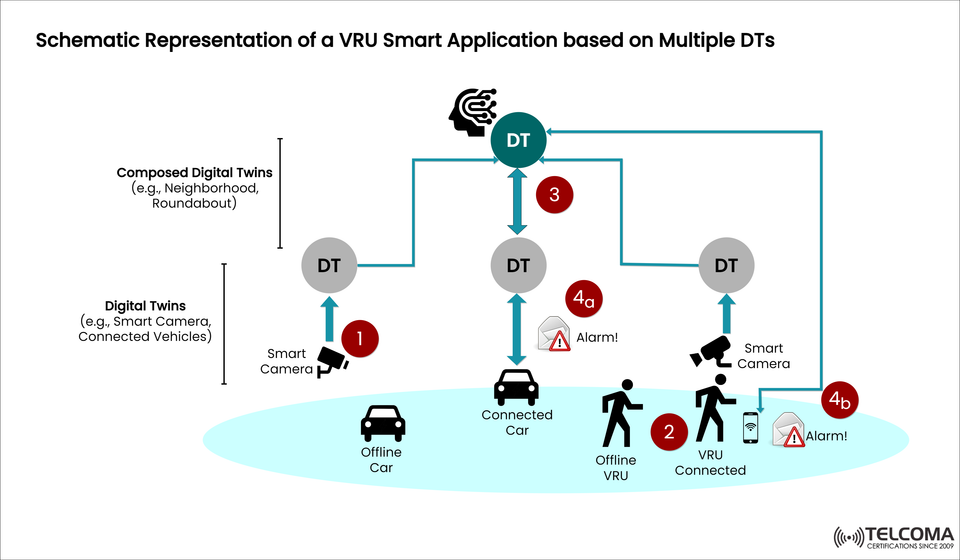
Digital Twin (DT) technology is where this transformation begins. The uploaded diagram of a VRU Smart Application based on multiple Digital Twins—developed by Telcoma—shows how interconnected DTs create a collaborative network that enhances urban mobility and road safety.
By making digital copies of physical entities, including vehicles, cameras, and even people, this setup provides real-time awareness, predictive risk detection, and automated alerts, significantly lowering the chances of road accidents.
Understanding VRUs and the Safety Challenge
Vulnerable Road Users (VRUs) are individuals who face greater risks in traffic situations—this includes pedestrians, cyclists, motorcyclists, and others without protective gear.
International road safety statistics reveal that VRUs make up a significant portion of urban traffic deaths. Conventional safety measures, like traffic lights and physical barriers, aren’t cutting it anymore in the complex smart city landscapes where mobility is driven by numerous interconnected devices and live interactions.
The key lies in achieving digital synchronization among humans, vehicles, and infrastructure—made possible with Digital Twins.
What Are Digital Twins (DTs)?
A Digital Twin is basically a virtual version of a physical object or system that keeps updating itself using real-time sensor data. In the transportation sector, DTs can represent anything from cars and infrastructure to even people.
In the context of a VRU Smart Application, DTs serve three main functions:
Sensing and awareness: Collecting live data from various physical entities (like cameras, sensors, and wearables).
Analysis and prediction: Leveraging AI algorithms to predict risks and pinpoint safety issues.
Communication and response: Sending alerts or automated responses to prevent accidents.
Digital Twins allow for cyber-physical interaction where the digital world reflects, predicts, and enhances real-world actions almost instantly.
Layers of Digital Twins in the VRU Smart Ecosystem
The uploaded diagram highlights two types of Digital Twins:
a. Digital Twins (Individual level)
These represent specific smart entities, such as:
Smart Cameras: Keep an eye on intersections, detecting pedestrians or vehicles.
Connected Vehicles: Constantly send and receive data about their position and context.
b. Composed Digital Twins (Aggregate level)
These higher-level DTs consolidate data from various sources, for example:
A neighborhood or roundabout digital twin that integrates feeds from cameras, car movements, and pedestrian data.
An AI-powered orchestration twin that compiles information for decision-making and initiating safety alerts.
By melding these two levels, the system achieves a multi-scale understanding of situations, ensuring that local sensor data feeds into a broader city-wide safety framework.
Key Components in a VRU Smart Application
To truly understand the technological sophistication of this system, let's break down its essential components:
Component Role in System Technology Used Smart Cameras Capture video data for AI analysis Computer Vision, Edge AI Connected Cars Communicate using V2X protocols5G NR, C-V2XVRU Devices Share location and movement data Smartphones, Wearables Digital TwinsReflect real-world entities and process dataIoT, Cloud, AIComposed DTsMerge multi-source data for decision-makingFederated Learning, AI AnalyticsAlert SystemsNotify users about hazardsMobile Apps, In-Vehicle Systems
Each of these elements helps create an intelligent, connected, and proactive road ecosystem.
The Role of Telecom Networks in VRU Applications
Telecom networks—especially 5G and edge computing technologies—are critical for the success of Digital Twin-based smart mobility systems.
Key Network Features That Support VRU Safety:
Ultra-Reliable Low-Latency Communication (URLLC): Guarantees sub-millisecond delay for real-time notifications.
Network Slicing: Provides dedicated bandwidth for safety-sensitive data.
Edge AI Processing: Processes data close to the source, minimizing latency.
Massive IoT Connectivity: Enables the connection of thousands of sensors, cameras, and vehicles in a single area.
This combination of telecommunications and digital twin systems empowers cities to build truly smart transportation networks that adapt to real-world conditions in an instant.
Advantages of Digital Twin-Based VRU Smart Applications
Using Digital Twins in road safety systems comes with a range of benefits:
Real-Time Risk Detection: Immediate alerts help reduce collision risks.
Predictive Analytics: AI helps foresee dangers before they happen.
Data Fusion: Multiple DTs merge to deliver a complete picture of road safety.
Scalable Integration: It's easy to add new sensors, vehicles, or areas.
Collaborative Intelligence: All connected entities—cars, people, and infrastructure—function as a synchronized network.
Lower Fatalities: Quicker response times and predictive warnings save lives.
For those in telecom, this system showcases how 5G, AI, and IoT come together to redefine intelligent mobility.
Practical Applications and Use Cases
a. Smart Intersections
Digital Twins monitor the interaction between vehicles and pedestrians at intersections to prevent accidents in real time.
b. Urban Mobility Platforms
Integrated DTs analyze traffic flows at the city level to better time signals and manage pedestrian crossings.
c. Connected School Zones
Smart systems alert drivers and pedestrians in high-risk areas like schools or hospitals.
d. Fleet and Delivery Safety
Commercial fleets use VRU detection to steer clear of collisions with pedestrians and cyclists in busy areas.
Challenges and Future Directions
Despite its promise, DT-based VRU safety systems face some challenges:
Data Privacy: Protecting anonymity in camera and sensor data.
Interoperability: Aligning standards across various vehicles and cities.
Latency Management: Ensuring millisecond-level responsiveness.
AI Bias: Making sure recognition algorithms are fair and accurate.
Emerging technologies like 6G networks, federated learning, and blockchain trust layers will further bolster these systems, paving the way for citywide VRU protection frameworks.
Conclusion
The VRU Smart Application utilizing Multiple Digital Twins signifies a significant step towards zero-accident mobility. By merging AI, 5G connectivity, and digital replicas, it changes how vehicles, pedestrians, and infrastructure communicate in real-time.
For professionals in telecom and technology, this system highlights how digital convergence is reshaping urban safety—turning data into decisions and connectivity into life-saving measures.
As cities advance and vehicles become more autonomous, Digital Twin-based safety systems will become essential to future smart transportation networks, ensuring the safety and awareness of all road users, whether connected or not.