
How Multi-Band Communication Enhances Connected Vehicle Networks with ITS, 5G FR1/FR2, and 60GHz Bands
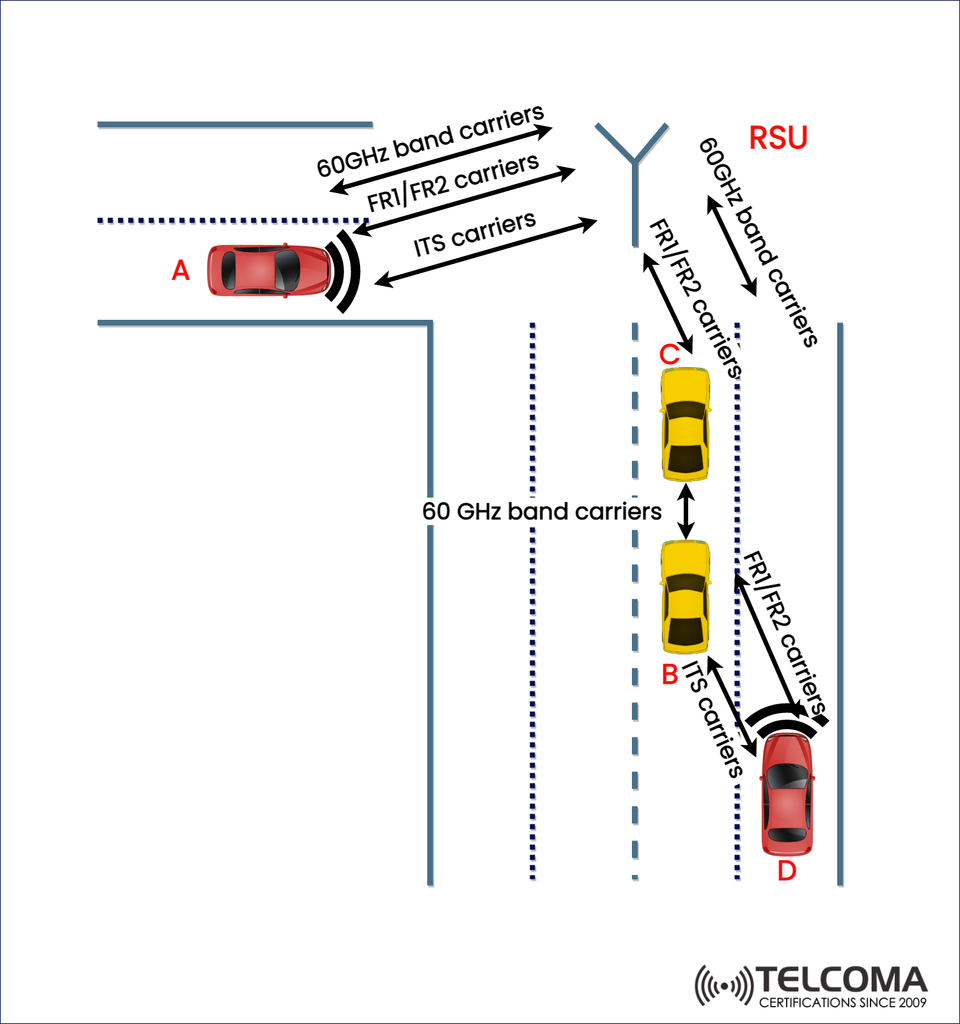

Multi-Band Communication in Connected Vehicles: Merging ITS, 5G FR1/FR2, and 60GHz Spectrum
Connected and autonomous vehicles (CAVs) are shaking up both the automotive and telecom industries by depending on Vehicle-to-Everything (V2X) communication. It's crucial for these vehicles to have ultra-reliable, low-latency data transfer with each other, roadside units (RSUs), and networks to keep roads safe and traffic flowing smoothly.
The image above from Telcoma Global illustrates how vehicles use multi-band communication (ITS, FR1/FR2, and 60GHz) to maintain constant connectivity and quick data exchanges with minimal interference or lag.
FR1/FR2 Carriers (5G NR):
FR1 covers sub-6 GHz bands, giving wide coverage and good penetration.
FR2 works in mmWave (24 GHz – 52 GHz), allowing for super-high data rates for advanced applications.
60 GHz Band Carriers: This extremely high-frequency band is used for short-range, ultra-fast data exchange, especially for high-definition sensor and camera data between closely located vehicles.
This mix ensures every vehicle has redundant, low-latency links—vital for safety-critical applications like avoiding collisions, coordinating lane changes, and navigating autonomously.
The Need for Multi-Band Communication in V2X
Relying on just one frequency band isn’t enough for connected vehicles given the ever-changing nature of road conditions and mobility hurdles.
Key Points:
Redundancy and Reliability: Employing multiple frequency bands means that if one link encounters interference or fades, others can step in to help.
Balancing Range and Bandwidth: Lower frequencies (ITS, FR1) offer long-range connectivity, while higher frequencies (FR2, 60GHz) allow for ultra-high-speed short-range data transfers.
Low Latency Needs: Safety features need latency below 10ms. High-frequency mmWave links are perfect for this.
Managing Spectrum Congestion: Spreading communication across several bands helps cut down on interference and network strain.
Communication Paths and Data Sharing
Let’s dive into the interactions shown in the image:
Vehicle / Entity Connected With Bands Used Purpose A → RSU Direct V2I link ITS, FR1/FR2, 60GHzShares and receives traffic information, hazard alerts, and navigation data. B ↔ CV2V (Vehicle-to-Vehicle)60GHz band Quick, short-range data sharing (like coordinating braking or lane changes).D ↔ BV2V linkFR1/FR2, ITS Reliable data sharing even at higher speeds. RSU ↔ C/DV2I linkFR1/FR2, 60GHzNetwork-assisted control, software updates, and relaying sensor data.
This hybrid approach allows for smooth transitions between short-range and wide-area connectivity—making sure communication stays strong even when certain paths are blocked by terrain, buildings, or other vehicles.
Each Frequency Band's Role in V2X Communication
A. ITS Carriers (5.9 GHz Band)
The ITS spectrum (Intelligent Transportation System) is globally standardized for V2X safety communication.
Primary Use: Basic safety messages, emergency braking signals, warnings about collisions at intersections.
Advantages:
Highly reliable in non-line-of-sight (NLOS) conditions.
Good at penetrating through vehicles and obstacles.
Limitations:
Bandwidth and data rate are somewhat limited (around ~10 Mbps typical).
B. 5G FR1 and FR2 Carriers
5G FR1 (under 6 GHz) and FR2 (mmWave) are key players for next-gen automotive connectivity.
FR1 (Sub-6 GHz): Best for wide-area coverage, it’s used for ongoing control-plane communication.
FR2 (24–52 GHz): Offers multi-Gbps speeds perfect for sensor fusion, HD mapping, and real-time telemetry.
Benefits:
Ultra-low latency (<1 ms in URLLC scenarios).
Supports network slicing that prioritizes safety-critical services.
Integrates well with edge computing for faster decisions.
C. 60 GHz Band Carriers
The unlicensed 60 GHz band (mmWave) delivers extremely high throughput over short distances (up to 100 meters).
Applications:
Cooperative perception amongst vehicles (sharing radar/LiDAR data).
Real-time video or sensor feed exchanges between closely situated vehicles.
Advantages:
Speeds of 7–10 Gbps are achievable.
Great for high-density traffic situations (like busy urban intersections).
Challenges:
Limited range and sensitivity to signal blockage.
By combining all three—ITS, FR1/FR2, and 60GHz—the communication system gets redundancy, high performance, and scalability.
The Role of the RSU (Roadside Unit)
The RSU serves as a smart edge node for the vehicular network. It links moving vehicles to cloud services and edge computing resources.
What the RSU Does:
Relays safety messages between vehicles and infrastructure.
Provides live traffic management updates.
Supports multi-band relay across ITS, 5G FR1/FR2, and 60GHz.
Hosts MEC (Multi-access Edge Computing) services for low-latency processing.
In the image shown, the RSU keeps continuous links on all three frequency bands, ensuring uninterrupted communication even if one route is disrupted.
How Multi-Band Communication Fuels Autonomous Driving
Autonomous and connected vehicles rely on sensor fusion, blending data from onboard sensors with inputs from nearby vehicles or infrastructure.
Supporting Use Cases:
Cooperative Collision Avoidance: Vehicles share their positions, speeds, and intentions in mere milliseconds.
Collective Perception: Vehicles trade camera and radar data to “see” beyond their line of sight.
Dynamic Traffic Coordination: RSUs manage platooning, signal timing, and lane merges in real-time.
Remote Diagnostics and OTA Updates: High-speed links enable secure firmware updates and software adjustments.
This layered connectivity framework is key to realizing smart roads and accident-free mobility.
Challenges in Multi-Band Vehicle Communication
While the promise is exciting, multi-band connectivity does come with its share of challenges:
Spectrum Coordination: Finding a way to manage the coexistence of licensed and unlicensed bands.
Handover Management: Smooth transitions between 60GHz, FR2, and ITS need some advanced algorithms.
Hardware Complexity: Vehicles must have systems that support multi-band, multi-antenna setups.
Interference and Blockage: mmWave signals can be easily obstructed by buildings or other vehicles.
Standardization Alignment: There’s still progress to be made on harmonizing standards across 3GPP, ETSI, and IEEE 802.11.
Research into 6G V2X and AI-enhanced radio resource management is working to tackle these issues.
Conclusion
Bringing together ITS, 5G FR1/FR2, and 60GHz bands forms a multi-band communication ecosystem that keeps vehicles continuously connected with ultra-reliable, low-latency links.
This multi-layered approach lays the groundwork for fully autonomous, cooperative, and intelligent transport systems (ITS 2.0), paving the way for safer, smarter, and greener mobility.
As 5G progresses towards 6G, these architectures will further evolve to incorporate terahertz bands, AI-driven connectivity management, and quantum-secure links, heralding a new era in intelligent transportation.