
How NFV and SDN Together Power MEC in 5G Networks

How NFV and SDN Collaboratively Power MEC in 5G Networks?
In today’s telecommunications architecture, Multi-access Edge Computing (MEC) is rapidly becoming a key enabler of ultra-low latency and real-time applications. MEC, however, is not isolated, it lives at the intersection of Network Function Virtualization (NFV), Software-Defined Networking (SDN) and Cloud.
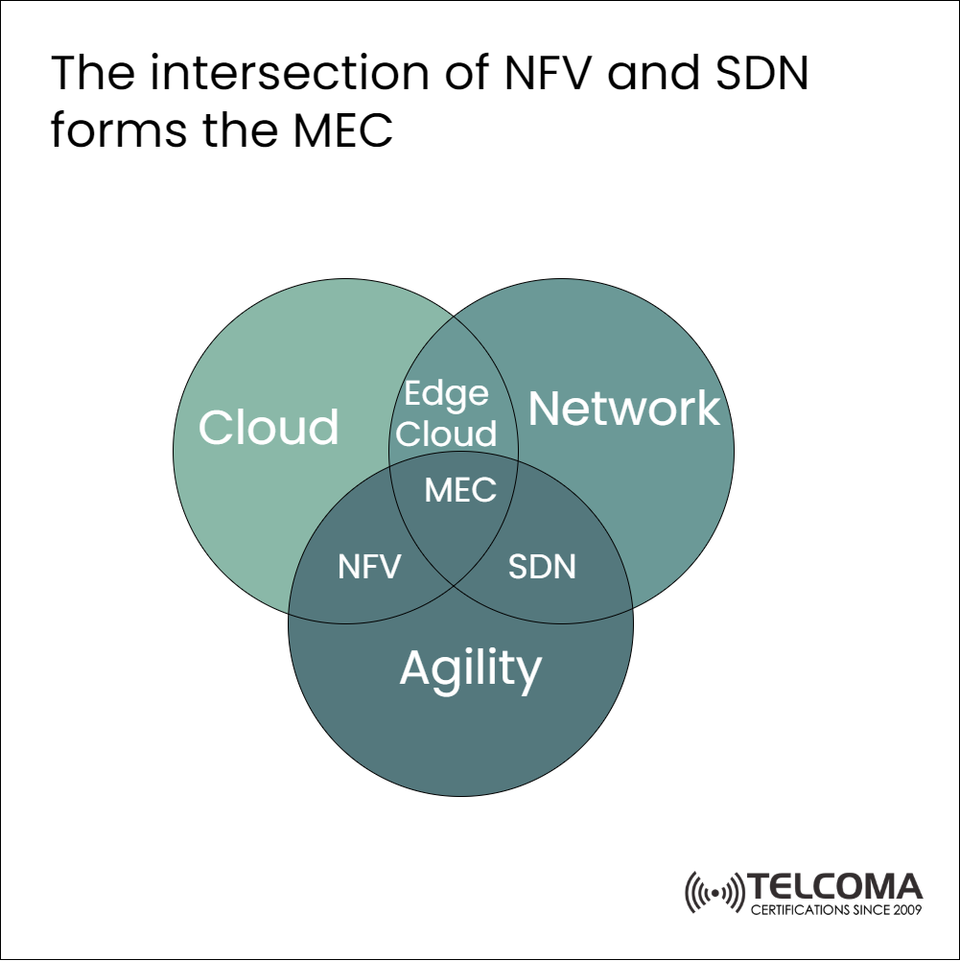
The uploaded Venn diagram shows where these technologies compliment MEC. MEC is in the happy space where Cloud, Network, and Agility converge, with the former powered by NFV, the latter by SDN, and technology by Edge Cloud.
🔍 What Is MEC and Why Is It Important?
MEC (Multi-access Edge Computing) represents a change in architecture to place compute and storage resources closer to the user, at the network edge. This enables use cases such as:
Real time AR/VR
Autonomous vehicles
Smart automation
Video analytics
Local content caching
To facilitate this agility and responsiveness, MEC embraces NFV and SDN technologies along with Cloud-native principles.
🧩 MEC Origins: NFV + SDN + Cloud
Technology Contribution to MEC Keywords
NFV (Network Function Virtualization) Virtualizes network functions, such as firewalls, routers and UPFs, allowing them to be run on generic hardware. VNF, service chaining, elasticity
SDN (Software-Defined Networking) Centralizes control over the delivery path of the network, making it possible to easily modify the routing dynamically and programmatically.
📌 What the Venn Diagram Specifies
The overlap of the circles clearly provides insights into the technological collaborations:
Cloud + NFV = Edge Cloud → Virtualized functions operating on distributed infrastructure.
Cloud + SDN = Network → Dynamic and instantiated networks that support cloud-native flows.
NFV + SDN = Agility → Services can be agile with rapid deployment and programmable control.
Everyone occupies the same space: MEC → Where edge computing enables virtualization, orchestration, and network programmability.
⚙️ Why NFV and SDN are So Important for MEC Deployments
There are:
✅ Benefits of NFV in MEC:
Multiple virtual network functions (VNFs) can be operated on a common platform
Reduce hardware and thus operational costs
Faster service delivery through automation
✅ Benefits of SDN in MEC:
Programmable network routes can move traffic to edge applications
Dynamic service chains and isolation for latency-sensitive applications
Network slicing can support enterprise and industry use cases
🧠 Real-World Use Cases
Use Case NFV's Role SDN's Role
Smart Factory Virtualized firewall and analytics on-premises Programmable traffic paths to sensors and machines
5G Gaming Edge compute servers as VNFs Prioritized traffic for gaming packets
Healthcare IoT Virtualized security and session management SDN policy providing secure data isolation
🔗 Internal Linking Recommendations
For SEO purposes and to keep readers on your site, create links from blog post to blog post:
✅ Conclusion: MEC Is a Convergence of Strategy
MEC is never operated in a vacuum. Instead, it is the convergence of:
Virtualized resources (NFV)
Programmable, intelligent networks (SDN)
Cloud infrastructures that scale and distribute.
It's essential for telecom engineers, architects, and decision-makers to understand how these domains fit together to build the kits for the next-gen applications and services they will be putting out via 5G.
However, MEC's inherent strengths are more than just its physical placement at the edge. MEC's strengths come from its architectural tenets of agility, virtualization, and intelligent/network programmability.
SEO Tags (WordPress optimized):
NFV SDN MEC, 5G Edge Computing Architecture, network function virtualization, SDN-enabled MEC, telecom cloud, edge cloud NFV SDN
🔁 Repurposing the NFV + SDN + MEC Post
You can turn this blog post into some very useful deliverables:
Format Purpose Platform
Infographic Visual aid for learning summarizing the NFV–SDN–MEC link for MA#’s and customers LinkedIn, Twitter/X, Instagram
Slide deck Short presentation for workshops or custom internal training SlideShare, webinars
Video Explainer Venn diagram into a narrated animation for MarCom purposes, 60-second explainer YouTube shorts, LMS
Whiteboard sketch post You tell your story using a whiteboard sketch (and links) to explain how NFV, SDN, and MEC converge Blog, LinkedIn article
🖥️ WordPress Publishing 🙂
To help improve your SEO + UX when publishing in WordPress, I will use the following:
✅ WordPress Gutenberg Block Options:
Image Block: Embed the diagram with appropriate alt text
Quote Block: Highlight "The real power of MEC lies not just in its location..."
Table Block: use for NFV vs SDN benefits or use cases
Internal Link Block: Add anchor links to connected MEC or 5G posts
✅ Image SEO Settings:
File Name: nfv-sdn-mec-intersection-diagram.png
Alt Text: "Venn diagram showing how NFV, SDN, and Cloud intersect to create MEC architecture"
Caption (optional): "The intersection of virtualization, agility, and programmability defines MEC."
📘 Add This as Chapter 5 in Your Series
The sequence looks like this now:
Carrier Network Architecture from the MEC Perspective
4G to 5G Deployment Options
vRAN Architecture Decoded
5G Core Interfaces: N4, N6, N9
NFV and SDN as the Foundation of MEC ✅
If you're ready, I can now create:
🔖 An eBook PDF combining all 5 chapters
🖥️ A landing page with CTAs to explore or download the full guide
🧠 A training deck or course act on this material
🛑 Final Thoughts
The combination of NFV, SDN, and Edge Cloud creates an ideal environment for MEC, offering the flexibility, scalability, and ultra-low latency that 5G applications require.
For MEC, it's more about how the compute is architected to deliver the next generation of digital services, than it is about where the compute happens.
📝 1. Complete eBook/Whitepaper (PDF)
A professional branded whitepaper that includes:
All 5 blog posts (formatted nicely)
Diagrams inline
Clickable internal links
Branded cover, TOC, and author section
Great for: Lead generation, client onboarding, downloadable gated content
→ Requires your confirmation for final format (A4 PDF / US Letter / Web View)
🌐 2. WordPress HTML Snippet
Receive the HTML code blocks (Gutenberg-modified) for:
Each blog post
Table blocks from the example, CTAs and image embeds
Metadata and structured data (Schema)
Great for: Quick publishing in the WordPress editor
→ You can copy and paste code blocks and publish them immediately.
🖥️ 3. Landing Page Design (HTML / WordPress)
Construct a resource hub with the following:
Summary of the full 5G series
Thumbnails and links to each post
CTA to download PDF
Optional contact form for lead capture
Great for: Permanent landing page(collection of each blog post)