
How NLOS Data Relaying Enhances Reliability in Connected Vehicle Communication

Enhanced Reliability for NLOS Data Relaying in Connected Vehicles
In the realm of connected and autonomous vehicles (CAVs), having reliable data is super important — especially when vehicles need to communicate in non-line-of-sight (NLOS) situations, like at busy intersections or on obstructed roadways.
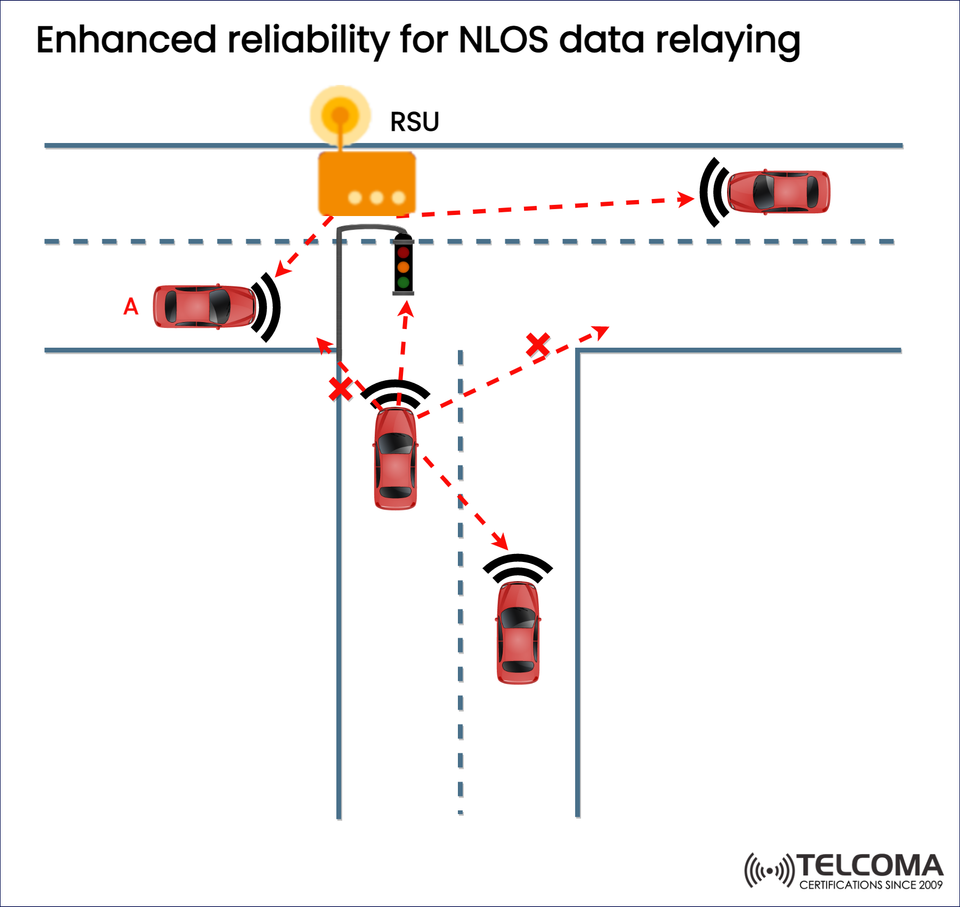
The image shared by Telcoma Global shows a typical Vehicle-to-Everything (V2X) scenario, where vehicles exchange information, even when direct visibility is hindered by things like buildings or other cars.
This idea, called NLOS data relaying, is crucial for dependable Vehicle-to-Vehicle (V2V) and Vehicle-to-Infrastructure (V2I) communication. It makes sure that vital safety messages still get through, even when there are obstacles.
Understanding the Image: NLOS Communication at an Intersection
The image showcases a four-way intersection filled with connected vehicles and a Roadside Unit (RSU).
Vehicle A (on the left) is trying to reach out to the RSU.
However, the direct line-of-sight communication gets blocked by obstacles (like buildings or other cars).
The RSU can only directly connect to vehicles that are visible to it (on the top and right).
To get around this, nearby vehicles step in as data relays, passing messages between Vehicle A and the RSU indirectly.
Key Elements in the Diagram:
Red dashed lines: Show the attempted communication links.
Cross marks (X): Indicate where communication fails due to NLOS conditions.
Successful path: Achieved through multi-hop relaying, where another vehicle sends data to the RSU for the obstructed one.
This relaying method guarantees robust connectivity and quick message delivery, even when vehicles aren't in direct sight of each other.
What is NLOS (Non-Line-of-Sight) Communication?
NLOS communication happens when the nodes sending and receiving data can’t see one another directly, thanks to physical barriers like buildings, trees, or other vehicles.
In V2X networks, particularly within dense urban settings, NLOS presents a common challenge that can hinder the performance of millimeter wave (mmWave) and high-frequency 5G connections.
Why It Matters:
mmWave frequencies (used in 5G and beyond) offer high data rates but are very vulnerable to blockages.
NLOS situations can result in signal loss, lower throughput, or dropped connections — issues that can’t be tolerated in safety-sensitive vehicle applications.
So, ensuring reliable NLOS data relaying is key for maintaining smooth communication for collision avoidance, traffic management, and autonomous control.
NLOS Data Relaying Explained
In an NLOS scenario, relay vehicles function as intermediaries between the sender and the receiver.
For instance:
Vehicle A → Relay Vehicle → RSU: Vehicle A sends a message to a nearby vehicle that has a clear line-of-sight to the RSU. The relay car then forwards this message on, ensuring that crucial data (like location or hazard alerts) gets to the RSU reliably.
Core Functions of Data Relaying:
Path Selection: Picking the best relay vehicle based on how close and connected it is.
Hop-by-Hop Transmission: Passing along messages one step at a time until they reach their target.
Redundancy: Having multiple relay options boosts reliability by offering backup routes.
This multi-hop V2V relaying setup turns a blocked network into a self-repairing, cooperative system.
How RSUs and Vehicles Collaborate in NLOS Conditions
The RSU (Roadside Unit) plays a crucial role in managing communication and resource distribution for NLOS data relaying.
RSU Responsibilities:
Keeps an eye on the link quality with all connected vehicles.
Spots vehicles that are facing NLOS challenges.
Chooses the best relay vehicles based on signal strength, location, and movement patterns.
Manages frequency resources to reduce interference.
At the same time, the vehicles can automatically detect when communication paths are blocked and switch into relay mode as needed, adapting in real time.
Communication Technologies Enabling NLOS Relaying
A. C-V2X (Cellular Vehicle-to-Everything)
C-V2X, as outlined by 3GPP, supports two communication modes:
Uu Interface: Vehicle-to-network through base stations.
PC5 (Sidelink): Direct V2V/V2I communication, which is crucial for NLOS relaying.
C-V2X promotes low-latency communication and flexible resource allocation for relay scenarios.
B. IEEE 802.11p / ITS-G5
Utilized in Dedicated Short-Range Communications (DSRC), 802.11p facilitates direct V2V and V2I links at 5.9 GHz. While it's older than C-V2X, it's still key in low-cost NLOS relaying systems.
C. 5G NR V2X
The 5G NR standard (Release 16+) boosts NLOS relaying by:
Backing mmWave bands for ultra-high throughput.
Incorporating edge computing (MEC) for rapid relay coordination.
Allowing for beamforming and dynamic link adjustment to enhance reliability.
Benefits of NLOS Data Relaying
Benefit | Description
Improved Reliability | Guarantees ongoing communication in obstructed areas.
Low Latency | Reduces delays via direct multi-hop V2V forwarding.
Enhanced Safety | Helps prevent accidents by sending critical alerts even when there’s no line of sight.
Spectrum Efficiency | Optimizes frequency usage by balancing the load among several relay nodes.
Scalability | Adjusts to heavy urban traffic with numerous vehicles.
Network Resilience | Offers alternate routes in cases of link disruptions or congestion.
This durability makes NLOS relaying essential for urban autonomous driving and smart city initiatives.
Example Use Case: Intersection Safety
At intersections, vehicles often encounter blocked lines of sight due to tall vehicles, infrastructure, or blind corners.
Thanks to NLOS data relaying:
Vehicle A spots an approaching Vehicle D from the opposite direction, even though they can’t see each other.
A relay vehicle in between forwards position and speed info between A and D.
The RSU manages this exchange, ensuring both vehicles get the data in just milliseconds.
As a result, the collision risk is significantly reduced, allowing both vehicles to navigate safely.
Challenges and Future Developments
While NLOS relaying shows promise, several hurdles still exist:
Relay Selection Algorithms: Need to make quick decisions based on movement and channel conditions.
Latency Management: Multi-hop relaying can introduce delays if not optimized.
Security: Data relaying can open up more opportunities for spoofing or attacks.
Standardization: Ongoing alignment between 3GPP, IEEE, and ETSI ITS frameworks is vital.
Hardware Requirements: Vehicles must be equipped with multiple radios and antennas to support different frequency bands (FR1/FR2, ITS, etc.).
Emerging 6G and AI-driven V2X networks are looking to tackle these issues through machine learning-based link prediction, adaptive beamforming, and edge-intelligent relaying.
The Road Ahead: Intelligent NLOS Relaying
Future transportation systems will shift from rigid, rules-based communication to context-aware, predictive relaying.
AI Integration: Predicts which vehicle should take on the role of a relay based on movement trends.
MEC Assistance: Edge servers at RSUs dynamically assign relays and manage resources.
6G V2X Networks: Aim to use terahertz frequencies for ultra-fast relaying in congested environments.
These advancements will pave the way for autonomous coordination among vehicles, guaranteeing zero-latency, zero-failure communication, even in tricky NLOS situations.
Conclusion
Enhanced NLOS data relaying marks a significant step towards achieving reliable, safe, and smart V2X communication within connected vehicle ecosystems.
By utilizing relay vehicles, RSUs, and multi-hop transmission, communication networks can overcome physical barriers that usually disrupt high-frequency 5G or mmWave signals.
This capability not only boosts traffic safety and collision avoidance but also sets the stage for the fully autonomous, cooperative driving future envisioned in the upcoming 6G intelligent transportation systems.