
How OFDMA Works in Wi-Fi 6 and 5G: Resource Unit Allocation Explained
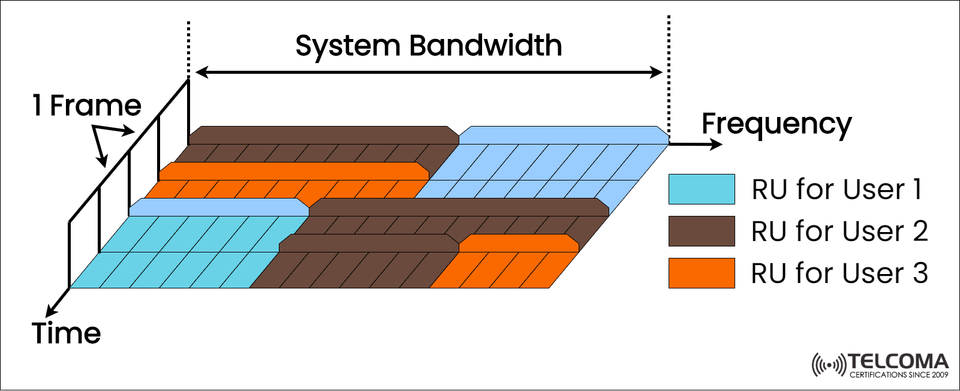

OFDMA: Resource Unit Allocation - Time-Frequency
With the increasing need for improved wireless communication that is faster, and more reliable, advancements have taken place in how networks manage access to spectrum and multiple users. OFDMA (Orthogonal Frequency Division Multiple Access) is one aspect of flexibility seen in Wi-Fi 6 (802.11ax) and 5G NR networks - a technology breakthrough.
In the illustrative example stated above, it shows very clearly how Resource Units (RUs) are allocated over time and frequency to serve more than one user simultaneously in one frame using the capabilities of OFDMA.
What is OFDMA?
OFDMA is a multi-user version of OFDM (orthogonal frequency division multiplexing), and allows the opportunity to subdivide a system bandwidth into smaller frequency chunks (RUs) that allow multiple users to be served at the same time.
Unlike OFDM, with OFDMA where all users share the channel, one user is given the entire channel for each time slot. In OFDMA, portions of the RUs are allocated to users in a time frame that allows for minimal delay, while you can have many users transmitting and/or receiving at the same time.
Visual Interpretation: RU Allocation in OFDMA
The below illustrates the allocation of RUs described above:
X-axis - frequency
Y-axis - time (the context of 1 frame)
Each color block represents a Resource Unit assigned to a user. Color's used:
Light Blue - User 1
Brown - User 2
Orange - User 3.
Each user's RU (Resource Unit) can be dynamically mapped in time and frequency, which shows that OFDMA could:
Serve multiple users in parallel.
Dynamically allocate resources in accordance with how much demand there is, and what the channel conditions are.
Utilize the available spectrum efficiently, through eliminating idle or wasted bandwidth on the network.
Main Benefits of OFDMA
🚀 Multi-User Parallelism
OFDMA allows us to transmit in parallel from multiple users in a single frame, yielding a dramatic network efficiency gain.
📶 Improved Spectral Efficiency
Bandwidth is not wasted waiting for turn based access — the entire spectrum is available for simultaneous utilization.
⚡ Reduced Latency
By utilizing transmissions in parallel, OFDMA reduces the wait and provides improved responsiveness — this can be very beneficial for real-time application users.
🔋 Overall Power Efficiency
Devices can wake up for short transmissions and then sleep again, providing battery life benefits for a myriad of IoT and mobile device use cases.
OFDMA vs OFDM: What is the difference?
Feature OFDM (Used in Wi-Fi 5) OFDMA (Used in Wi-Fi 6/5G)
User per time slot 1 Multiple
Spectrum utilization Lower Higher
Latency Higher Lower
Battery efficient Lower Higher
Use case Legacy network Highly dense environment
Real World Examples of OFDMA
📱 Wi-Fi 6 Networks:
Supported in high density venues (stadiums, schools, airports, etc).
Allow a better expectation of consistency of performance for streaming, video calling, and common cloud applications.
🔗 IoT Ecosystems
Enables efficient communication for a large number of low power devices.
Minimizes contention in congested spectrum space.
How Resource Units are Assigned
Resource Units can vary in size depending on:
Channel bandwidth (20 MHz, 40 MHz, 80 MHz, etc.)
Number of users.
Traffic type (e.g., VoIP vs bulk data).
QoS requirements.
OFDMA permits flexible scheduling, therefore one user could receive more RUs than another based on the amount of data required.
Conclusion
OFDMA provides a breakthrough in wireless communication that designs smarter, parallel access to spectrum unlike the legacy model of one user per channel prior to OFDMA. By dynamically allocating Resource Units in both time and frequency, OFDMA provides both Wi-Fi 6 and 5G networks the possibility of improved performance, reduced latency and energy efficiency; that are now required to provide the connectivity needed today.
🧠 Advanced Concepts: OFDMA Scheduling and Flexibility
Not only does OFDMA provide the ability for simultaneous multi-user access but it has flexible and dynamic scheduling capabilities. This is how it happens behind the scenes:
📊 Dynamic Resource Allocation
Uplink (UL) and Downlink (DL): OFDMA enables both uplink and downlink movements. In Wi-Fi 6, the AP (Access Point) manages the RU allocations for users, as it does in 802.11, with TRIGGER FRAME to ensure uplink coordination.
About Scheduling Intelligence: the network scheduler assesses usage baselines for each of the users buffers.
⏱ RU Size Granularity
RU sizes are specified in Wi-Fi 6 in increments of subcarriers (26, 52, 106, 242, 484, 996). For example:
A 26-tone RU is perfect for low throughput IoT applications.
A 996-tone RU will support high throughput, low latency applications such as 4K video.
RU Size (tones) Typical Use Case
26-tone IoT low bandwidth, sensors
106-tone VoIP, telemetry
242-tone Streaming, web traffic
996-tone Video conferencing, downloads
🏗 Deployment Insights for Telecom Engineers
Here are best practices and planning considerations for deployment of OFDMA capable networks:
✔ Wi-Fi 6 (802.11ax) Deployment Tips
Turn ON OFDMA in both UL and DL; ensure devices and APs are able to use it.
Higher bandwidth users should be grouped together in larger RU sizes and reserve smaller RU sizes for background usage.
Co-existence of legacy devices: Using BSS coloring and scheduling to minimize interference with Wi-Fi 5 clients.
✔ 5G NR Use Case Deployment
Massive Machine-Type Communications (mMTC): Assign 26-tone RUs to support thousands of devices with infrequent transmission.
URLLC applications: Pre-assign RUs over time slots to guarantee ultra-low latency for autonomous systems.
Enhanced Mobile Broadband (eMBB): RU sizes in 5G are dynamic and can be adjusted based on the velocity of the end user and the application type.
📝 Conclusion
For telecom engineers, network designers, and future-thinking technologists, OFDMA provides a crucial foundation for developing capable wireless environments. Whether developing a new Wi-Fi 6 network in a smart building, or designing a 5G-based industrial automation system, knowing how OFDMA allocates resource units in the time deons and frequency domains, will help you optimize for performance and congestion and provide high-quality user experiences.