
How SD-WAN Transforms Corporate Networking vs Traditional MPLS VPN

SD-WAN vs Traditional MPLS VPN: Understanding Enterprise Traffic Flows in the Modern Network
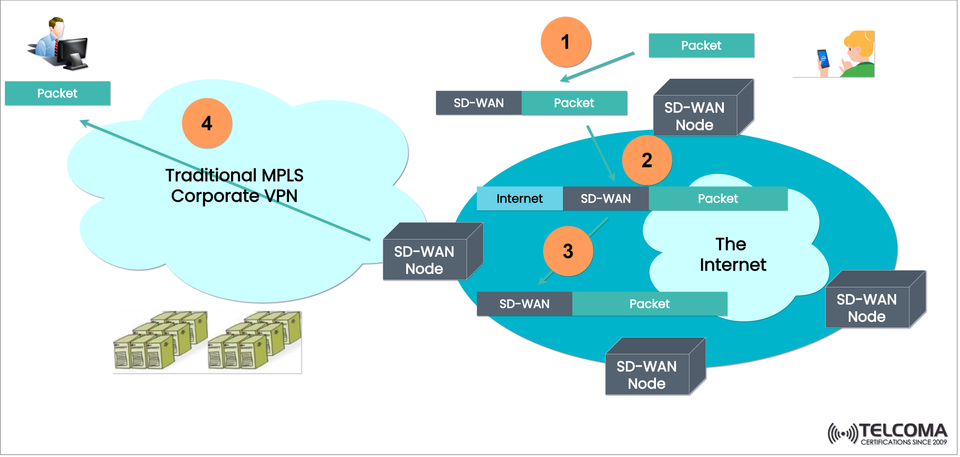
With businesses increasingly moving to cloud and remote working environments, the architecture of traditional MPLS VPNs is not able to cope with dynamic traffic portfolios. Software-Defined WAN (SD-WAN) is a viable, more cost effective alternative to MPLS VPN – and provides a more efficient way to move packets. We will explore the packet flow between users and enterprise resources in SD-WAN and MPLS networks using an illustrative diagram for comparison.
The diagram attached above shows how a packet moves from each architecture, demonstrating the inherent differences and use cases available in each environment.
🌐 What is SD-WAN?
SD-WAN (Software-Defined Wide Area Network) is a virtual WAN architecture that allows enterprises to securely connect users to applications by providing a choice of transport services, including but not limited to MPLS, broadband internet, and LTE.
🔄 The Packet Flow: MPLS vs SD-WAN
Let's go through all the steps in the diagram.
🧭 Path 1: User to Application via SD-WAN
User Packet Origination: A user sends a packet from a mobile or desktop device.
Local SD-WAN Node: The packet enters the nearest SD-WAN node where policies, QoS (Quality of Service) and security are applied.
Internet Transit: The SD-WAN routes the packet through the internet after the exact prep was applied into the SD-WAN.
🚀 SD-WAN Deployment Approaches
All SD-WAN solutions require careful analysis, so there is continuity, security, and performance for each underlying architecture. Below are the approaches enterprises most commonly use:
- Over-the-Top (OTT) SD-WAN
How it works: will use existing Internet circuits and provide a layer of SD-WAN "over the top".
Benefit(s): Speedy deployment and few obstructions.
Best for: Distributed or branch sites, retail stores, and remote workers.
- Hybrid WAN
How it works: uses a combination of MPLS and broadband to create one SD-WAN fabric.
Benefit(s): Most effective in their ability to meet existing organizational and budgetary boundaries by balancing application reliability with cost.
Best for: Enterprises moving away from MPLS.
🔁 Move your busines from MPLS to SD-WAN
Once you have decided to migrate off MPLS, you must consider these four key steps:
✅ Assessment
Perform an audit of your existing network (MPLS circuits, performance SLAs, application dependencies).
Understand which cloud/SaaS applications are being used across branches.
✅ Pilot
Deploy SD-WAN in a few locations.
Measure the improvements made and reliability of your network.
✅ Rollout
Deploy SD-WAN to other branches.
Decommission MPLS circuits based on performance SLA.
✅ Training & Policy setup
Utilize training to strengthen the IT department’s knowledge on SD-WAN control and monitoring dashboards.
🔮 WAN architecture of the future
As SD-WAN continues to evolve, many trends in SD-WAN are shaping the future of how enterprise connectivity will be performed moving forward:
- SASE (Secure Access Service Edge)
Combines SD-WAN with a cloud-native security stack.
Policy enforcement is performed in closer proximity to the user or application.
- AI/ML driven WAN optimization
Predictive analytics based on traffic shaping in real time.
⚠️ Common Issues with SD-WAN Deployment
SD-WAN has many benefits, however transitioning to SD-WAN may have a few challenges that may not be an issue if managed properly:
🔄 Compatibility
Interoperability issues can arise with legacy routers, firewalls and MPLS circuits where the technology could be considered incompatible.
Solution: Utilize hybrid WAN while transitioning and selecting an SD-WAN solution that supports routing protocols such as BGP and OSPF.
🛡 Security
Misconfiguration of policies within an SD-WAN can expose your traffic to vulnerabilities.
Solution: DO NOT deploy unless you have a vendor with a fully integrated Zero Trust and SASE strategies.
🔧 Skill Gaps
Teams that have worked with legacy WANs often have minimal experience with SD-WAN tools and concepts.
Solution: Self-led hands-on training or leverage managed service providers (MSPs).
✅ SD-WAN Best Practices for Successful Implementation
Use these SD-WAN best practices to successfully roll out a SD-WAN:
Set Realistic Objectives: Clearly define the goals for SD-WAN implementation, such as cost savings, performance, cloud application access, or security.
Segment Traffic by Application: Application-aware policies are used to prioritize and enhance critical business applications over others.
Use Multiple ISP Paths: Multiple ISPs or circuits are utilized to create redundancy, while enabling load balancing.
Encrypt Everything: Behavior of encryption must be seamless, while encrypting even public internet paths.
Monitor in Real-Time All Performance Metrics: Leverage analytical capture and visualization frameworks or platforms to detect poor performance early.
Plan for Future Growth: Vendor solutions should meet the next-generation cloud integrators and edge compute readiness.
🔧 Traditional Setup:
MPLS links to each store, or branch site
Centralized (branch) VPN backhauls to head office
Poor performance of Office 365 and CRM applications
🚀 SD-WAN Solution:
SD-WAN Nodes deployed in each branch using local broadband + LTE failover backup service
Direct access to Internet resources (Office 365, Salesforce)
Enhanced application-aware routing and QoS
Secure IPSec tunnel and cloud-based security end points with SD-WAN overlay solution.
📈 Savings and Benefits:
50% savings on connectivity
Time from activation to new site being online: 48 hours or less
3x improvement on cloud app performance
Lower IT ticket counts through centralized visibility
📥 Resources for your next steps
Reviewed below are additional tools and templates that may assist you:
✅ [SD-WAN vs MPLS Comparison Checklist]
✅ [RFP Template for SD-WAN Vendor Evaluation]
✅ [Cloud Integration Planning Guide for cloud migration]
✅ Conclusion
This diagram illustrates how SD-WAN provides more flexibility, easier financial management, and more accessible to cloud apps than the traditional MPLS VPN model. As digital transformation progresses and cloud adoption becomes more common, telecom professionals and IT architects should be careful to adapt their networking strategies to meet the needs of the new world.
For those considering if SD-WAN is right for their organization, understanding this packet flow model is an excellent starting point for architectural design and vendor comparisons.