
Hybrid SD-WAN/MPLS Architecture for Secure Enterprise and Cloud Access

🍃 Introduction: Why Hybrid Connectivity is Now the Norm
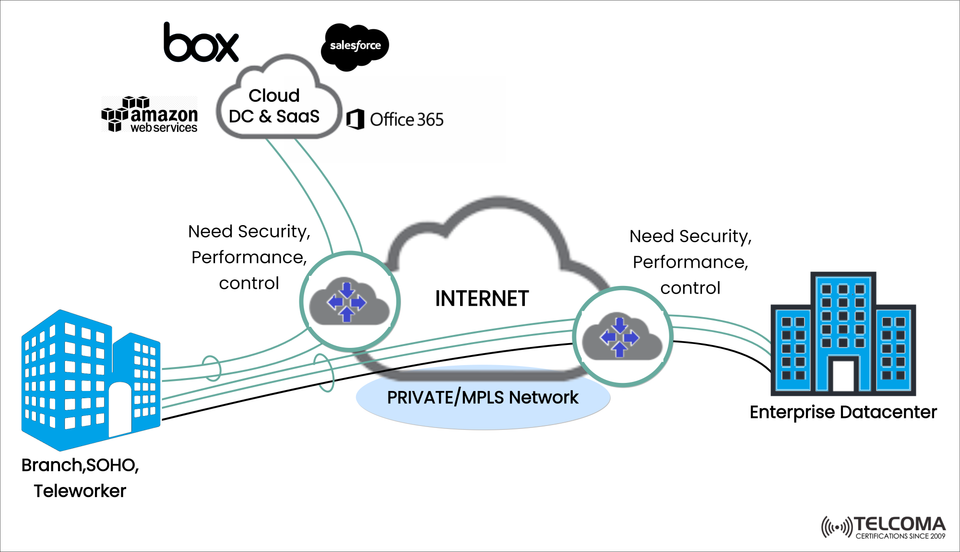
Today, businesses are moving to a hybrid networking model that can support distributed users, cloud-first applications, and legacy data centers. The image above depicts how various Branch offices, SOHO (Small Office/Home Office), and Teleworkers connect to cloud-based SaaS platforms (AWS, Box, Salesforce, Office 365, etc.) and an Enterprise Data Center, combining the Internet with an MPLS (Multiprotocol Label Switching) model.
This enables the best of security, performance, and control in today's multi-cloud, remote-access world.
📈 Key Elements of the Hybrid Architecture
- Branch, SOHO, and Teleworker Nodes
These are the end-users connecting from many different locations.
Need seamless access towards internal/external services.
Must route their traffic dynamically based on the type of application.
- Cloud DC & SaaS
This includes services such as AWS, Office 365, Box, or Salesforce.
Public cloud application services demand an optimized, secure access method with low latency.
- Enterprise Data Center
This is the home of the business-critical apps that may have to run over conventional private connections.
It is just as vital as public cloud services, for many regulated industries and older workloads.
- PRIVATE/MPLS Network
This allows for high-performance, low-latency data connectivity between the datacenter and the branch.
It guarantees standards of service and very large lots of mission-critical traffic management.
🔒 Why Security, Performance & Control Matter
The hybrid architecture requires balance. Each leg of the network-cloud and data into the data center-needs to be handled on a "case-by-case' basis and:
Requirement MPLS Path Internet Path (SD-WAN)
Security Inherent security in private links Security via IPsec tunnels, and FWaaS
Performance Guaranteed via SLAs Performance dynamically adjusted via SD-WAN data analytics
Control Centralized routing Policy-based routing and path selection
🎯 Advantages of Using a Hybrid SD-WAN/MPLS Model
Optimized Access to Cloud-based Applications: Direct secure routing enables more intelligent routing to SaaS for better user experience.
Cost Management: More sensitive traffic loads are offloaded onto broadband or LTE connections, rather charge more for redundant traffic via MPLS plan.
Zero Trust Security Model: Full-frame encryptions across all traffic paths with strict user- and app-aware policies.
Scalability: Provides an avenue for on-boarding remote workers without necessarily incurring additional costs to MPLS.
Central Orchestrated Management Plane: Allows centralized IT teams to manage endpoints using the same set of rules.
🛠️ Implementation Considerations
Prior to implementing this hybrid infrastructure, consider the following:
Diagnose Application Requirements such as: latency and security sensitivities.
Classify traffic to determine potential routing options. For example Office365 can use internet routes and ERP could be mandated to use MPLS
Use SD-WAN controller to automate failover and traffic steering.
Allow for integration of security solutions ie. CASB, FWaaS, and DLP wherever you route traffic to/from the cloud.
🧠 Summary: Navigating Enterprise Hybrid SD-WAN Strategy
The graphic is indicative of the reality for how the modern enterprise must serve on-prem and cloud based workloads, requiring equal regard for security on both sides.
📌 Real-World Use Cases of Hybrid SD-WAN/MPLS Networks
- Enablement of the Remote Workforce
With the increase in employees working from home, companies need to make sure of the following:
Very fast access to productivity suites (such as Office 365, Salesforce)
Secure VPN tunnels, or zero-trust access to the Internet
Application-aware QoS policies ensuring priority access to real-time tools, such as Zoom and Teams.
- Cloud-First Transformation
Organisations moving workloads to:
AWS, Azure, or GCP will need to reroute any traffic based on application latency.
In this case, SD-WAN will dynamically steer traffic away from congested paths.
With redundant Internet links providing active/active high availability.
- Retail and Other Dispersed Branches
Retail outlets must comply with PCI DSS secure links for their POS systems (MPLS for sure).
SD-WAN can be used to offload Guest Wi-Fi, and digital signage traffic, to broadband or LTE.
- Mission-Critical Data Center Connectivity
Support our legacy systems which are hosted in Private DC or Private Cloud, would need to run MPLS for the foreseeable future.
However, an SD-WAN overlay would meet our requirement for real-time monitoring, builds an intelligent path to our DC, including backup path in case of MPLS loss.
✅ SD-WAN Vendor Selection Checklist
Feature must-have nice to have
Dynamic Path Selection Yes -
Application Aware Routing Yes -
[Integrated Firewall & Security capabilities] Yes -
Support for MPLS & Broadband Mix Yes -
Cloud On-Ramps (e.g., AWS, Azure) Yes -
Centralised Orchestration (e.g., true SD-WAN) Yes -
AI/ML driven analytics - Yes
Supports LTE/5G modems - Yes
🧾 Summary: Hybrid WAN as a Strategic Advantage
Enterprises are being faced with complex networking decisions due to a:
Accelerated demand for cloud instantiation
Increased number of remote and branch locations
Constantly evolving cyber risks
A hybrid WAN that combines SD-WAN with existing MPLS creates a robust, user-scalable, user-secure network architecture that fits today's networking realities.
By leveraging the deterministic performance of MPLS, with the cost-effective flexibility of SD-WAN enterprises can:
Optimize performance of applications
Reduce ongoing operational costs
Maintain business continuity
Articulate security for multi-cloud access
This evolution is much more than a technical upgrade, it is a strategic enabler of digital transformation, agility, and competitive differentiation.
📌 SEO Tags & Keywords
To enhance search visibility, the following tags are SEO optimized:
Keywords:
SD-WAN architecture?
MPLS vs SD-WAN?
Hybrid WAN?
SD-WAN for the enterprise?
Telecom network transformation?
Secure cloud access?
Enterprise datacenter connectivity?
SD-WAN use cases?
WAN optimization?
SD-WAN orchestration?
💼 Who Should Read This
This guide is important for:
Telecom professionals launching next generation network services.
Network architects tasked with evolving legacy infrastructures.
CIOs/CTOs developing a roadmap for digital transformation.
IT Admins impacted by secure remote access and cloud adoption.
Service Providers building managed SD-WAN offerings.