
Hybrid SON in Telecom: Architecture, Benefits, and Role in 5G Networks

Intro: Why SON is Important in Today’s Telecom
As mobile networks move towards 5G and 6G, managing their complexity is getting trickier. With the massive roll-out of small cells, mixed networks, IoT devices, and services that need ultra-low latency, doing things manually just isn’t feasible anymore. That’s where Self-Organizing Networks (SON) come into play.
SON automates crucial tasks like:
Self-configuration
Self-optimization
Self-healing
In the past, SON architectures were either centralized (C-SON) or distributed (D-SON), but now the telecom sector is shifting towards a Hybrid SON (H-SON) model that harnesses the advantages of both.
What’s Hybrid SON?
Hybrid SON (H-SON) combines:
Centralized SON (C-SON): This operates from the network management system (NMS), providing a broad, network-wide view aimed at long-term optimization.
Distributed SON (D-SON): This is embedded within the radio access network (RAN) nodes, enabling quick decision-making right at the edge.
Hybrid SON ensures that:
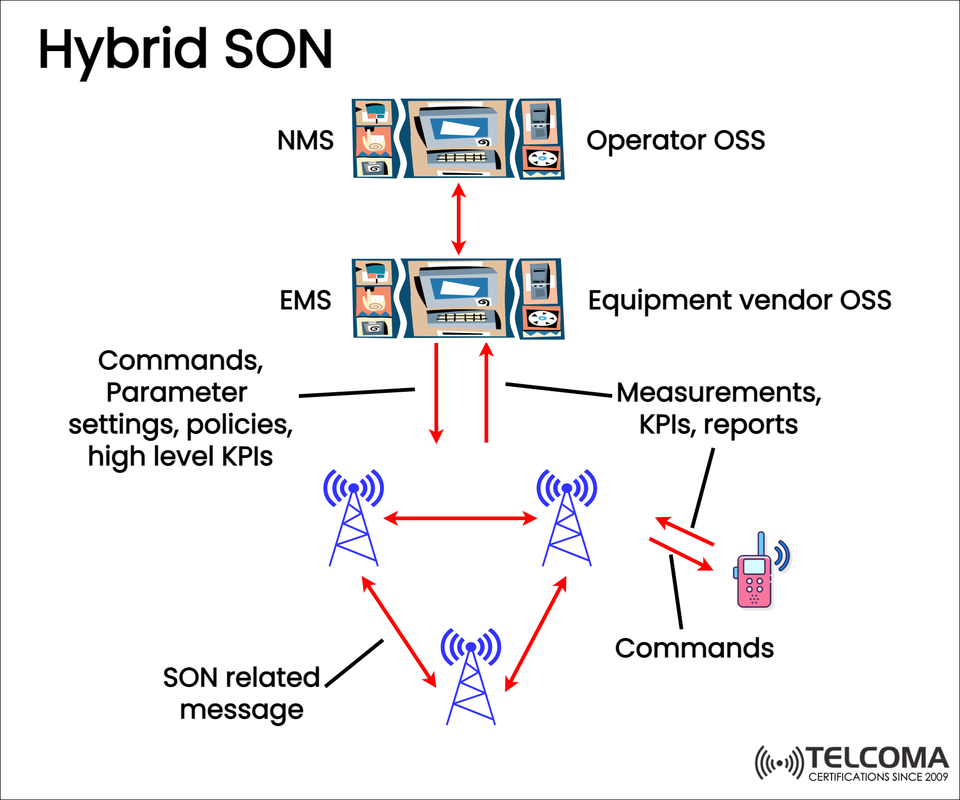
Operator OSS (Operations Support System) and Equipment Vendor OSS can share policies, KPIs, and reports.
EMS (Element Management System) acts as the go-between, handling measurements, commands, and high-level configurations.
Base stations and UEs (User Equipment) keep sending SON-related messages and getting optimization commands in return.
This balance brings together real-time efficiency (from D-SON) and long-term consistency (from C-SON).
A Look at Hybrid SON Architecture
If we check out the diagram, we spot three essential functional layers:
Top Layer – OSS/NMS/EMS * Here, the Operator OSS and vendor OSS manage policies, KPIs, and parameter settings. * Commands and reports zip back and forth between these systems and the lower network layers.
Middle Layer – SON Controllers * The EMS stands at the control and decision-making center, making sure the network adjusts according to high-level commands while analyzing incoming measurements.
Bottom Layer – Radio Nodes & UE * Base stations trade SON-related messages amongst themselves. * Users interact with the network through signaling and receive commands that affect their service quality.
This layered setup ensures complete visibility and quick adaptability.
Key Functions of Hybrid SON
Hybrid SON underpins several core functionalities that are essential for 5G networks:
Self-Configuration * It automates the initial setup of new nodes, speeding up how quickly we can launch new deployments.
Self-Optimization * It fine-tunes handovers, load balancing, and interference management. * Better spectrum utilization across LTE, NR, and future 6G technologies is a big plus.
Self-Healing * Automatically spots and fixes network faults. * This ensures services stay active even if nodes fail.
Policy-Driven Management * Operator policies steer SON algorithms for energy efficiency, QoS, or specific SLA needs.
Why Hybrid SON is Better than C-SON and D-SON
Feature Centralized SON (C-SON)Distributed SON (D-SON)Hybrid SON (H-SON)Decision Scope Network-wide Local node Both combined Response Time Slower (centralized)Fast (local)Balanced optimization Scalability High Limited High + Local detail Optimization Long-term Real-time Synergized Complexity High cost Easier, but limited view Moderate, well-balanced
Hybrid SON takes the strengths of both approaches, allowing for network-wide intelligence and local responsiveness.
Use Cases for Hybrid SON in 5G Networks
5G Small Cell Deployment * Automating configuration makes deploying dense small-cell networks in cities a whole lot simpler.
Interference Management * D-SON’s real-time capabilities identify interference issues, while C-SON policies provide long-term solutions.
Mobility Optimization * Smooth handovers between LTE and 5G NR lead to better service for moving users (think vehicles, trains).
Energy Efficiency * Policies can switch off cells that aren’t being used much, promoting green networking without affecting service.
Network Slicing in 5G * Hybrid SON ensures that the slices are optimized from both local and global perspectives, especially vital for enterprise-grade private 5G setups.
Challenges in Rolling Out Hybrid SON
Even though it shows promise, there are hurdles:
Interoperability issues between vendor OSS and operator OSS.
Algorithm conflicts when centralized and distributed functions overlap.
Data overload from constant KPI reporting.
Security concerns due to automated commands and policies.
Addressing these challenges will require standardization (like 3GPP specifications), vendor collaboration, and AI-driven SON frameworks.
The Role of AI and ML in Hybrid SON
AI and ML are crucial for powering next-gen SON:
Predictive analytics help in traffic forecasting.
Reinforcement learning optimizes handovers in real-time.
Anomaly detection spots unusual patterns in KPIs.
Closed-loop automation allows SON to improve itself without needing manual input.
AI-enhanced Hybrid SON will be key in realizing 6G’s vision of fully autonomous networks.
Future Outlook: Hybrid SON in 6G
Intent-Based Networking (IBN): Operators will express desired outcomes, and SON will automatically configure the network.
Multi-RAT Management: Beyond LTE and 5G NR, SON will also handle satellite, Wi-Fi 7, and IoT-specific protocols.
Cloud-Native SON: SON functions will be deployed as microservices in edge and cloud setups for better scalability.
Security-Embedded SON: AI-driven security will be in place to detect and counter cyberattacks in real-time.
Key Takeaways
Hybrid SON merges centralized and distributed SON for peak efficiency.
It offers real-time adaptability and long-term optimization all at once.
It supports critical 5G applications like network slicing, energy efficiency, and mobility optimization.
There are challenges in interoperability, algorithm conflicts, and security, but AI and ML are on track to tackle these.
Looking ahead, future networks (6G) will depend on Hybrid SON for fully autonomous, intention-driven operations.
Conclusion
Hybrid SON isn’t just a step forward for SON — it’s a crucial foundation for both 5G and future 6G networks. By blending centralized intelligence with distributed flexibility, it provides the necessary automation, intelligence, and adaptability to manage the growing complexity of telecom infrastructures.
For those in the telecom field, grasping the concepts of Hybrid SON will be vital for keeping network operations future-proof, ensuring efficiency, and tapping into the full potential of 5G and beyond.