
Immediate MDT vs Logged MDT in 5G Networks: Key Differences Explained

Immediate MDT vs Logged MDT in 5G Networks: A Complete Guide
In 5G networks, Minimization of Drive Tests (MDT) is super important for improving coverage and performance while cutting back on expensive, manual drive tests. Instead of sending engineers out with all their gear to check signal strength and coverage, MDT lets the user equipment (UE)—like smartphones—gather and report network performance data automatically.
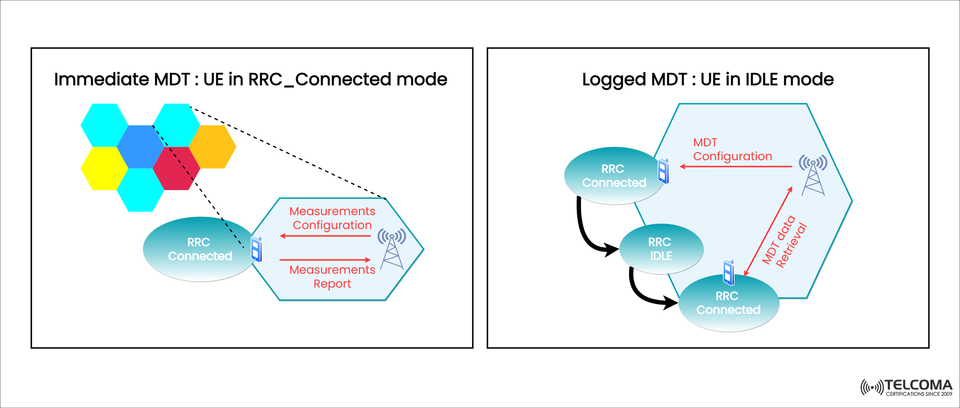
The image shows the two main MDT modes: Immediate MDT (in RRC Connected mode) and Logged MDT (in RRC Idle mode). Both methods give operators valuable insights into radio conditions, but they function differently based on whether the UE is connected or idle. Let’s dive deeper into each one.
What is MDT in 5G?
MDT stands for Minimization of Drive Tests, which was introduced by 3GPP to boost network efficiency. Its main goals are:
To reduce the need for physical drive testing.
To automate the collection of network performance data.
To provide real-world insights into coverage and QoS (Quality of Service).
To help operators analyze user experience across various locations.
MDT is especially handy in 5G NR (New Radio) setups since these networks can be quite complex, involving a mix of frequency bands, small cells, and massive MIMO.
Immediate MDT: UE in RRC Connected Mode
In Immediate MDT, the UE is in RRC Connected mode, meaning it's actively communicating with the base station and has an ongoing connection.
How it Works:
The network sets up specific measurement tasks for the UE.
The UE makes real-time measurements of things like RSRP (Reference Signal Received Power), RSRQ (Reference Signal Received Quality), and SINR.
The UE sends these measurement reports back to the network instantly.
Example in the Image:
The UE (in RRC Connected) gets Measurement Configuration from the network.
It gathers data on coverage and quality.
It sends the Measurement Report back to the gNB in real-time.
Advantages of Immediate MDT:
Real-time tracking of coverage and mobility.
Faster identification of network problems (like handover failures).
Particularly useful in areas with high mobility users such as trains or cars.
Limitations:
Higher battery consumption since the UE needs to stay active.
Only available for users who are already in RRC Connected mode, not for idle users.
Logged MDT: UE in Idle Mode
Logged MDT operates differently. In this case, the UE is in RRC Idle mode, meaning it’s not actively connected but still within the network’s coverage area.
How it Works:
When connected, the network sets the UE up with MDT instructions.
Once the UE moves to RRC Idle mode, it begins logging measurements locally.
Later, when the UE reconnects to the network (switching back to RRC Connected), it uploads the stored measurement data.
Example in the Image:
The UE toggles between RRC Connected and RRC Idle.
While in Idle mode, the device collects and stores MDT data.
Upon reconnection, the stored data is sent for network analysis.
Advantages of Logged MDT:
Gathers data from users in an idle state, capturing a more realistic picture of mobility scenarios.
Helps identify coverage gaps since idle users often move into areas where active connections might drop.
Lower battery consumption than Immediate MDT.
Limitations:
Data won’t be available in real-time.
Relies on UEs to reconnect for uploading logs, which could delay reporting.
Key Differences Between Immediate MDT and Logged MDT
Feature Immediate MDT (RRC Connected)Logged MDT (RRC Idle)UE Mode Active connection (RRC Connected)Idle state (RRC Idle)Data Collection Real-time, immediate reporting Stored locally, reported later Battery Impact Higher consumption Lower consumption Use Case Live mobility, handover, QoS monitoring Coverage analysis, long-term user experience Reporting Immediate reports to gNB Reports uploaded when UE reconnects
Why Are Both MDT Types Important in 5G?
5G networks are super dynamic, covering all kinds of environments—from busy cities to rural areas. Both Immediate and Logged MDT work well together:
Immediate MDT supports real-time troubleshooting, helping operators to quickly tackle network issues.
Logged MDT gives detailed coverage insights, even when users are idle, making it crucial for long-term optimization.
By using both approaches, operators get a better overall view of user experience, which is key for improved coverage, optimized mobility, and smart resource use.
Practical Use Cases
Coverage Optimization: * Logged MDT identifies coverage holes in less populated or indoor spaces.
Mobility Enhancement: * Immediate MDT ensures smooth handover performance in high-speed situations.
QoS Monitoring: * Real-time data from Immediate MDT guarantees a consistent user experience for things like video streaming or VoIP.
Cost Savings: * Both MDT methods lessen reliance on traditional drive testing, saving time and resources.
Future Outlook: MDT in AI-driven 5G Networks
As 5G advances toward self-optimizing networks (SON), MDT data will integrate with AI and machine learning algorithms for:
Spotting coverage gaps.
Automating parameter adjustments.
Boosting network reliability for new applications like autonomous vehicles and smart cities.
This turns MDT into more than just a reporting tool; it becomes a key component of smart 5G network management.
Conclusion
Choosing between Immediate MDT and Logged MDT really depends on what you need. Immediate MDT gives real-time insights for connected UEs, while Logged MDT offers broader coverage data from idle users. Together, they create a comprehensive system for 5G performance monitoring, leading to better coverage, reduced costs, and a smoother user experience.
By making the most of both MDT modes, operators can get closer to realizing self-healing, AI-driven 5G networks—boosting efficiency while keeping manual work to a minimum.