
Impact of Modulation, Bandwidth, and MIMO on 5G Downlink Data Rates

Introduction: What Affects 5G Downlink Speed
One question that comes up a lot with mobile networks is: What actually determines my connection speed? While users notice download speeds, telecom engineers pay attention to a few key factors—modulation order, channel bandwidth, carrier aggregation, and MIMO (Multiple Input Multiple Output) techniques.
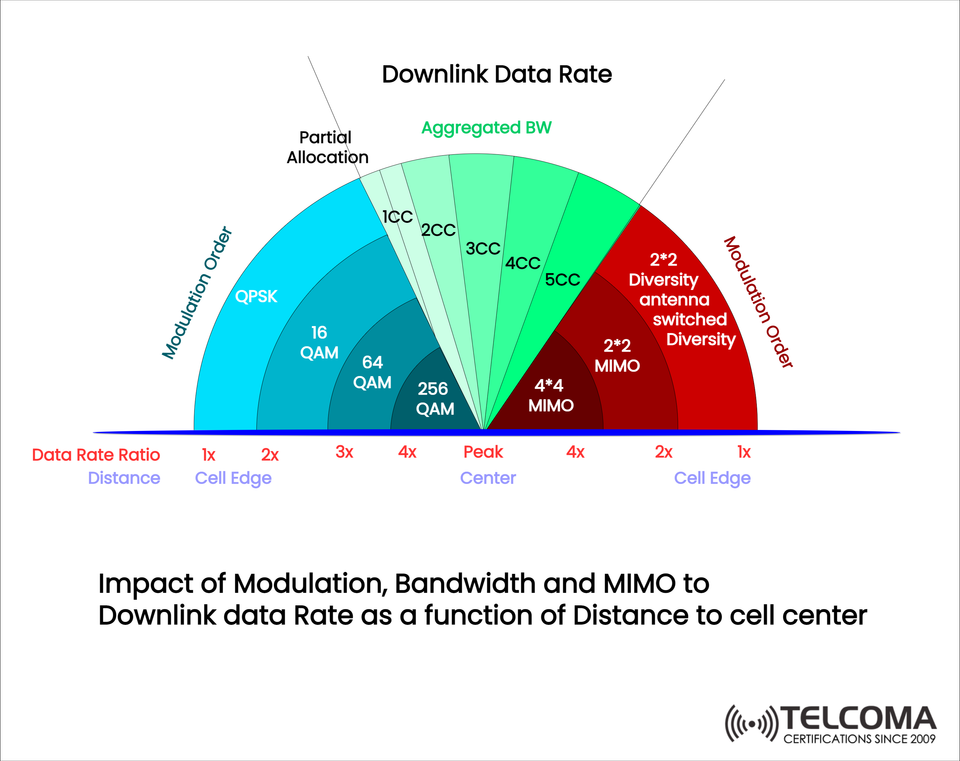
The image provided illustrates how these elements work together and how your distance from the cell center can affect downlink data rates.
This blog will dive into the technical effects of modulation, bandwidth aggregation, and MIMO diversity on data throughput in today’s 4G and 5G networks.
Modulation and Its Impact on Data Rates
Modulation is crucial because it decides how many bits can be sent per symbol. Higher modulation schemes transmit more information but need a better signal-to-noise ratio (SNR), which is stronger closer to the cell center and weaker as you move towards the cell edge.
Common Modulation Schemes in LTE/5G:
QPSK (Quadrature Phase Shift Keying): * Used mainly at cell edges. * It’s great against noise but carries fewer bits per symbol.
16 QAM (Quadrature Amplitude Modulation): * More efficient than QPSK. * Needs better channel quality.
64 QAM: * Common in LTE. * It significantly boosts data rates in mid-range conditions.
256 QAM: * Found near the cell center where SNR is high. * Can transmit 8 bits per symbol, maximizing throughput.
👉 Key Takeaway: The closer you are to the cell tower, the higher the modulation order that can be supported, leading to faster downlink speeds.
Bandwidth and Carrier Aggregation (CA)
The second factor to consider is available bandwidth. A wider bandwidth allows more data to be sent at once.
Single Carrier (1CC): Limited throughput.
2CC to 5CC (Carrier Aggregation): This combines several carriers to provide more bandwidth.
In LTE-Advanced and 5G, operators can use up to 5CC or even more to increase effective bandwidth.
For instance:
1CC with 20 MHz bandwidth gives limited throughput.
When you aggregate 4–5 carriers (resulting in 100 MHz effective bandwidth), you could see the downlink data rate go up several-fold.
👉 Key Takeaway: Bandwidth aggregation is essential for achieving peak speeds in 4G LTE-A and 5G NR networks.
MIMO: Multiple Antennas for Higher Capacity
MIMO (Multiple Input Multiple Output) technology uses multiple antennas at both the transmitter and receiver to boost throughput and reliability.
Types of MIMO Configurations:
2x2 MIMO: Two transmit and two receive antennas.
4x4 MIMO: Four transmit and four receive antennas for higher parallel data streams.
Massive MIMO (in 5G): Many antennas at the base station enable beamforming and spatial multiplexing.
The image also includes diversity techniques, like 2x2 diversity antenna switched diversity, which enhance reliability in poor conditions, but don’t increase capacity as much as true MIMO multiplexing.
👉 Key Takeaway: More antennas mean higher capacity, but how effective they are depends on signal conditions and how far you are from the cell center.
Distance from Cell Center: Why Location Matters
The image clearly demonstrates how your distance from the cell center affects data rates.
At Cell Edge: * Low SNR, higher interference. * Networks revert to QPSK or 16 QAM. * Limited bandwidth and MIMO benefits. * Data rate ratio: ~1x.
Mid-Cell: * Better SNR allows for 64 QAM and some carrier aggregation. * Gains from 2x2 MIMO become more noticeable. * Data rate ratio: 2x–3x.
Near Cell Center: * Best SNR conditions. * Enables 256 QAM. * Can use 4CC or 5CC carrier aggregation. * Active 4x4 MIMO or Massive MIMO. * Achieves peak throughput (4x or more).
👉 Key Takeaway: How far you are from the cell tower impacts the modulation, bandwidth usage, and MIMO effectiveness, which ultimately affects your downlink data rate.
Putting It All Together: How Factors Combine
The peak downlink speed a user feels is a mix of all three factors:
Modulation: Sets the bits per symbol.
Bandwidth (Carrier Aggregation): Dictates how many symbols can be transmitted per second.
MIMO: Determines the number of parallel data streams.
Formula (Simplified):
Data Rate ≈ Modulation Efficiency × Bandwidth × Number of MIMO Streams
For example:
Condition Modulation Bandwidth MIMO Approx Throughput
Cell Edge QPSK 1CC 2x2 Low (~1x)
Mid-Cell 64 QAM 2–3CC 2x2 MIMO Medium (~2x–3x)
Cell Center 256 QAM 4–5CC 4x4 MIMO High (~4x or more)
Why This Matters for 5G
5G builds on these same ideas but takes it further with:
Higher Modulation Orders: Up to 1024 QAM in some cases.
Massive Bandwidth: Up to 400 MHz in mmWave.
Massive MIMO & Beamforming: Supporting many antenna streams.
This expansion allows 5G peak speeds to hit multi-Gbps, but actual performance still depends on location, network setup, and interference factors.
Real-World Example
Picture a smartphone in different spots:
At the edge of a 5G cell: * QPSK or 16 QAM, minimal carrier aggregation. * Maybe 50–100 Mbps.
Mid-cell in an urban area: * 64 QAM, several carriers combined. * Up to 500 Mbps possible.
Close to the gNodeB (cell center): * 256 QAM or better, 100+ MHz bandwidth, 4x4 or 8x8 MIMO setup. * Several Gbps achievable.
👉 This illustrates why users often experience different speeds based on their proximity to the base station.
Key Takeaways
Modulation boosts data throughput, needing high SNR.
Bandwidth aggregation enables higher peak speeds.
MIMO facilitates parallel streams and higher capacity.
Distance from the cell center determines how effectively these techniques work.
Conclusion
Understanding how modulation, bandwidth, and MIMO influence downlink data rates is key to grasping modern mobile networks.
At the cell edge, robust modulation (QPSK) and limited resources hold speeds back.
As users venture toward the cell center, higher modulation (256 QAM), broader bandwidth (5CC), and advanced MIMO (4x4 or massive MIMO) unlock peak speeds.
With 5G, these concepts are amplified, featuring higher modulation orders, more spectrum availability, and massive MIMO setups, making way for ultra-fast data rates for things like AR/VR, IoT, and self-driving cars.
Ultimately, the user experience in mobile networks hinges on the balance between radio conditions and advanced technology—all aimed at delivering the best possible throughput wherever you are.