
Impact of Modulation, Bandwidth, and MIMO on Uplink Data Rates in 4G and 5G

Introduction: The Importance of Uplink Data Rate
Most mobile users tend to prioritize download speeds, but the uplink data rate deserves just as much attention. Whether you're sending videos, uploading large files, or supporting real-time IoT applications, how well the uplink performs can really shape the overall user experience.
Compared to download speeds, the uplink is more limited since mobile devices (UEs) transmit with less power than base stations. This makes it essential to consider factors like modulation order, bandwidth, MIMO setup, and distance from the cell center when assessing uplink throughput.
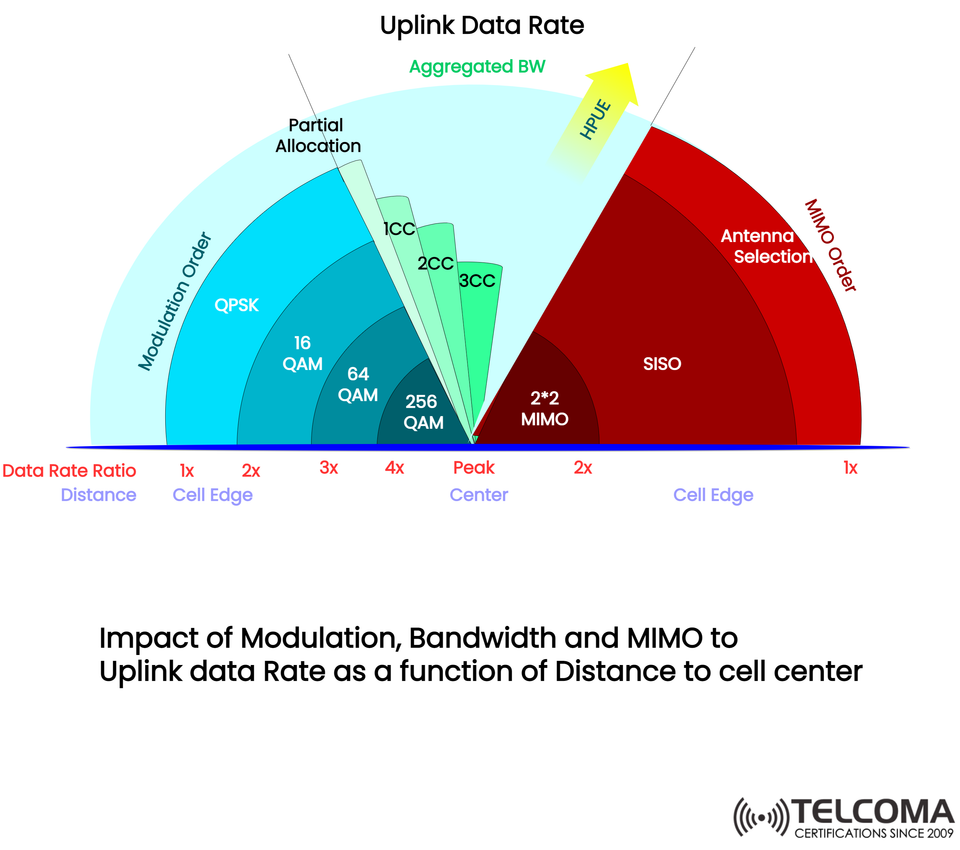
The diagram we'll look at breaks down these dependencies, and we'll dive into how each element impacts uplink performance in both LTE and 5G.
Modulation in the Uplink Path
Like the downlink, modulation order dictates how many bits get sent per symbol in the uplink. Still, achieving high modulation in the uplink can be trickier because the device has to work with limited power.
Common Uplink Modulation Schemes
QPSK (Quadrature Phase Shift Keying):
Very reliable, often used near cell edges.
Good resistance to noise, but offers lower data rates.
16 QAM:
Provides moderate throughput, but needs stronger SNR.
64 QAM:
Achieves higher spectral efficiency, but is available only closer to the cell center.
256 QAM:
Delivers the maximum bits per symbol for LTE uplink.
At the edges of the cell, uplink modulation typically drops down to QPSK or 16 QAM, limiting speeds. Only close to the base station can you maintain 64 or 256 QAM.
Bandwidth and Uplink Carrier Aggregation
Bandwidth directly impacts the spectrum available for uplink data transmission. More bandwidth means better throughput.
1CC (Single Carrier): Basic uplink, limited capacity.
2CC (Dual Carrier Aggregation): Enhances uplink bandwidth.
3CC (Triple Carrier Aggregation): Facilitates much higher uplink speeds when conditions are right.
Carrier aggregation is trickier for uplink than downlink since devices must balance transmission power across the carriers, making partial allocations a common challenge at cell edges.
Uplink CA can boost speeds significantly, though its effectiveness is limited by UE power constraints.
Uplink MIMO Configurations
MIMO has a role in uplink too, but it’s a bit more restricted compared to downlink because devices have fewer antennas and less power to work with.
Configurations in Uplink:
SISO (Single Input Single Output):
Standard mode at cell edge.
Offers limited capacity but is more reliable.
2x2 MIMO Uplink:
Possible when you’re closer to the cell center.
Provides spatial multiplexing for better data rates.
Antenna Selection:
Instead of using parallel streams, the device picks the best antenna for transmission to keep the connection quality high.
Unlike downlink, where you often see 4x4 MIMO or Massive MIMO, uplink is usually limited to 2x2 MIMO, making modulation and bandwidth even more critical.
HPUE: Boosting Uplink Coverage
The diagram shows HPUE (High Power User Equipment), a special category of devices that can transmit at higher power levels.
HPUE can stretch the uplink coverage radius.
It allows for better modulation and bandwidth usage, even at a distance from the cell center.
It improves uplink throughput in cell edges, which usually have weaker signals.
HPUE really changes the game for uplink performance, especially in rural areas and for IoT applications.
Distance to Cell Center: A Key Element
The image illustrates how uplink performance changes with distance:
At Cell Edge (1x data rate ratio):
Experience low SNR limits.
Uplink relies on QPSK, single carrier, and SISO.
Throughput is minimal.
Mid-Cell (2x–3x data rate ratio):
Improved SNR allows for 16 QAM or 64 QAM.
Dual-carrier uplink is possible.
2x2 MIMO begins to show some benefits.
At Cell Center (Peak Throughput, 4x+):
Best SNR conditions.
256 QAM is enabled.
Triple carrier aggregation is utilized.
2x2 MIMO works at peak efficiency.
HPUE devices maximize performance.
Uplink data rate heavily depends on distance, with peak performance only reachable near the base station.
Combined Impact: Modulation, Bandwidth, and MIMO
To get the full picture, let’s put all these factors together.
Simplified Throughput Formula:
Uplink Data Rate ≈ Modulation Efficiency × Bandwidth × MIMO Streams × UE Power Capability
Example Table:
Location Modulation Bandwidth MIMO Typical Uplink Performance Cell EdgeQPSK1CCSISOVery Low (~1x)Mid-Cell16–64 QAM2CC2x2 MIMO Moderate (~2x–3x)Cell Center256 QAM3CC2x2 MIMO Peak (~4x or more)HPUE Device64–256 QAM2–3CC2x2 MIMO Extended high-rate even beyond mid-cell
Uplink in 5G: Going Further
5G uplink enhances these concepts:
Higher Modulation Orders: Some networks are testing beyond 256 QAM.
Wider Bandwidth: Uplink can tap into spectrum from sub-6 GHz to mmWave.
Massive MIMO at gNodeB: Improves beamforming for uplink reception, even if the UE has fewer antennas.
Dynamic Spectrum Sharing (DSS): Offers flexible uplink bandwidth allocation between LTE and 5G.
In 5G, uplink performance is crucial for AR/VR, cloud gaming, live streaming, and mission-critical IoT, making these upgrades essential.
Real-World Example
Let’s look at a user uploading a 4K video to the cloud:
At the Cell Edge: The device falls back to QPSK and SISO. Upload speeds might be below 10 Mbps.
At Mid-Cell: With 64 QAM and 2CC aggregation, uplink speeds can rise to around 50–100 Mbps.
Near Cell Center: With 256 QAM, 3CC, and 2x2 MIMO, speeds could exceed 200–400 Mbps.
With HPUE: Even at mid-cell or further, speeds stay close to what you’d get near the cell center.
This illustrates why users often experience dramatic improvements in upload speeds when they get closer to a base station or use HPUE-supported devices.
Key Takeaways
Modulation Order: Higher modulation = higher throughput, but requires good SNR.
Bandwidth (Carrier Aggregation): More carriers = more throughput, but limited by UE power.
MIMO: Uplink MIMO isn’t as powerful as downlink, but 2x2 still helps boost speeds.
HPUE Devices: Extend coverage and enhance uplink reliability.
Distance from Cell Center: Determines which techniques can be effectively applied.
Conclusion
The uplink data rate in mobile networks comes from a careful balance of modulation, bandwidth aggregation, MIMO configurations, and device power capabilities.
As we transition to 5G and beyond, uplink performance is set to play an even bigger role in cloud-native applications, interactive gaming, AR/VR, and IoT. Telecom operators need to optimize spectrum, roll out HPUE-capable devices, and take full advantage of advanced modulation techniques to keep up with the rising demand for faster and more reliable uplink speeds.