
IMS Core Network Explained: Architecture, Key Components, and Functional Flow
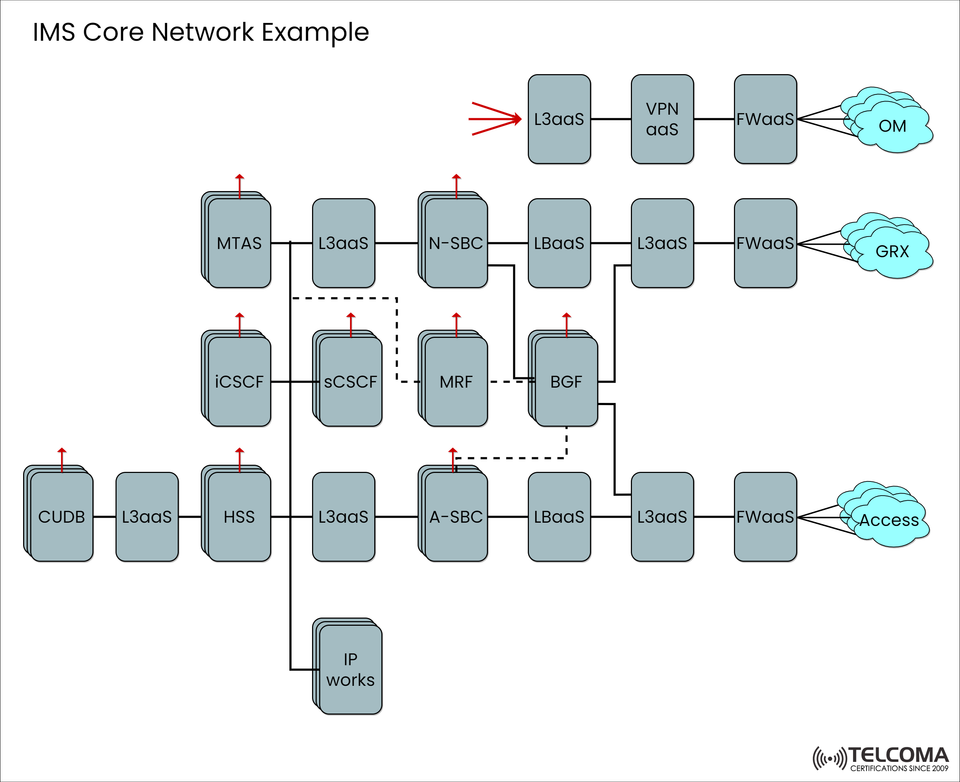

Understanding the IMS Core Network: Architecture, Components, and Functionality
The IP Multimedia Subsystem (IMS) serves as the foundation of contemporary telecom networks, allowing smooth voice, video, messaging, and multimedia communication over IP. It's central to technologies like VoLTE (Voice over LTE), VoWiFi (Voice over Wi-Fi), and 5G Voice (VoNR).
The diagram labeled “IMS Core Network Example” illustrates how various IMS components work together — from access networks to service and control functions. In this post, we'll break down the IMS architecture, explain each part of the network, and show how everything collaborates to deliver real-time communication services effectively.
What Is IMS (IP Multimedia Subsystem)?
IMS is a standardized framework established by the 3rd Generation Partnership Project (3GPP) aimed at providing multimedia services across both fixed and mobile networks.
It helps telecom operators transition from outdated circuit-switched systems to all-IP networks, supporting advanced communication services like:
Voice and video calls over LTE or 5G.
Multimedia conferencing and presence services.
Messaging and Rich Communication Services (RCS).
IMS separates control, session, and media functions, which makes the network more modular, flexible, and ready for the cloud.
Overview of IMS Core Network Architecture
The IMS architecture features three logical layers that handle signaling, service control, and media management:
Layer Role Key Components Access Layer Connects users to the IMS network via LTE, Wi-Fi, or broadband. A-SBC, FWaaS, L3aaS Control Layer Manages session setup, routing, and signaling. CSCF (P/I/S), HSS, SBC Application Layer Provides services and applications. MTAS, MRF, CUDB
In the diagram, these layers include a mix of traditional IMS components and modern cloud-native services like L3aaS, LBaaS, and FWaaS — representing a contemporary, virtualized IMS core.
- Key Components of the IMS Core Network
Let’s take a closer look at each component in the diagram and their roles in the IMS ecosystem.
A. CSCF (Call Session Control Function)
The Call Session Control Function (CSCF) acts as the signaling hub of IMS, comprising three types:
P-CSCF (Proxy CSCF): * Acts as the first point of contact for user equipment (UE). * Sets up SIP (Session Initiation Protocol) signaling. * Maintains QoS and security through IPsec.
I-CSCF (Interrogating CSCF): * The entry point for all SIP messages from other networks. * Queries the HSS (Home Subscriber Server) to find the right S-CSCF.
S-CSCF (Serving CSCF): * The main session manager responsible for user registration, authentication, and call control. * Connects with application servers like MTAS to deliver telephony services.
In the diagram, both iCSCF and sCSCF link directly with other control and service entities like MRF and MTAS, showcasing their vital role in IMS signaling.
B. SBC (Session Border Controller)
SBCs serve as security and interworking gateways within IMS. The diagram shows two SBCs:
A-SBC (Access SBC): * Safeguards the IMS core from threats on the subscriber side. * Handles NAT traversal, media anchoring, and policy enforcement.
N-SBC (Network SBC): * Manages operator-to-operator or interconnect traffic. * Offers topology hiding and session interworking between IMS and external networks (like GRX).
Together, they ensure secure SIP signaling and RTP media exchange across different domains.
C. HSS (Home Subscriber Server)
The HSS serves as the main subscriber database in IMS, containing:
User profiles and identities.
Authentication credentials.
Service and policy details.
It primarily interacts with the S-CSCF for user authentication and authorization during SIP registration.
D. MTAS (Multimedia Telephony Application Server)
The MTAS supports voice and video telephony services such as:
Call forwarding, call waiting, and conferencing.
Handling emergency calls and voicemail routing.
It works with S-CSCF and MRF to manage media and call features.
E. MRF (Media Resource Function)
The MRF manages media plane functions and is often divided into:
MRFC (Media Resource Function Controller) — Controls media sessions.
MRFP (Media Resource Function Processor) — Takes care of media processing (mixing, recording, announcements).
In the diagram, MRF connects to BGF (Border Gateway Function) to manage media routing.
F. BGF (Border Gateway Function)
The BGF regulates the flow of RTP streams across the network boundaries, offering:
Media routing.
NAT traversal for media.
Implementation of QoS and security policies.
It acts as the link between MRF, SBC, and external access networks.
G. CUDB (Centralized User Database)
The CUDB supports user data storage, service policies, and configuration details for application servers. It complements HSS by retaining additional non-authentication information.
H. IP Works
This component represents the IP transport backbone that provides routing, addressing, and packet forwarding among IMS entities and access domains. It ensures reliable IP connectivity throughout the network.
I. Cloud-Native Service Components
The diagram also includes cloud-native elements, illustrating how IMS adapts in virtualized and containerized settings:
L3aaS (Layer 3 as a Service): Offers virtualized routing and IP layer management.
LBaaS (Load Balancer as a Service): Evenly distributes SIP signaling and media traffic across network functions.
FWaaS (Firewall as a Service): Provides security at various network boundaries (Access, GRX, and OM).
VPNaaS (VPN as a Service): Creates secure connections for management and operational connectivity.
These services enhance IMS's scalability, automation, and cloud-readiness — aligning with NFV (Network Function Virtualization) and CNF (Cloud-Native Function) principles.
External Connectivity in IMS
The diagram illustrates three main external connections that broaden IMS capabilities:
Access Network (Access Cloud): * Links subscribers via LTE, 5G, or Wi-Fi. * Utilizes A-SBC, L3aaS, and FWaaS for secure access.
GRX (GPRS Roaming Exchange): * Facilitates inter-operator connections for roaming users. * Secured using N-SBC, L3aaS, and FWaaS.
OM (Operations and Management): * Offers tools for monitoring, analytics, and orchestration. * Connects securely through VPNaaS and FWaaS.
This modular design guarantees high reliability and separation between service, management, and external connectivity domains.
Simplified IMS Call Flow
Here’s a rundown of how a typical IMS call setup works:
User Registration: * The UE connects through Access Network → A-SBC → P-CSCF → I-CSCF → HSS → S-CSCF. * User authentication and session binding take place.
Session Setup: * SIP INVITE is transmitted via CSCFs. * Media resources are allocated by MRF and managed through BGF.
Media Exchange: * RTP streams flow through SBCs and BGF for media handling.
Service Delivery: * MTAS oversees call features (like call waiting, transfer).
Session Termination or Roaming: * Calls are either ended locally or rerouted through GRX if roaming.
The Importance of Cloud-Native IMS
Today’s telecom networks are shifting from hardware-based PNFs to virtualized VNFs and containerized CNFs.
By incorporating cloud-native elements (as shown in the diagram), IMS benefits from:
Scalability: Ability to scale dynamically during peak times.
Automation: CI/CD and DevOps processes make deployment smoother.
Portability: Can operate across private, public, or hybrid clouds.
Cost Efficiency: Optimized resource utilization.
Resilience: Self-healing capabilities through orchestration frameworks like Kubernetes.
Conclusion
The IMS Core Network is the backbone of next-gen communication — linking users, managing sessions, and providing rich multimedia services.
As the diagram showcases, IMS has transformed into a cloud-native, modular, and automated structure that meets the rising demand for 5G and IP-based services.
By merging established network elements like CSCF, SBC, and HSS with current services such as L3aaS, FWaaS, and LBaaS, telecom operators can achieve enhanced flexibility, scalability, and efficiency.
In this 5G era and beyond, IMS continues to be a crucial driver of convergence, innovation, and high-quality real-time communication across all IP networks.