
IMS Hosting Scenarios Explained: Multi-Operator Virtualization in Modern Telecom Networks

IMS Hosting Scenarios: How Operators Share Virtualized Infrastructure Efficiently
As the telecom industry moves towards cloud-native and virtualized systems, making the most of resources and managing multiple tenants effectively is crucial. A significant development leading this change is the IMS (IP Multimedia Subsystem) hosting model. It enables various operators (OpCos) to share infrastructure while keeping services separate and maintaining quality.
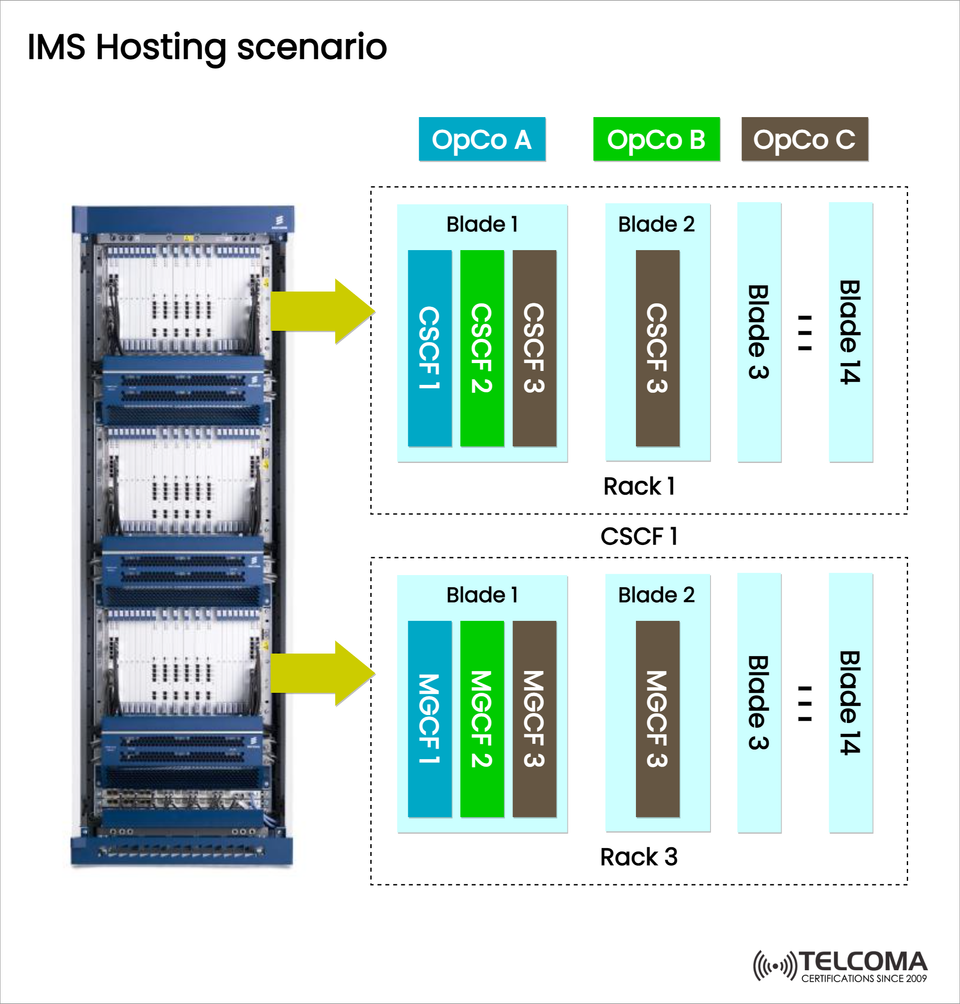
The image uploaded shows an IMS hosting scenario, detailing how OpCo A, OpCo B, and OpCo C utilize IMS functions like CSCF (Call Session Control Function) and MGCF (Media Gateway Control Function) across different modular blades and racks. This design boosts scalability, cuts down on capital expenses, and simplifies network management.
Understanding IMS Hosting: The Foundation of Multi-Operator Collaboration
The IP Multimedia Subsystem (IMS) serves as a standardized framework for delivering VoLTE, VoNR, and other IP-based multimedia services. Traditionally, operators had their own dedicated IMS cores, which led to redundancy and higher operating costs.
In contrast, IMS hosting allows several operators to share a common physical setup while logically isolating their network functions. Each operator runs its own instances of essential IMS components like:
CSCF (Call Session Control Function)
MGCF (Media Gateway Control Function)
TAS (Telephony Application Server)
This arrangement guarantees both independence and efficient use of resources.
Architecture Overview of the IMS Hosting Scenario
The image illustrates a multi-rack IMS hosting setup with several blades within each rack. Each blade is assigned specific IMS functions for different operators.
Key Components in the Diagram:
Racks – Physical units that contain multiple blades. Each rack supports different IMS functional layers (like CSCF and MGCF).
Blades – Modular servers within the racks. Each blade can host one or more IMS functions for various operators.
Operators (OpCos) – OpCo A (blue), OpCo B (green), and OpCo C (brown) are the telecom service providers that share the infrastructure. Each operates its own virtual IMS functions on the same hardware.
Functional Layers – CSCF Layer (Rack 1) manages SIP-based signaling, while the MGCF Layer (Rack 3) oversees media gateway control and interfacing with older networks.
This structured approach enables logical separation, efficient scaling, and flexible deployment for multiple network operators.
CSCF Layer: Managing Call Sessions Across Operators
At the heart of IMS signaling lies the Call Session Control Function (CSCF), which manages SIP registration, session setup, and routing for voice and multimedia calls.
In Rack 1 (CSCF Hosting Layer):
Blade 1 hosts CSCF instances for OpCo A (CSCF1), OpCo B (CSCF2), and OpCo C (CSCF3).
Blade 2 provides extra capacity for OpCo C (CSCF3), ensuring scalability.
Blades 3–14 can be dynamically provisioned for new operators or functions.
This modular approach ensures that each operator’s SIP signaling remains isolated, all while using the same underlying physical hardware. It allows for elastic scaling, letting operators add or shift CSCF instances as network demand changes.
MGCF Layer: Handling Media and Legacy Interworking
The Media Gateway Control Function (MGCF) acts as a connection point between IMS-based IP networks and traditional circuit-switched systems (like PSTN). It employs H.248/Megaco signaling for managing Media Gateways (MGWs) to convert and transport voice.
In Rack 3 (MGCF Hosting Layer):
Blade 1 hosts MGCF instances for OpCo A (MGCF1), OpCo B (MGCF2), and OpCo C (MGCF3).
Blade 2 increases capacity for OpCo C (MGCF3) to manage higher call volumes.
Additional blades can be added to accommodate future demand or to support new operators.
By centralizing MGCF resources in shared racks, telecom operators can cut down on hardware duplication while maintaining high performance and reliability.
Multi-Operator Hosting: Logical Isolation and Resource Sharing
IMS hosting supports multi-tenancy, allowing several operators to safely share the same physical infrastructure. This approach combines virtualization and network slicing to ensure both performance and security.
Benefits of Multi-Operator Hosting:
Resource Optimization – Shared hardware lowers CAPEX and OPEX for all operators.
Logical Isolation – Virtual machines or containers keep each operator’s data and signaling secure and separate.
Scalability – Adding more blades or virtual instances is straightforward for expanding traffic loads.
Simplified Maintenance – Centralized management makes software updates and patches much more efficient.
Reduced Power and Space Consumption – A smaller hardware footprint means lowered power usage and less space taken up in data centers.
Through IMS hosting, telecom providers can scale efficiently without sacrificing service quality or security.
The Role of Virtualization and Cloud-Native Technologies
Today's IMS hosting setups rely heavily on NFV (Network Function Virtualization) and cloud-native architecture. These technologies separate IMS software from physical hardware, allowing for flexible deployment across shared resources.
Key Virtualization Advantages:
Dynamic Resource Allocation – Compute and storage resources are distributed based on real-time traffic needs.
Fault Tolerance – If one blade fails, virtualized IMS instances can automatically switch to another blade or rack.
Elastic Scaling – Operators can easily expand or reduce capacity without disrupting services.
Simplified Orchestration – Centralized management tools (like Kubernetes or OpenStack) oversee deployment, scaling, and lifecycle processes.
This shift enables telecom-grade performance combined with data center agility, bridging the gap between traditional IMS and the next-gen 5G core networks.
Deployment Flexibility: Scaling IMS with Demand
IMS hosting allows for both horizontal and vertical scaling:
Horizontal Scaling: Adding new blades or racks to distribute traffic load.
Vertical Scaling: Increasing the computing power or capacity of existing blades.
For instance, if OpCo C sees a rapid rise in users, more CSCF and MGCF instances can be launched on additional blades without affecting the other operators. This elastic capacity management ensures service continuity and optimal performance for all tenants.
Operational Benefits of IMS Hosting for Telecom Operators
a. Cost Efficiency
Shared racks and blades cut down on the need for separate setups.
Optimized resource use lowers both capital and operational costs.
b. Simplified Management
Centralized orchestration tools keep track of all operators’ IMS instances.
This makes lifecycle management, upgrades, and troubleshooting much simpler.
c. Enhanced Security and Compliance
Logical isolation protects operator data integrity and privacy.
Role-based access controls and encryption help safeguard boundaries between operators.
d. Future-Proof Scalability
Ready for merging with 5G Core (5GC) and VoNR networks.
Supports cloud-native functions, automation, and orchestration frameworks.
Conclusion: IMS Hosting as the Backbone of Shared Telecom Infrastructure
The IMS hosting model shown in the diagram represents the future of telecom infrastructure, where multiple operators can effectively share computing and networking resources while maintaining autonomy and service quality.
By implementing virtualized IMS components like CSCF and MGCF on shared blades and racks, operators can achieve:
Cost savings through hardware consolidation,
Agility through virtualization and elastic scaling, and
Reliability via redundancy and centralized management.
As telecom networks evolve towards 5G Standalone (SA) and cloud-native cores, IMS hosting will continue to be a strategic enabler for scalable, secure, and efficient service delivery.
Essentially, IMS hosting is transforming network infrastructure into a versatile, multi-operator platform that ensures the telecom industry can keep up with the increasing demands of our connected world.