
Inclusion of Non-Terrestrial Networks (NTN) in Mobile Communications
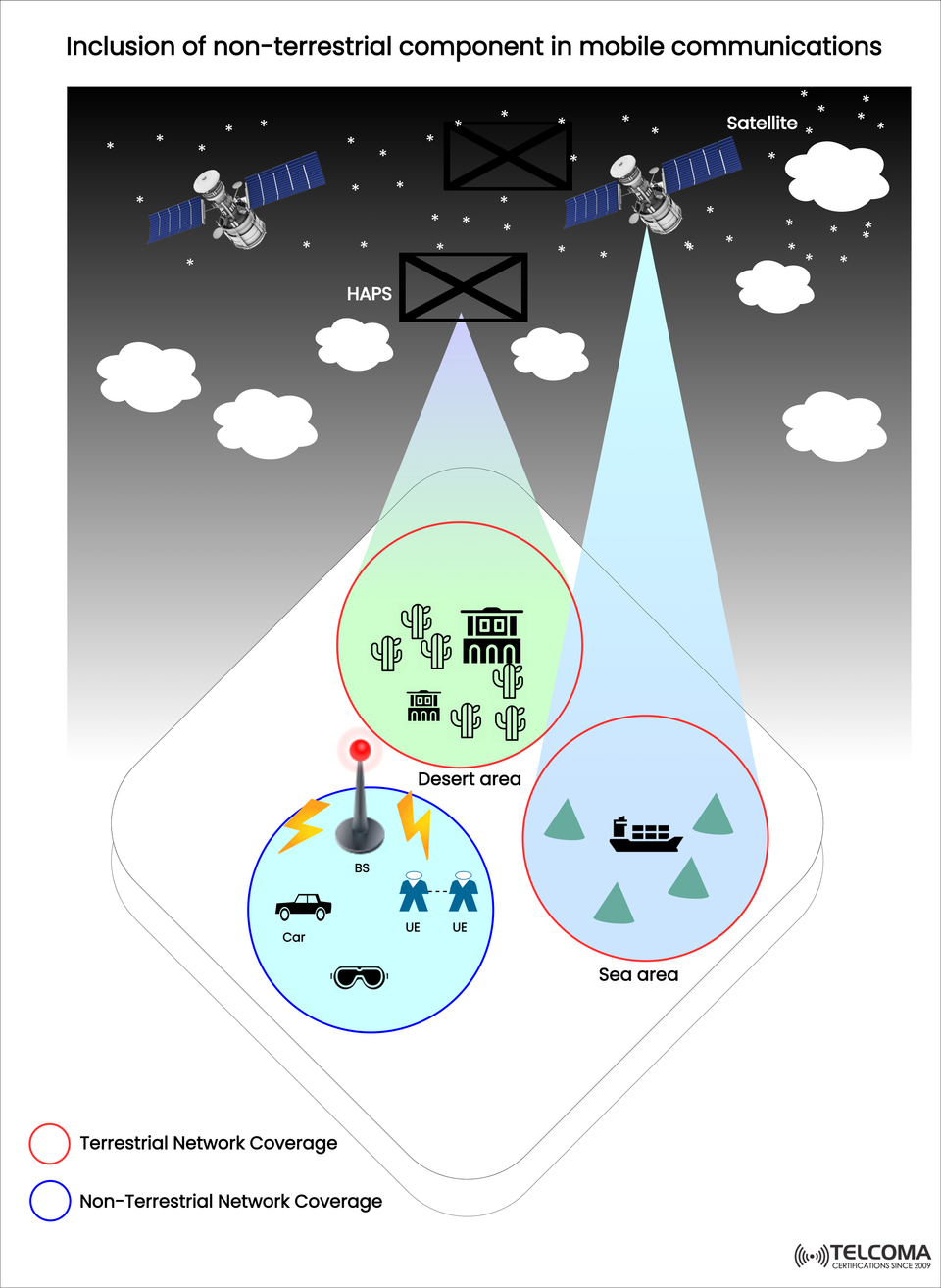

Including Non-Terrestrial Components in Mobile Communications
Mobile communications have come a long way in the past twenty years, yet one major hurdle still exists: coverage in remote and underserved areas. While terrestrial networks, thanks to base stations (BS), have been great for urban and suburban locations, huge deserts, oceans, mountains, and rural regions are often left out of the loop.
This is where Non-Terrestrial Networks (NTN) step in — powered by satellites and High-Altitude Platform Stations (HAPS), they play a crucial role. If you look at the image, you’ll notice that terrestrial coverage is marked in red and is quite limited, whereas non-terrestrial coverage, shown in blue, reaches out to areas that normally don’t get connected.
When we think about 5G-Advanced and 6G, integrating those non-terrestrial elements is key to achieving truly global connectivity. This helps bridge the digital divide and supports essential applications across the globe.
Why Non-Terrestrial Networks Matter
Adding NTN isn’t just about patching coverage holes — it opens up a new level of network resilience, reliability, and scalability.
Why we need NTN:
🌍 Global Coverage: It connects places where setting up terrestrial networks isn't practical, like deserts, oceans, and rural areas.
🚢 Mobility Support: Offers uninterrupted connectivity for ships, planes, and vehicles that are outside the reach of land-based networks.
🛰️ Disaster Recovery: Keeps communication lines open during natural disasters when terrestrial systems may fail.
⚡ IoT Scalability: Supports a massive number of IoT devices in remote sectors like oil rigs, smart farming, and environmental monitoring.
🔒 Defense and Security: Essential for government, military, and emergency operations in hard-to-reach places.
What Makes Up Non-Terrestrial Networks
The image highlights two key components enabling NTN:
- Satellites
They orbit in Low Earth Orbit (LEO), Medium Earth Orbit (MEO), or Geostationary Orbit (GEO).
Offer wide coverage.
Example uses: * Broadband internet for rural communities. * Connectivity for maritime and aviation. * Backhaul support for far-off base stations.
- High-Altitude Platform Stations (HAPS)
These are unmanned aircraft or balloons positioned at around 20 km in the stratosphere.
They fill the gap between terrestrial cells and satellites.
Offer flexible, lower-latency coverage compared to satellites.
Example uses: * Helping with disaster recovery in hit areas. * Improving 5G access in deserts and rural places. * Assisting smart agriculture and online education.
Comparing Terrestrial and Non-Terrestrial Networks
Here’s a quick side-by-side look at terrestrial networks and NTNs:
Feature Terrestrial Networks (BS)Non-Terrestrial Networks (NTN)Coverage Area Limited by cell radius (~1–50 km)Regional to global Deployment Cost High in remote areas High initial but more cost-effective for sparsely populated areas Latency Low (1–10 ms)Medium (20–600 ms, depending on orbit)Mobility Support Urban and suburban mobility Global mobility (ships, planes, deserts)Reliability Vulnerable to disasters Provides a backup Use Case Dense population centers Remote & underserved areas, mobility, emergencies
How NTNs Work with 5G and 6G
The effectiveness of NTN comes from how well it integrates seamlessly with current and future mobile networks.
5G-Advanced (Release 17 & 18) already sets out how NTN supports New Radio (NR) and IoT (NB-IoT, LTE-M).
6G will push this even further with AI-driven handovers between terrestrial and non-terrestrial components.
Ways to Integrate:
Hybrid Coverage: Terrestrial BS and NTN collaborate for uninterrupted coverage.
Roaming and Handover: Users (UEs) can switch automatically between BS and satellite/HAPS signals.
Spectrum Sharing: Smart allocation between terrestrial and NTN links.
Edge Computing in NTN: Helps cut down latency by processing data closer to users, whether it’s from space or HAPS nodes.
Real-World Uses of NTN
🌍 Connecting the Unconnected
Narrowing the digital gap by offering broadband in rural areas.
Supporting remote healthcare and e-learning opportunities in underserved regions.
🚢 Maritime and Aviation Connectivity
Constant coverage for cruise ships, cargo fleets, and airlines.
Aids in navigation, safety, and passenger services.
🌋 Disaster Management
After major storms, earthquakes, or floods, satellites and HAPS ensure emergency communications when terrestrial towers are out of commission.
🛰️ Global IoT Ecosystem
Monitoring oil pipelines, wildfires, and agricultural land.
Supporting logistics tracking and environmental sustainability initiatives.
⚡ Defense and Security
Secure networks for military installations in isolated areas.
Surveillance and situational awareness in zones of conflict.
Challenges with NTN Integration
Even though NTN shows great promise, there are still major challenges to overcome:
Latency Issues: Especially with GEO satellites, which can experience delays of up to 600 ms.
Spectrum Management: Preventing interference with terrestrial systems.
Infrastructure Costs: Launching satellites and deploying HAPS can be pricey.
Device Compatibility: Making sure smartphones and IoT devices work well with NTN.
Energy Consumption: Managing power use in satellites and ground stations.
The Future of NTN in 6G
Looking forward, 6G networks (2030 and beyond) will heavily depend on NTN for ubiquitous connectivity.
AI-Powered NTN: AI will handle things like dynamic spectrum management, beam steering, and handovers.
Integration with Sub-THz and Photonics: This will speed up NTN backhaul.
Space-Terrestrial Convergence: Merging terrestrial and space networks into one.
Commercial Growth: Major projects like Star link, One Web, and Amazon Kuiper are leading the way.
By the time we hit the 2030s, NTNs will be a crucial part of the global mobile infrastructure.
In Closing
Including non-terrestrial elements in mobile communications is a big game changer for the telecom sector. With satellites and HAPS, we're getting closer to achieving smooth global connectivity that ensures every user and device is connected, whether they're on land, at sea, or in the air.
For those in the telecom field, NTNs represent not just a way to expand coverage, but a transformative paradigm that will reshape how networks are built, deployed, and managed in the era of 6G.
The future of connectivity is going to be hybrid: terrestrial + non-terrestrial — creating a truly global network without limits.