
Initial 6G KPIs: Technology, Productivity, and Societal Goals Driving Next-Gen Networks

Getting Ready for 6G: Setting New Standards for Connectivity
As the world gears up for 6G networks, we're laying the groundwork with specific Key Performance Indicators (KPIs). These KPIs move beyond the benchmarks established by 5G and aim to create a balance between tech performance and societal impact.
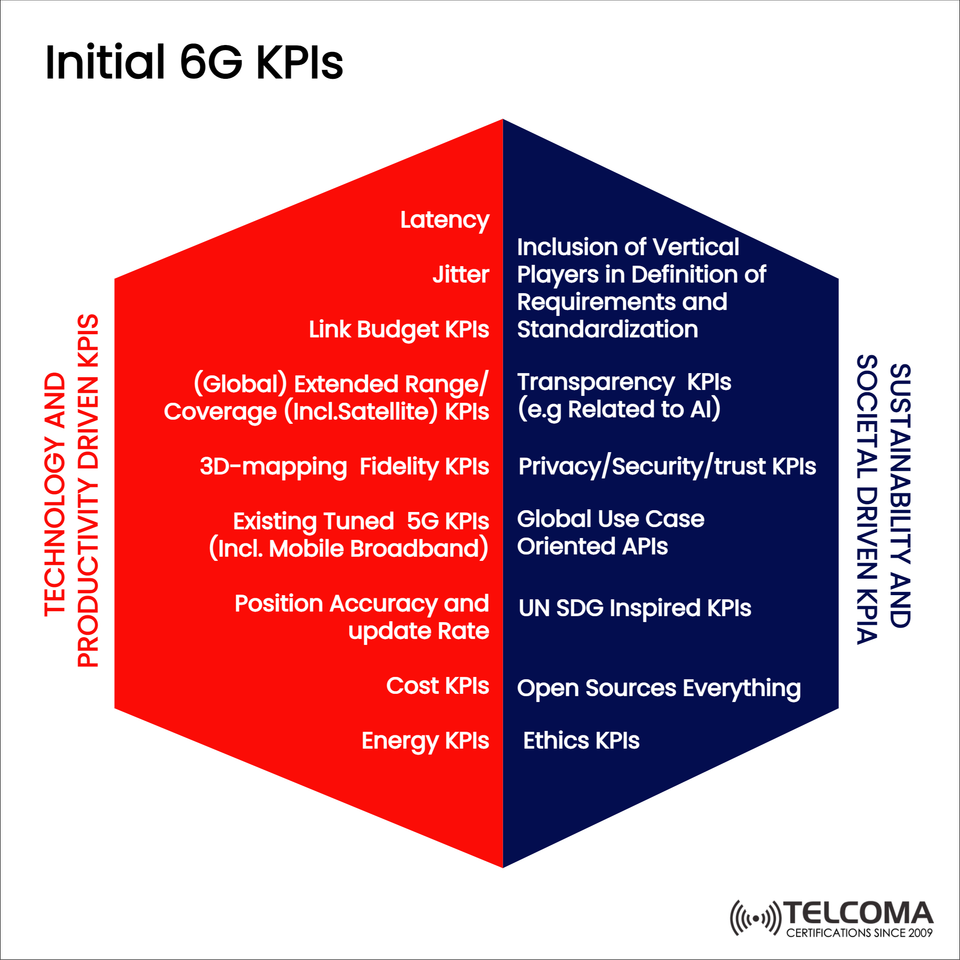
The image above shows two key areas of focus for 6G KPIs:
Tech and Productivity-Driven KPIs
Sustainability and Society-Focused KPIs
These together create a roadmap for a next-gen network that’s not just quicker and smarter but also responsible, secure, and inclusive.
Why 6G Calls for New KPIs
While 5G brought about significant advancements like network slicing, ultra-reliable low-latency communications (URLLC), and extensive IoT connectivity, its focus was mainly on technology.
In contrast, 6G is set to be a human-centered, sustainable, and intelligent network. It needs to:
Support AI-driven services.
Provide real-time, immersive experiences, like holographic communications.
Extend its reach globally, incorporating satellite integration.
Align with global sustainability goals (UN SDGs).
This means we need a whole new set of KPIs that not only gauge network performance but also consider trust, transparency, and societal value.
Tech and Productivity-Driven KPIs
These KPIs ensure that 6G can achieve unmatched performance, efficiency, and reliability.
- Latency and Jitter
Aim for sub-millisecond latency for critical applications like remote surgery and tactile internet.
Minimize jitter (the variation in latency) to ensure smooth, real-time communication.
- Link Budget KPIs
Focus on maintaining strong signal quality over longer distances and in challenging environments.
- Extended Range and Coverage (Satellite Included)
6G seeks to deliver global coverage by merging terrestrial and non-terrestrial networks (NTN), including satellites.
- 3D-Mapping Fidelity KPIs
Networks will support real-time 3D mapping, crucial for autonomous vehicles, drones, and extended reality (XR).
- Enhanced 5G KPIs (Mobile Broadband)
Building on enhanced mobile broadband (eMBB), ensuring better throughput and smarter use of the spectrum.
- Position Accuracy and Update Rate
Aiming for centimeter-level accuracy, essential for AR/VR, industrial automation, and smart transport.
- Cost KPIs
Ensuring affordable deployment and operations to make 6G accessible worldwide.
- Energy KPIs
Focusing on energy efficiency to help cut down the carbon footprint and support green ICT efforts.
Sustainability and Society-Driven KPIs
Beyond just performance, 6G is expected to bring social value and align with global ethics and sustainability standards.
- Inclusion of Vertical Players
Involving industries like healthcare, automotive, and manufacturing early in defining standards and requirements.
- Transparency KPIs (Related to AI)
Making sure AI models used in networks are explainable and transparent to avoid bias and ensure accountability.
- Privacy, Security, and Trust KPIs
Enhancing defenses against cybersecurity threats.
Fostering user trust through strong privacy protections.
- Global Use Case-Oriented APIs
Standardizing open APIs to enable smooth cross-industry adoption of 6G services.
- UN SDG Inspired KPIs
Making sure 6G supports the United Nations Sustainable Development Goals (SDGs), like climate action, education, and digital equality.
- Open Source Everything
Encouraging open-source innovation to speed up adoption, lower costs, and prevent vendor lock-in.
- Ethics KPIs
Adding ethical considerations into network design, AI use, and global deployment strategies.
Comparing 5G and Initial 6G KPIs
Dimension5G KPIs Initial 6G KPIsLatency~1 ms< 0.1 ms (sub-ms tactile internet)Coverage Primarily terrestrial Global with satellite integration Positioning Accuracy Meter-level Centimeter-level with high update rates Energy Efficiency Improved vs. 4GEnergy-positive, sustainability-focused AI Limited Transparent, ethical, AI-native Security Strong encryption Privacy, trust, and global resilience Use Case Alignment eMBB, URLLC, mMTC Global use cases aligned with SDGs
How These KPIs Influence 6G Applications
These KPIs are going to shape future 6G applications, like:
Immersive XR Experiences: With high-quality 3D mapping, ultra-low latency.
Autonomous Systems: Accurate positioning and global reach for drones and vehicles.
Smart Cities: Energy-efficient networks that align with sustainability goals.
Healthcare: Remote surgeries backed by transparent AI-driven decision-making.
Global Connectivity: Integrating satellites to ensure no area is left behind.
Challenges in Defining 6G KPIs
While these goals are ambitious, they also come with challenges:
Finding the balance between performance and energy efficiency.
Standardizing measures across different industries and nations.
Building trust in networks powered by AI.
Ensuring affordability globally to avoid widening the digital gap.
Looking Ahead: More Than Just Initial 6G KPIs
While the graphic shows some initial KPIs, researchers and industry groups like 3GPP and ITU are already thinking about additional metrics that could define 6G. Some of these are:
Carbon Neutrality KPIs → Evaluating networks based on their net-zero carbon footprint.
Resilience KPIs → Measuring how well networks can function during cyberattacks or natural disasters.
Interoperability KPIs → Making sure different types of networks (like satellite, Wi-Fi 7, and IoT) work together smoothly.
Human-Centric KPIs → Focusing on user satisfaction, fairness, and inclusivity—not just speed.
Bringing up these future-oriented points in your blog shows thought leadership and helps ensure your content remains relevant down the line.
Sample Internal Linking Strategy
If you’re crafting a series of telecom/6G articles, here’s a way to link them together:
From this blog: * Link “latency and jitter” → to a detailed article on sub-millisecond 6G latency. * Link “UN SDG Inspired KPIs” → to an article discussing 6G and Sustainability Goals. * Link “Extended Range with Satellite” → to an article about 6G NTN and Satellite Integration.
Doing this creates a content ecosystem where readers (and search engines) can easily navigate.
Wrapping Up
The Initial 6G KPIs signal the start of a new chapter in telecommunications. Unlike earlier generations, 6G is not just about getting faster speeds or lower latency—it’s about creating a network that’s intelligent, transparent, sustainable, and centered around people.
By concentrating on both tech-focused metrics (like latency, 3D mapping, and energy efficiency) and societal KPIs (such as transparency, ethics, and alignment with UN SDGs), 6G has the chance to reshape how telecommunications fit into our daily lives.
For telecom professionals, these KPIs offer guidance for research, deployment strategies, and cross-industry collaboration. For tech enthusiasts, they provide a sneak peek into how future networks will fuel AI, XR, global connectivity, and sustainable innovation.
6G isn’t just another network; it’s the groundwork for a connected, ethical, and inclusive digital future.