
Initial Access in 5G NSA Mode | Beam Sweeping, SS Blocks, and RACH Procedure
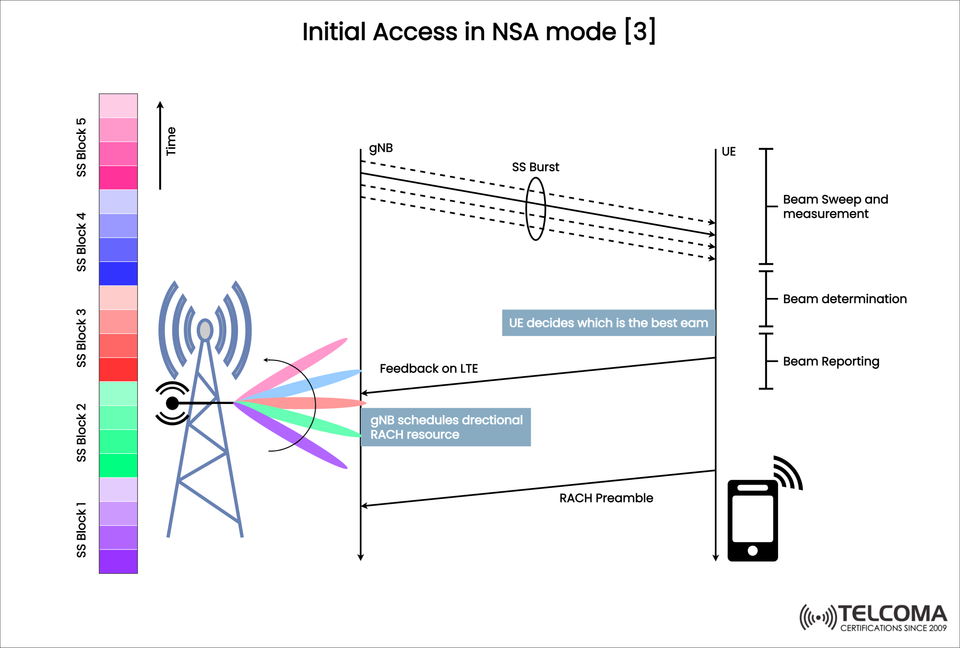

When a device (UE) connects for the first time to a 5G Non-Standalone (NSA) network, it needs to sync up, find the best beam, and complete access signaling. This whole process is called Initial Access. Unlike in Standalone (SA) mode, where the NR takes care of the entire connection, NSA depends on an LTE anchor for controlling the signaling, while NR boosts data capacity.
The image uploaded gives a helpful visual representation:
The gNB sends out SS Blocks for beam sweeping.
The UE measures these and picks the best beam.
Feedback is communicated through LTE.
The gNB then assigns a directional RACH resource to establish the connection.
This article dives deep into Initial Access in NSA mode, detailing beam sweeping, measuring, reporting, and the random access process.
What is NSA Mode in 5G?
Non-Standalone (NSA) mode is the first deployment model for 5G NR, built to utilize existing LTE infrastructure. In NSA:
LTE acts as the control plane anchor.
NR (gNB) provides the user plane data for speedy connectivity.
This dual connectivity model allows for quicker rollouts of 5G services by taking advantage of the well-established LTE ecosystem. So, initial access in NSA kicks off with NR synchronization, but it relies on LTE for signaling feedback.
SS Blocks and Beam Sweeping
At the heart of initial access is the SS (Synchronization Signal) block, which includes:
PSS (Primary Synchronization Signal): This sets the symbol timing and frequency.
SSS (Secondary Synchronization Signal): This gives the cell ID and frame timing.
PBCH (Physical Broadcast Channel): This carries system info.
Beam Sweeping
The gNB sends out multiple SS blocks across different beams in sequence.
Each beam points in a different direction, covering the whole cell.
The UE listens to these SS blocks, checking signal strength and quality.
This sweeping method makes sure that even if the UE is on the edge of the cell or in a tricky area for signals, it can still catch at least one reliable beam.
UE Measurement and Beam Determination
The UE performs:
Beam Measurement: It checks the received SS blocks for signal-to-noise ratio (SNR) or reference signal received power (RSRP).
Beam Determination: It chooses the best beam that has the highest link quality.
As illustrated in the image:
SS Block 1 through SS Block 5 get broadcasted one after the other.
The UE finds out which beam direction gives the strongest and most dependable connection.
This is particularly important for mmWave frequencies, where the coverage is limited and aligning beams is key.
Beam Reporting via LTE
Since NSA mode is based on dual connectivity, the UE reports its best beam choice through LTE signaling, not NR.
The UE sends feedback over the LTE anchor link.
This keeps NR from having to deal with complex initial access signaling all on its own.
LTE, known for its reliability and broad coverage, ensures smooth feedback.
This illustrates how LTE and NR work together effectively in NSA mode.
gNB Scheduling Directional RACH
Once the gNB gets the beam report, it:
Allocates a directional RACH (Random Access Channel) resource.
Makes sure the UE uses the chosen beam direction for its connection attempt.
The directional RACH resource minimizes collisions, ensuring that access requests align perfectly with the selected beam.
This is where NSA mode distinguishes itself from LTE-only access, as beam-specific RACH is something unique to NR's directional setup.
Random Access (RACH) Procedure in NSA
The RACH procedure wraps up the initial access. The UE sends a RACH Preamble aligned with the selected beam.
Steps include:
RACH Preamble Transmission: The UE sends it out using the beam-specific resource.
gNB Response: The gNB confirms and provides timing adjustments.
Message Exchange: The UE and gNB finish synchronization and initial setup.
By merging beam-specific access with LTE’s solid control signaling, NSA makes sure there’s a smooth transition into active 5G service.
Summary of Initial Access in NSA Mode
The figure captures the flow:
Step Process Technology Used
1 gNB transmits SS Blocks (Beam Sweep) 5G NR
2 UE measures beams and selects the best 5G NR
3 UE reports best beam LTE Anchor
4 gNB schedules directional RACH resource 5G NR
5 UE transmits RACH Preamble 5G NR
6 gNB completes initial access signaling LTE + NR
This blended approach takes advantage of both LTE and NR strengths.
Benefits of Initial Access in NSA Mode
Quick Deployment * Utilizes LTE control framework. * Speeds up the early rollout of 5G networks.
Reliable Beam Management * Beam sweeping secures precise beam alignment. * Directional RACH limits access collisions.
Better User Experience * UEs connect faster and more reliably. * LTE fallback guarantees stability even in weak NR coverage.
Spectrum Efficiency * Narrow beams cut down on interference. * Resources get allocated only where they’re needed.
Smooth Transition Path * Operators can move to 5G without jettisoning LTE resources. * It supports dual connectivity until full SA is ready.
Challenges in NSA Initial Access
Signaling Overhead: Extra coordination needed between LTE and NR.
Beam Sweeping Latency: Multiple beams can slow down discovery time.
Mobility Complexity: Handover needs to sync up across LTE and NR.
Hardware Requirements: UEs have to support both radio access technologies at the same time.
Even with these challenges, NSA serves as a practical bridge for widespread 5G adoption.
NSA vs SA: Initial Access Comparison
Feature NSA Mode SA Mode
Control Signaling Anchored on LTE Fully on NR
Deployment Speed Faster (reuses LTE) Slower (requires standalone infrastructure)
Beam Reporting Via LTE Via NR
Reliability Higher (LTE fallback) Dependent solely on NR
Long-Term Use Transitional Future standard
So, NSA is a transition phase, while SA is the ultimate goal for 5G networks.
Applications of NSA Initial Access
Enhanced Mobile Broadband (eMBB): Fast access to high speeds.
Fixed Wireless Access (FWA): Reliable setups using beam-specific connections.
Enterprise 5G: Seamless integration with existing LTE networks.
Vehicular Communications: Beam sweeping helps with mobility at high speeds.
Conclusion
Initial Access in NSA mode is fundamental for early 5G rollouts. By blending beam sweeping with SS blocks, beam reporting over LTE, and directional RACH scheduling, it allows UEs to establish connections quickly and reliably in NR.
For telecom professionals, grasping this process is vital, as it shows how 5G builds on LTE’s legacy while bringing in beam-centric access. While NSA is just a stepping stone to full SA, it's been crucial in speeding up 5G rollout and adoption globally.