
Inside the Core Architecture of Fixed Wireless Access (FWA): How Modern Broadband Works

Core Architecture of Fixed Wireless Access (FWA): The Backbone of Next-Gen Broadband
As the global appetite for high-speed internet grows, Fixed Wireless Access (FWA) is quickly becoming a key player in providing scalable broadband solutions. It utilizes wireless cellular networks—like 4G LTE and 5G NR—to deliver home and business broadband without the need for extensive fiber installation.
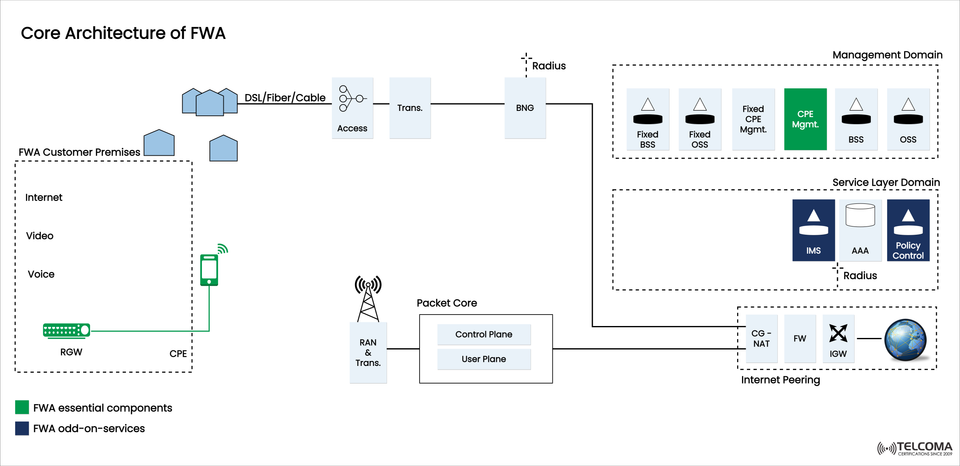
The diagram we’ve included, titled “Core Architecture of FWA”, gives a clear visual of how the FWA ecosystem works — spanning from customer premises to the internet peering gateway and integrating both fixed and mobile network elements into a unified broadband structure.
In this post, we’ll dissect each layer of the architecture, describe the main components, and demonstrate how telecom operators seamlessly provide Internet, video, and voice services through FWA.
What Is Fixed Wireless Access (FWA)?
Fixed Wireless Access (FWA) is a tech solution that delivers high-speed broadband to homes and businesses using wireless cellular connections, rather than relying on traditional copper or fiber.
Unlike mobile broadband, where users are constantly on the move, FWA connects fixed points — usually customer premises equipment (CPE) and base stations — ensuring a stable, consistent service.
Key Benefits of FWA
Quick deployment: No need for major fiber installations.
Cost-effective: Lower capital expenses compared to wired broadband.
Scalable: Easily upgraded with enhancements in 4G and 5G.
Expanded coverage: Perfect for rural areas and regions that are underserved.
Understanding the Core Architecture of FWA
The FWA architecture, illustrated in the accompanying image, comprises several interconnected domains that work together:
Customer Premises Domain
Access and Transport Network
Packet Core Network
Management Domain
Service Layer Domain
Internet Peering Domain
Let’s dig into each one.
FWA Customer Premises Domain
On the customer side, the Residential Gateway (RGW) and Customer Premises Equipment (CPE) are the primary points of connectivity.
Components:
RGW (Residential Gateway): This is the router in the user’s home connecting different devices (PCs, TVs, smartphones) to the broadband network.
CPE (Customer Premises Equipment): This device connects wirelessly to the base station, usually via 4G/5G radio signals.
Delivered Services:
Internet access: Broadband for browsing, streaming, and cloud apps.
Video services: IPTV or streaming options offered over broadband.
Voice services: VoIP or IMS-based telephony over fixed wireless connections.
Both RGW and CPE are marked as essential FWA components in the diagram (highlighted in green). They serve as the link between the user and the network core.
Access and Transport Network
The Access section of the architecture links the CPE to the Radio Access Network (RAN), and then to the transport and backhaul layers.
Key Components:
Access: Connects DSL, fiber, or cable to aggregation points.
Transmission (Trans.): Ensures high-speed backhaul connectivity between RAN sites and the core.
BNG (Broadband Network Gateway): This acts as the first IP anchor point, managing subscriber sessions and routing.
The BNG also connects with AAA (Authentication, Authorization, Accounting) systems through the RADIUS protocol, helping ensure secure user management and service authorization.
This part of the network is crucial for managing scalability and Quality of Service (QoS), which keeps track of bandwidth allocation and user sessions.
Packet Core: The Network Brain
The Packet Core is the heart of the mobile network, in charge of routing, policy control, and managing data sessions. It connects the radio side (RAN) with external IP networks and service platforms.
Core Components:
Control Plane: Manages session creation, user mobility, and authentication.
User Plane: Deals with actual user data forwarding (internet, video, voice packets).
Together, these planes ensure low latency, reliable sessions, and optimized data flow. In modern 5G FWA scenarios, this could be part of a cloud-native 5G core (5GC).
Management Domain
The Management Domain looks after network operation, maintenance, and service delivery. It integrates both Fixed Network and Mobile Network management systems.
Components:
Fixed BSS (Business Support System): Manages billing, CRM, and customer lifecycle.
Fixed OSS (Operations Support System): Handles network monitoring, configuration, and fault management.
Fixed CPE Management: Monitors user devices remotely (e.g., using TR-069 or TR-369 protocols).
CPE Management (Essential FWA Component): This is highlighted in green in the image, ensuring configuration, diagnostics, and firmware updates for CPEs.
BSS & OSS (Mobile side): These perform similar functions for the mobile infrastructure.
Function:
The Management Domain acts as the control hub, coordinating efforts between the access network, the packet core, and the service layer to ensure reliable performance and a good customer experience.
Service Layer Domain
The Service Layer Domain manages application-level services and add-ons that run on top of the network infrastructure.
Core Modules (Highlighted in Blue – FWA Add-on Services):
IMS (IP Multimedia Subsystem): Manages voice and video services over IP, like VoLTE and VoWiFi for FWA users.
AAA (Authentication, Authorization, Accounting): Validates users via RADIUS and tracks data for billing.
Policy Control: Allocates network resources based on service type, QoS, and subscriptions.
These components let operators offer varied services, enforce fair usage policies, and create customized service tiers for residential and business FWA subscribers.
Core Components:
CG-NAT (Carrier Grade Network Address Translation): Turns private IP addresses into public ones for better user access.
FW (Firewall): Protects user and network data from outside threats.
IGW (Internet Gateway): This is the final connection point to the global internet backbone.
This domain ensures secure, scalable, and compliant connections between the operator’s core and the global network.
FWA Essential Components vs. Add-On Services
Category Component Function Essential Components CPE, RGW, CPE Management Key devices enabling broadband delivery to users Add-On Services IMS, AAA, Policy Control Enhance service quality, security, and management
This layered strategy allows operators to quickly deploy FWA, and then add premium services as demand increases—without needing to redesign the whole architecture.
Security and Scalability in FWA Networks
Security is important at every level:
RADIUS and AAA provide user authentication.
Firewalls and CG-NAT keep network boundaries secure.
Policy Control upholds bandwidth fairness and service prioritization.
Scalability is achieved through cloud-native cores, SDN/NFV-based management, and virtualized network functions (VNFs) that allow for dynamic scaling based on demand.
Future of FWA: 5G Integration and Beyond
With 5G, FWA performance can now compete with fiber broadband:
Gigabit speeds via mmWave and mid-band spectrum.
Ultra-low latency for real-time apps.
Network slicing to deliver dedicated virtual broadband channels for businesses.
Integrating AI-driven OSS/BSS and Edge Computing will make FWA even more adaptable—optimizing user experience in real time based on location and traffic.
Conclusion
The Core Architecture of FWA brings together fixed and wireless networks into a flexible, efficient, and scalable system that can provide broadband, video, and voice services to various users.
By bridging the gap between fiber-speed and wireless mobility, FWA stands as a future-forward solution for universal broadband connectivity—especially in places where fiber deployment isn’t an option.
As 5G rolls out, FWA will be crucial for global digital inclusion, enabling telecom operators to connect every home, business, and community with cutting-edge internet access.