
Inside the Metaverse Architecture: Layers, Technologies, and Telecom Integration

Getting to Know the Metaverse Architecture: Crafting the Next Digital Universe
The Metaverse isn’t just a virtual space; it’s a complicated ecosystem where immersive technologies, telecom networks, and AI all come together to create shared digital experiences. It’s basically the internet evolving from a flat, two-dimensional platform into a three-dimensional, interconnected, real-time digital environment.
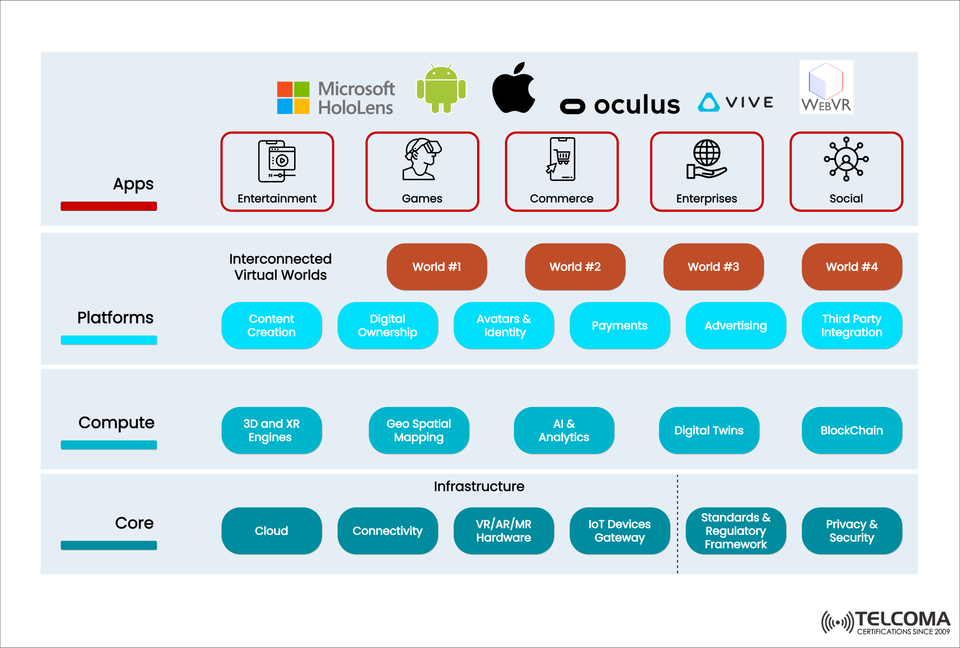
The diagram above outlines the architecture of the Metaverse in four main layers:
Core Infrastructure
Compute Layer
Platform Layer
Application Layer
Every layer plays an essential part in creating, linking, and maintaining virtual places where users can work, play, socialize, and do business.
Let’s dive into each layer so we can see how the Metaverse functions and how telecom professionals can support it.
The Core Infrastructure Layer: The Metaverse's Foundation
At the base of the Metaverse architecture is the Core Infrastructure, which gives the computing, connectivity, and security framework needed to build and maintain virtual experiences.
Main Components of the Core Layer:
Component Function Cloud Computing Provides scalable compute and storage for vast 3D environments. Connectivity Enables high-speed data transfers through 5G, fiber, and low-latency edge networks. VR/AR/MR Hardware Devices like Microsoft HoloLens, Oculus, and Vive create immersive experiences. IoT Devices Gateway Connects physical sensors and devices to their digital counterparts in virtual spaces. Standards & Regulatory Framework Ensures interoperability, digital identity management, and compliance with safety regulations. Privacy & Security Protects data ownership, identity, and transactions via encryption and blockchain.
This layer delivers the telecom and data infrastructure necessary to support immersive platforms. Without low-latency 5G, AI-driven edge computing, and secure cloud systems, the Metaverse won't operate smoothly.
The Compute Layer: Enabling Real-Time Interaction
The Compute Layer is responsible for data processing, rendering, and simulation, making virtual experiences feel real and seamless. It combines various advanced computing technologies to mimic reality and link physical and digital spaces.
Key Elements of the Compute Layer:
3D and XR Engines: These engines—like Unity, Unreal Engine, and CryEngine—create immersive 3D worlds and virtual spaces, rendering lighting, physics, and movement in real-time.
Geo-Spatial Mapping: Gives digital representations of real-world places to anchor AR experiences and provide accurate virtual overlays.
AI and Analytics: Artificial Intelligence enhances realism with smart NPCs (non-player characters), predictive behaviors, and dynamic customization.
Digital Twins: Virtual copies of physical systems (like factories, cities, or vehicles) used for simulation, monitoring, and optimization.
Blockchain: Ensures decentralized ownership, asset traceability, and transparent transactions across interconnected worlds.
This compute layer is the engine room of the Metaverse, enabling immersive experiences for millions of users at once.
The Platform Layer: The Metaverse Ecosystem
Above the compute layer sits the Platform Layer, which creates the ecosystem of interconnected virtual worlds. This is where digital experiences, content, and economies thrive.
Core Aspects of the Platform Layer:
Interconnected Virtual Worlds: These are various linked environments where users can move their avatars, digital assets, and identities effortlessly.
Content Creation Tools: Let users, developers, and businesses craft and customize immersive experiences—everything from 3D architecture to virtual events.
Digital Ownership: Fueled by blockchain and NFTs, ensuring users have verifiable control over their digital assets, avatars, and collectibles.
Avatars & Identity: AI-driven avatars serve as digital representations of users, preserving identity across different virtual realms.
Payments & Commerce: Digital wallets and cryptocurrencies enable easy transactions within and across virtual environments.
Advertising & Third-Party Integration: Open APIs and advertising platforms let brands create immersive marketing experiences in the Metaverse.
This layer is where telecom and technology firms come together to promote interoperability, allowing users seamless transitions between worlds without losing data or identity.
The Application Layer: Engaging with the Metaverse
At the top is the Application Layer, where users directly interact with the Metaverse through entertainment, commerce, social experiences, and enterprise applications.
Key Application Areas:
Application Description Entertainment Immersive concerts, interactive media, and virtual theme parks powered by VR headsets. Games Real-time multiplayer and cross-platform gaming experiences (like Fortnite, Roblox, and Meta Horizon).Commerce Virtual marketplaces where users can buy digital assets, NFTs, and even real-world goods. Enterprises Remote collaboration, immersive training, and digital twin simulations for various industries. Social Virtual networking platforms combining AR and VR to connect people globally.
Supported by Key Ecosystems:
Microsoft HoloLens – for industrial and enterprise AR applications
Android & Apple ecosystems – powering mobile AR and app-based virtual experiences
Oculus and Vive – for immersive gaming and exploration in the metaverse
WebVR – making the Metaverse accessible through browsers
These applications are built upon the Metaverse's layered structure, bolstered by strong telecom connectivity, AI engines, and secure digital ecosystems.
The Telecom Role in the Metaverse
Telecom networks form the backbone of the Metaverse. High-bandwidth, low-latency connections support smooth virtual interactions, real-time rendering, and immersive collaboration.
Telecom Contributions Include:
5G and 6G Networks: Providing gigabit speeds and sub-millisecond latency crucial for AR/VR experiences.
Edge Computing: Cuts down latency by handling data closer to the user, enabling real-time responsiveness.
IoT Integration: Connects physical devices and sensors to their digital counterparts in the virtual space.
Network Slicing: Dynamically allocates bandwidth for various Metaverse applications.
Telecom operators are shifting from just providing connectivity to becoming experience enablers, facilitating immersive content delivery and new digital business models.
Security, Privacy, and Standards
To build trust and ensure interoperability, the Metaverse must emphasize data privacy, user security, and compliance with regulations.
Key Security Considerations:
Decentralized Identity (DID): Safeguards user identity across different platforms.
Blockchain Security: Validates transactions and the ownership of digital assets.
End-to-End Encryption: Protects personal communications and payments.
Global Standards: Ensures consistency across hardware, software, and data exchange protocols.
Groups in telecom and technology, like 3GPP, IEEE, and ITU, are expected to play key roles in establishing communication and interoperability standards for the Metaverse.
Interoperability and Third-Party Integration
A thriving Metaverse relies on the smooth interaction of varied virtual environments. Open APIs, SDKs, and standardized frameworks help developers integrate third-party tools and services.
Cross-world identity and asset transfer
Shared AI frameworks for avatars and interactions
Unified payment gateways
Collaborative content creation tools
These integrations ensure users experience the Metaverse as a single, interconnected ecosystem—not a bunch of disconnected applications.
The Future of Metaverse Architecture
As the Metaverse evolves, new technologies will enhance each layer:
6G networks will provide ultra-reliable, high-speed connectivity.
Quantum computing will allow for advanced real-time simulations.
Federated AI will tailor experiences while maintaining data privacy.
Decentralized storage and compute will promote resilience and user ownership.
Telecom professionals will be at the leading edge of this transformation—creating adaptive, AI-driven networks that make the Metaverse a reality.
Conclusion: The Metaverse as New Digital Infrastructure
The Metaverse architecture represents the coming together of telecom networks, AI, cloud computing, and immersive technologies into a cohesive ecosystem.
From the core infrastructure (cloud and connectivity) to the application layer (entertainment, commerce, and social networks), every layer is crucial for enabling real-time, immersive, and interoperable digital experiences.
For telecom professionals, the Metaverse presents both challenges and opportunities—a new arena where connectivity meets creativity. As networks advance and become smarter, the Metaverse is set to shape the next generation of the digital economy, changing how we connect, communicate, and collaborate.