
Inside the NEC 5G Vertical Business Platform: Architecture, Ecosystem & Security Layers
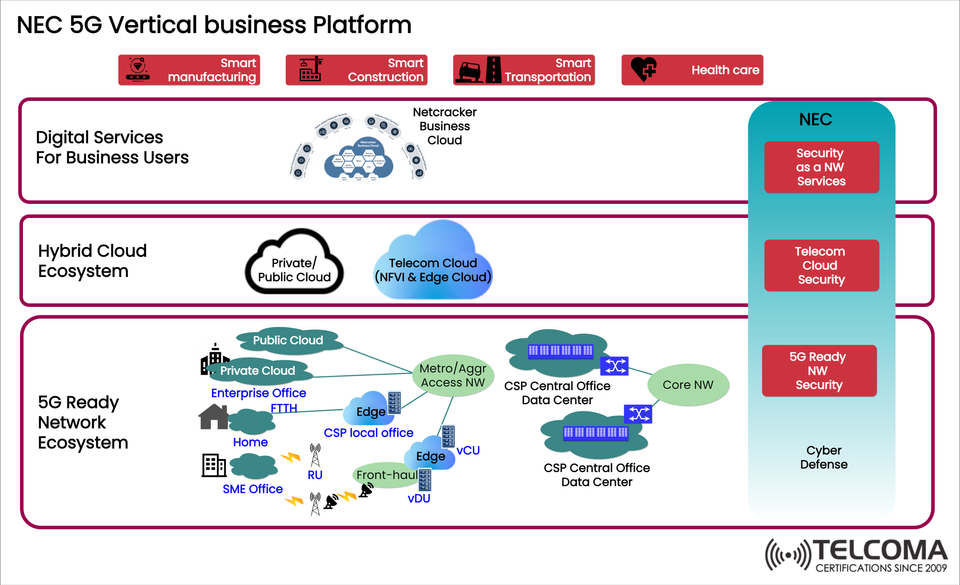

NEC 5G Vertical Business Platform: Enabling Digital Transformation Across Sectors
As industries look to rapidly transform and digitize, adopting 5G to drive automation, real-time connectivity, and digital transformation, it is increasingly important to offer enterprise customers a comprehensive, secure, scalable platform. The NEC 5G Vertical Business Platform encapsulates these parameters through a combination of 5G-ready network infrastructure, hybrid cloud environments, and vertical-specific digital services, with security embedded.
In this blog, we will deconstruct the architecture presented in the image above to assist telecom executives, network engineers, and tech strategists better understand the multi-layered ecosystem of the platform and how it facilitates use cases in smart manufacturing, smart construction, transport, and healthcare to name a few.
The NEC 5G platform is essentially made up of 3 layers that integrate with the 5G-ready network infrastructure for seamless engagement with enterprise use cases:
- Digital Services for Business Users
Target Verticals
Smart Manufacturing
Smart Construction
Smart Transportation
Healthcare
Solutions Layer
This layer, powered by the Netcracker Business Cloud, provides vertical specific applications and services as cloud-native orchestrated and automated environments.
- Hybrid Cloud Ecosystem
Cloud Components:
Private/Public Cloud
Telecom Cloud (NFVI and Edge Cloud)
Functions:
Provides dynamic resource scheduling
Supports latency-sensitive and bandwidth-heavy applications
Interoperability:
Links enterprise systems to telecom infrastructure
Provides independent and scalable hybrid integration
3. 5G-Ready Network Ecosystem
Infrastructure backbone that provides connectivity to homes, SMEs, enterprises, and CSPs (Communication Services Provider) networks.
Main Components:
RU (Radio Unit): Provides wireless access
vDU (Virtual Distributed Unit) / vCU (Virtual Centralized Unit): Cornerstone of Open RAN architectures
Edge: Local processing for low-latency use cases
CSP Central Office: Hosts virtualized network functions
Metro/Aggregation Network: Provides connectivity from edge to core
Core NW: Provides centralized control, routing, and analytics
Access Points:
SME/Home/Enterprise Office
FTTH (Fiber to the Home)
CSP Local Offices
NEC’s End-to-End Security Architecture
NEC not only includes network and cloud infrastructure but also embeds multiple layers of cybersecurity for protection of the platform and user data.
Security Layers:
Layer Functionality
Security as NW Services Network level security as a service
Telecom Cloud Security Provides protection to virtualized and cloud-based assets
5G Ready NW Security Addresses security of the RAN and core network
Cyber Defense Detects and mitigates advanced threats
Key Benefits for Telecom and Industry Stakeholders
- Vertical-Focused Design
Customizable to meet requirements of many industry use cases
Enable rapid deployment of sector specific services - Cloud-Native Architecture
Supports NFV (Network Function Virtualization) and MEC (Multi-access Edge Computing)
Scalable to meet enterprise and operator demands - End-to-End Security
Integrated cybersecurity approaches aligned to the 3GPP
Offers security across physical, virtual, and cloud - Flexibility and Performance
Dynamic scaling and orchestration
Supports ultra-reliable low-latency communication (URLLC)
Real World Use Cases for NEC’s 5G Platform
Vertical Use Case Example
Smart Manufacturing Robotics, production line monitoring in real time
Smart Construction Remote controlled equipment, safety analytics
Smart Transportation Fleet management, connected vehicle infrastructure
Healthcare Telemedicine, AI-assisted diagnosis
Conclusion:
Shaping Future Business with NEC’s 5G Business Platform
NEC 5G Vertical Business Platform is an robust, scalable and secure architecture that bridges the gap between network infrastructure, edge capabilities and real-world enterprise implementations. With the hybrid cloud, 5G-enabled network, and deep security stack, NEC's enterprise and telecom operator networks can unlock the full potential of 5G across an ever-growing range of verticals.
As industries develop into Industry 4.0 with smart connectivity, such an integrated
Alignment with Industry 4.0 in a 5G World
The NEC platform isn't just built for 5G; it's built for IT / OT convergence too; which is essential in many sectors that are part of a digital evolution toward greater industrial capability, also known as Industry 4.0.
Why is NEC's Platform Future-Ready?
Support for Open Standards: compliant with 3GPP, ETSI NFV, and Open RAN standards.
Service-Based Architecture (SBA): Ability to integrate services in a modular way.
Microservices and Containers: Facilitates high availability, portability, and rapid scaling.
API-first Ecosystem: Enables interoperability with third-party apps and platforms.
Compliance and Security
With the spotlight shining on mandates for data sovereignty, network security, and resilience, NEC's platform has compliance baked-in to every layer.
Examples of Security Certifications and Compliance Objectives:
ISO/IEC 27001 for information security
GDPR and frameworks for data protection laws
ZTNA (Zero Trust Network Access) requirements
Security Assurance specifically for 5G from GSMA and 3GPP
Future-Ready: Role for NEC in Adapting Telecom Network Architectures
As telecom networks become cloud-native and service-based platforms, the role of NEC and its vertical business architecture for 5G will become vital.
New capabilities to monitor:
AI / ML Orchestration
Create Self-Optimizing Networks (SON) based on data-driven intelligent analytics
Suggestions for telecommunications operators
For a successful implementation of NEC’s 5G business platform or similar architectures, the telecommunications operators should:
- Determine the readiness of their existing infrastructure for NFV, edge, and hybrid cloud.
- Develop personnel skills in orchestration, Kubernetes, and various cloud environments for AI/ML platforms.
- Launch industry vertical pilots (i.e. smart manufacturing or eHealth) and then scale up.
- Include compliance and security personnel early in the process, if the industry process involves personally identifiable information or critical infrastructure sectors.
Conclusion:
How NEC Serves as the Bridge to Digital Industry Innovation
The NEC 5G Vertical Business Platform is more than a telecommunications stack, it serves as a foundation for digital innovation for the smart industries. The modular architecture, cloud-native structure, and attention to security supports the telecommunications operators move to being digital enablers and not just connectivity providers.
From enterprise cloud, to edge technology, to cybersecurity and from advising on specific industry services, NEC provides a full solution to support businesses into a connected, intelligent, and automated future.