
Inside the O-RAN Architecture: Components, Interfaces, and Intelligent Control Explained

O-RAN Architecture Explained: Open, Intelligent, and Cloud-Native Networks
We're entering a new era with Radio Access Networks (RAN) — one that focuses on openness, intelligence, and cloud-native design. The O-RAN (Open Radio Access Network) architecture, backed by the O-RAN Alliance, is reshaping how mobile networks are constructed and administered. It's all about vendor interoperability, AI-driven control, and flexible deployments, pushing telecom far beyond the old-school monolithic systems.
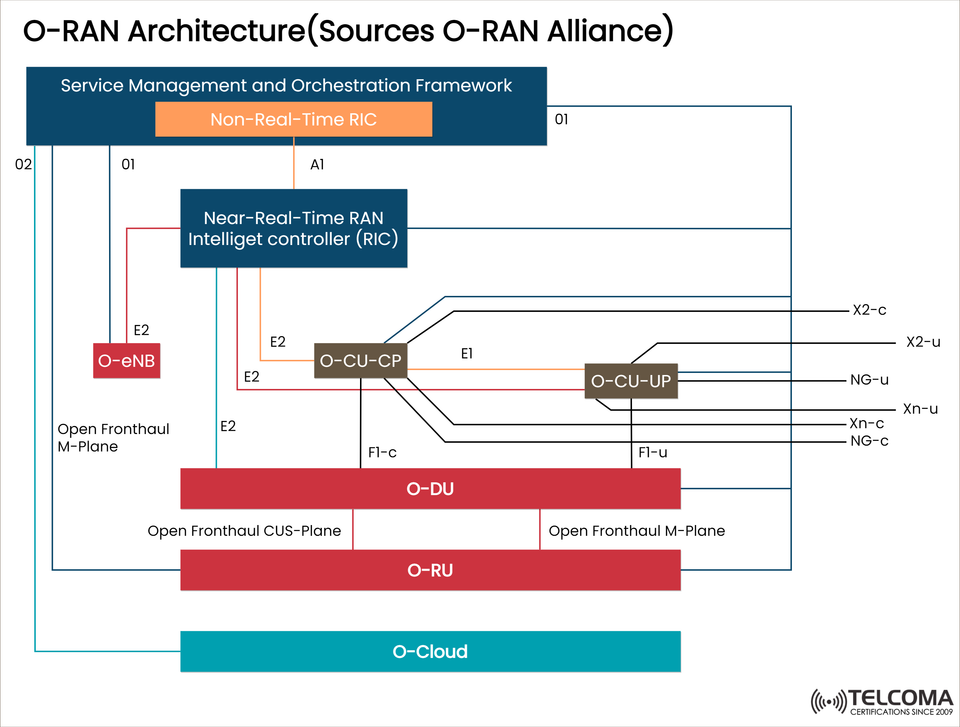
Take a look at the image — “O-RAN Architecture (Source: O-RAN Alliance)” — that really shows how O-RAN breaks traditional RAN down into modular pieces, linking them through standardized open interfaces like A1, E2, O1, and F1.
In this article, we’ll dive into all the parts of the O-RAN architecture, detailing how they work together and why they matter for the evolution of modern networks.
The Core Layers of O-RAN Architecture
Per the O-RAN Alliance reference model (check the image), the O-RAN architecture comprises several functional layers that interact using open interfaces. Let’s go through these layers from the top down.
a. Service Management and Orchestration (SMO) Framework
At the top, we have the Service Management and Orchestration Framework, which manages the entire O-RAN lifecycle — everything from configuration to monitoring and optimization.
Key Functions:
Network and service orchestration
Policy management and automation
Integration with OSS/BSS systems
Hosting of Non-Real-Time RIC
The SMO connects to network functions mainly through the O1 and O2 interfaces.
O1 Interface: Links the SMO with O-RAN network elements (like O-CU, O-DU, O-RU) for configuration, fault, and performance management.
O2 Interface: Connects the SMO with the O-Cloud infrastructure for orchestrating virtual resources.
b. Non-Real-Time RIC (Non-RT RIC)
The Non-Real-Time RAN Intelligent Controller lives within the SMO framework and operates on a timescale greater than one second.
Main Roles:
Generating policies and guidance for the Near-Real-Time RIC
Training and deploying AI/ML models
Optimizing networks based on historical and predictive data
It talks to the Near-RT RIC through the A1 interface, sharing policies, machine learning parameters, and performance goals.
c. Near-Real-Time RIC (Near-RT RIC)
Nestled in the RAN domain, the Near-Real-Time RIC works within a 10 milliseconds to 1 second timescale. This makes it perfect for dynamic, near-real-time network optimizations.
Key Functions:
Running control loops with xApps
Optimizing radio resources, mobility, and QoS
Communicating with O-CU and O-DU over the E2 interface
Receiving policy and guidance from the Non-RT RIC via A1
The Near-RT RIC brings intelligence closer to the edge, enabling speedy decisions for congestion management, load balancing, and interference reduction.
d. O-CU (Central Unit)
The O-RAN Central Unit (O-CU) consists of two logical parts as shown in the diagram:
O-CU-CP (Control Plane)
O-CU-UP (User Plane)
These two units interact using the E1 interface.
O-CU-CP handles signaling, mobility control, and session establishment, while O-CU-UP takes care of user data traffic and packet routing.
Other interfaces connected to the CU include:
F1-c and F1-u: Connect O-CU with O-DU (for control and user planes).
Xn-c / Xn-u: Allow communication between 5G gNBs.
NG-c / NG-u: Link to the 5G Core Network.
e. O-DU (Distributed Unit)
The O-DU performs real-time baseband processing and sits between the O-CU and O-RU.
Key Responsibilities:
Layer 1 (PHY) and lower-layer MAC tasks
Scheduling and HARQ management
Communicating with the O-RU via the Open Fronthaul Interface (Split 7.2).
The O-DU also communicates with the Near-RT RIC through the E2 interface for real-time, policy-driven optimization.
f. O-RU (Radio Unit)
The O-RU takes care of RF processing, which includes modulation, amplification, and sending out radio signals to user equipment.
It connects to:
O-DU via Open Fronthaul CUS-Plane (for Control, User, and Synchronization plane)
O-DU via Open Fronthaul M-Plane (for management and configuration)
This open fronthaul allows for multi-vendor compatibility between DUs and RUs, which is a big advantage of O-RAN.
g. O-Cloud
At the bottom of the architecture is the O-Cloud, a cloud platform hosting the virtualized O-RAN functions (O-CU, O-DU, and RICs).
O-Cloud Responsibilities:
Offers virtual compute, storage, and networking resources
Supports Kubernetes-based orchestration for network functions
Ensures scalability and flexibility for dynamic network needs
The O2 interface connects the O-Cloud with the SMO for resource orchestration and monitoring.
O-RAN Interfaces Overview
The O-RAN architecture relies on a set of standardized open interfaces that guarantee interoperability among different vendors and components.
Interface Function Connected ComponentsA1Policy exchange, AI/ML feedback Non-RT RIC ↔ Near-RT RICE2Control and optimization signaling Near-RT RIC ↔ O-DU/O-CUO1Network management and orchestration SMO ↔ O-RAN NodesO2Cloud resource management SMO ↔ O-CloudE1Control/User plane separation O-CU-CP ↔ O-CU-UPF1Interface between CU and DUO-CU ↔ O-DU Open Fronthaul (M/CUS Planes)RU-DU connectivity O-DU ↔ O-RU
These interfaces together create an open ecosystem that allows for flexibility, cost savings, and innovation in 5G networks.
Intelligence and Automation in O-RAN
O-RAN brings in two crucial components — Non-RT RIC and Near-RT RIC — to infuse intelligence and automation into the RAN environment.
Non-RT RIC Enables:
Long-term network policy management
Machine learning model training and deployment
Predictive analytics based on network KPIs
Near-RT RIC Enables:
Real-time policy enforcement via xApps
Balancing loads and tackling interference
Optimizing quality of experience (QoE)
Together, these RICs form a tiered AI control system that bridges automation and real-time decision-making in telecom networks.
Benefits of O-RAN Architecture
Multi-Vendor Interoperability: Lets operators mix and match components from various suppliers.
Cost Efficiency: Employs commercial off-the-shelf (COTS) hardware and cloud infrastructure.
Faster Innovation: Open standards fuel creativity from startups and smaller vendors.
AI-Driven Optimization: Smart RICs enhance network efficiency with adaptive control loops.
Scalability and Flexibility: Cloud-native design allows for dynamic scaling across the network.
Challenges in O-RAN Implementation
Even with these advantages, some challenges remain:
Integration Complexity: Navigating interoperability across multiple vendors.
Performance Overheads: Cloud virtualization might add latency.
Security Risks: Open interfaces can create more potential attack vectors.
Operational Readiness: New skills and DevOps capabilities are needed for operators.
Telecom companies need to tackle these hurdles with thorough testing, certification, and ongoing AI-based monitoring.
Conclusion
The O-RAN architecture represents a groundbreaking shift in telecom network design, embracing open interfaces, vendor diversity, and AI-driven intelligence. By separating hardware from software and integrating both real-time and non-real-time controllers, O-RAN enables operators to set up more flexible, cost-effective, and smart networks.
As 5G grows and 6G research pushes forward, O-RAN’s open and programmable framework will be fundamental for future network automation, slicing, and edge innovations. This isn’t just a tech upgrade — it’s the blueprint for the next generation of mobile connectivity.