
Inside the Wireless Tactile Internet: Architecture, Domains, and Real-Time Interaction Explained
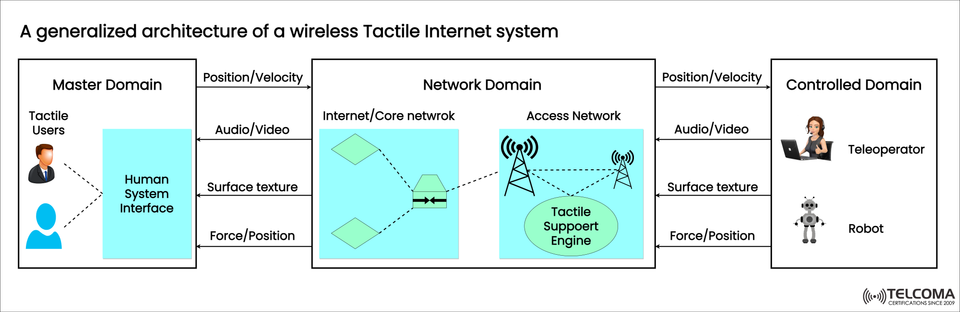

A Look at How a Wireless Tactile Internet System Works
The Tactile Internet is an exciting leap in communication tech—allowing for real-time interaction between people, machines, and objects with super-low latency and great reliability. It goes beyond just transferring data and video, enabling haptic communication, so users can actually feel and manipulate things from a distance.
In this blog, we’ll explore the generalized architecture of a wireless Tactile Internet system. We’ll break it down based on the diagram, looking at its components, how data flows through it, and the vital role of 5G networks in making tactile communication possible.
What’s the Tactile Internet?
The Tactile Internet is basically a next-level internet setup that allows for real-time sharing of touch, force, and motion data, in addition to regular audio and video streams.
It’s designed for situations where every millisecond counts—think remote surgeries, self-driving cars, industrial automation, and immersive virtual experiences.
Key Features of the Tactile Internet:
Ultra-low latency: Under 1 millisecond delay from start to finish
High reliability: Network uptime exceeding 99.999% (often called five nines)
High availability: Keeps you connected, even when you're on the move
Security and privacy: End-to-end encryption for crucial data
Scalability: Can handle millions of tactile devices all at once
Master Domain: Where Human Interaction Kicks Off
The Master Domain is the user’s side of the Tactile Internet system. This is where a Human System Interface (HSI) connects users—people using devices that can detect and replicate touch sensations—with the network.
Key Elements:
Tactile Users: These are the folks starting control commands (like surgeons, gamers, or engineers).
Human System Interface (HSI): This is the tech (hardware/software) that turns human sensations (like motion, touch, and force) into digital signals and back again.
Data Flow from Master Domain:
Position/Velocity: Info about how the user’s hand or device is moving.
Audio/Video: Standard multimedia data that supports situational awareness.
Surface Texture & Force/Position: Haptic data that allows users to “feel” objects from a distance.
Example Use Case:
Imagine a remote surgery. A surgeon’s movements in the Master Domain are captured through sensors and sent to a robot in the Controlled Domain. At the same time, the robot provides real-time feedback—letting the surgeon “feel” tissue resistance or pressure.
Network Domain: The Core of Real-Time Communication
The Network Domain is where the ultra-reliable and low-latency communication (URLLC) occurs. It serves as the link between the Master and Controlled domains.
This domain is split into two parts:
Core Network (Internet/Core Network)
Access Network
a. Internet/Core Network
The core network takes care of routing data packets efficiently. It guarantees reliable connections between remote endpoints, whether those are in the same city or halfway around the world.
Functions: * Data transport and routing * Managing network resources * Quality of Service (QoS) assurance * Reducing latency
b. Access Network and Tactile Support Engine (TSE)
The Access Network handles radio communication between users and the network, while the Tactile Support Engine (TSE) makes sure the network meets real-time tactile needs.
Controlled Domain: Where the Action Happens
The Controlled Domain is where tasks are actually carried out. It’s home to teleoperators and robots that act based on inputs from the Master Domain through the Network Domain.
Key Components:
Teleoperator: A human or system that oversees or partially controls the remote process.
Robot: Takes care of physical tasks based on commands received (think industrial arms, medical robots, or drones).
Feedback Loop in the Controlled Domain:
The robot mimics the operator’s movements, matching position and velocity exactly.
Sensors on the robot gather force, surface texture, and position feedback.
This feedback travels back through the network domain to the Human System Interface, completing the tactile feedback loop.
This closed-loop setup makes sure there’s synchronization between what the human wants and what the robot does—making remote operations feel quick and natural.
Data Exchange in a Tactile Internet System
To clarify the info flow, here’s a quick summary of the key data types exchanged among the domains:
Data Type | Direction | Purpose
Position/Velocity | Master → Controlled | Transmit user motion and control commands
Audio/Video | Both directions | Provide visual and auditory context
Surface Texture | Controlled → Master | Deliver tactile feedback sensations
Force/Position | Controlled → Master | Communicate resistance or object interaction feedback
The ongoing two-way data flow allows the system to create a real-time haptic experience, which is critical for tasks needing precision and immediacy.
Technologies Making the Tactile Internet Possible
The Tactile Internet relies on various technologies that work in concert within the 5G ecosystem and beyond:
5G URLLC (Ultra-Reliable Low-Latency Communication): Guarantees sub-millisecond latency.
Edge Computing (MEC): Processes data close to the user to lessen delay.
Artificial Intelligence (AI): Predicts user actions to help reduce latency.
Network Slicing: Dedicates resources specifically for tactile uses.
Advanced Haptic Devices: Turn electrical signals into realistic touch sensations.
These technologies collectively make the Tactile Internet not only viable but also reliable and scalable for industrial and medical uses.
What Can We Do with the Wireless Tactile Internet?
The Tactile Internet opens up a whole world of possibilities across different fields by merging real-time control with sensory feedback:
Remote Surgery: Surgeons can perform operations on patients from afar with tactile accuracy.
Autonomous Vehicles: Real-time communication between vehicles ensures safety on the roads.
Industrial Automation: Robots are guided by remote human operators to carry out tasks.
Education and Training: Virtual labs where students can physically interact with simulated objects.
Gaming and AR/VR: Immersive experiences that go beyond just sight and sound to include touch.
Conclusion
The wireless Tactile Internet system is changing how we interact with the digital world by bringing together ultra-low latency communication, real-time control, and haptic feedback.
Its three-domain architecture—Master, Network, and Controlled—creates a smooth feedback loop, allowing human actions and machine responses to happen almost instantly.
As 5G and edge computing continue to improve, the Tactile Internet is set to transform industries—from remote surgeries to autonomous robotics—bringing us closer to a genuinely real-time, touch-enabled internet.