
Inter-Band Carrier Aggregation in 5G and LTE: Boosting Speed and Spectrum Efficiency

Inter-Band Carrier Aggregation in 5G and LTE: A Closer Look at Improved Spectrum Use
As mobile networks progress, the need for quicker speeds, solid reliability, and smarter utilization of radio spectrum skyrockets. A major breakthrough that drives this advancement is Carrier Aggregation (CA) — an essential feature that debuted in LTE-Advanced (Release 10) and has seen enhancements in 5G NR (New Radio).
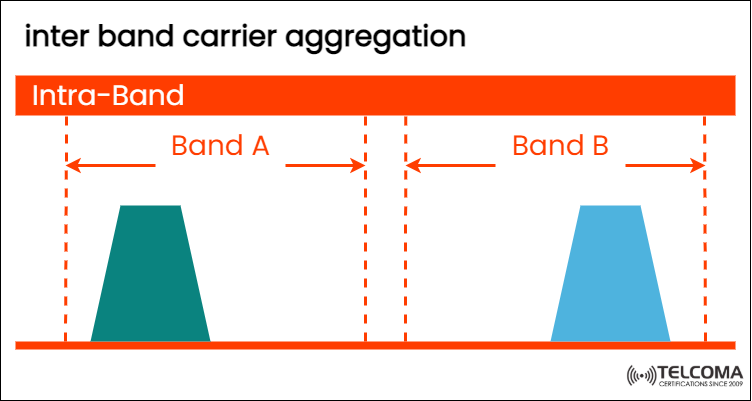
The image attached shows a particular type of carrier aggregation called Inter-Band Carrier Aggregation, which demonstrates how combining multiple frequency bands (Band A and Band B) boosts overall bandwidth and user data rates.
Let’s dive into what Inter-Band Carrier Aggregation is, how it functions, its benefits, and why it’s crucial for modern mobile communications.
What is Carrier Aggregation (CA)?
Carrier Aggregation is a method that allows mobile operators to merge several component carriers (CCs) to form a larger bandwidth.
Each component carrier operates as a distinct LTE or 5G carrier with its own frequency and bandwidth (like 5 MHz, 10 MHz, or 20 MHz). When these carriers are combined, it leads to higher data throughput and better use of the spectrum.
This technique was first standardized in 3GPP Release 10 (LTE-Advanced) and continues to be vital in achieving gigabit speeds in 5G NR.
Types of Carrier Aggregation
Carrier Aggregation can be set up in three primary ways, based on how the component carriers are arranged within the spectrum:
Type Description Example Intra-Band Contiguous CA Carriers are adjacent within the same frequency band. Band 3: 1800 MHz (10 MHz + 10 MHz)Intra-Band Non-Contiguous CA Carriers are in the same band but separated by a slight frequency gap. Band 40: 2300 MHz (20 MHz + 20 MHz with gap)Inter-Band Carrier Aggregation Carriers belong to entirely distinct frequency bands. Band 3 (1800 MHz) + Band 7 (2600 MHz)
The image you provided particularly highlights Inter-Band Carrier Aggregation, showing how Band A and Band B come together even though they sit in different frequency ranges.
Understanding Inter-Band Carrier Aggregation
In Inter-Band CA, the user device (UE) and the base station (either eNodeB or gNB) work simultaneously on multiple frequency bands that are not adjacent — they exist separately on the frequency chart.
As an example:
Band A might be in the 1800 MHz range.
Band B could be in the 2600 MHz range.
By combining these separate carriers, users benefit from increased overall bandwidth — resulting in faster data rates and more reliable service.
How Inter-Band Carrier Aggregation Works
The diagram illustrates two distinct bands:
Band A – One component carrier.
Band B – Another component carrier.
The process unfolds like this:
Component Carrier Assignment: The network identifies two different frequency bands (Band A and Band B) ready for aggregation.
Primary and Secondary Carriers:
One is labeled as the Primary Component Carrier (PCC) (e.g., Band A).
The other (Band B) serves as the Secondary Component Carrier (SCC).
Control and Signaling:
The PCC takes charge of all RRC (Radio Resource Control) and signaling duties.
The SCC mainly boosts user data throughput.
Aggregation at the UE Level:
The UE sends and receives data over both carriers at once.
These combined carriers present themselves as one large bandwidth channel to the higher protocol layers.
Scheduling and Coordination: The base station scheduler efficiently distributes user data packets across the two carriers to maximize efficiency and throughput.
Advantages of Inter-Band Carrier Aggregation
Inter-Band CA brings a slew of advantages, particularly in real-world 5G and LTE settings where spectrum is spread out across various bands:
- Higher Data Throughput
The clear perk — merging carriers boosts total bandwidth, which translates to better data rates for users.
For example, combining two 20 MHz bands yields a practical 40 MHz channel.
- Efficient Spectrum Utilization
Operators can leverage their existing fragmented spectrum assets.
There’s no need for contiguous spectrum, which can often be tough or pricey to secure.
- Enhanced User Experience
Consistent streaming, quicker downloads, and low-latency applications thrive on the boosted capacity.
Perfect for 4K video, AR/VR, and gaming.
- Load Balancing
Traffic can be dynamically spread across various bands based on congestion levels and signal quality.
- Coverage and Capacity Optimization
Lower bands (like 800 MHz, 900 MHz) provide better coverage.
Higher bands (like 2600 MHz, 3500 MHz) support higher capacity.
Inter-Band CA merges these benefits for reliable performance across various settings.
Example: LTE-A Inter-Band CA Combination
Here’s a hands-on example in LTE:
Band 3 (1800 MHz) — 20 MHz bandwidth
Band 7 (2600 MHz) — 20 MHz bandwidth
When combined:
Total bandwidth = 40 MHz
Peak theoretical downlink throughput (assuming 2x2 MIMO and 64QAM) ≈ 300 Mbps
5G NR takes this concept up a notch, allowing for up to 16 aggregated carriers (totaling up to 640 MHz) in advanced setups.
Challenges in Inter-Band Carrier Aggregation
Despite the advantages, rolling out Inter-Band CA isn’t without its hurdles:
- RF Hardware Complexity
UEs must handle multiple transceivers and filters to manage various frequency bands at once.
- Increased Power Consumption
Operating on several carriers can ramp up the energy use of devices.
- Synchronization and Scheduling
Precise coordination is essential between the PCC and SCC to ensure smooth data aggregation.
- Interference Management
Cross-band interference and intermodulation can lower performance if not properly addressed.
- Network Planning Complexity
Operators need to carefully design the frequency combinations and guarantee device compatibility.
Inter-Band CA in 5G NR
5G NR takes Inter-Band CA even further through:
Flexible Numerologies (different subcarrier spacing for each band).
Dynamic Spectrum Sharing (DSS) between LTE and 5G.
Carrier Aggregation across FR1 (Sub-6 GHz) and FR2 (mmWave) bands.
Example 5G Scenario:
Band n78 (3500 MHz) + Band n258 (26 GHz mmWave)
Offers very high peak data rates.
Utilizes lower frequency bands for coverage and higher ones for capacity.
This pairing ensures strong coverage even when high-frequency mmWave signals face loss or blockage.
Inter-Band vs Intra-Band CA: Quick Comparison
Feature Intra-Band CA Inter-Band CA Frequency Location Within the same band Across different bands Spectrum Contiguity Contiguous or Non-Contiguous Always Non-Contiguous Hardware Complexity Lower Higher Use Case Single-band setups Multi-band operations Flexibility Moderate Very High Example Band 3 (1800 MHz) + Band 3 (adjacent)Band 3 (1800 MHz) + Band 7 (2600 MHz)
Future Outlook: Moving Toward Multi-Gigabit Speeds
As 5G-Advanced (Release 18 and beyond) continues to evolve, Inter-Band Carrier Aggregation will be even more pivotal.
Multi-RAT aggregation (NR + LTE) enables a smooth transition and combined throughput.
AI-driven schedulers will fine-tune carrier selection in real-time based on traffic and radio conditions.
Massive MIMO and beamforming will further boost performance on aggregated carriers.
As networks gear up for 6G, this idea will transform into spectrum aggregation across varied access technologies (like cellular, satellite, and Wi-Fi).
Conclusion
Inter-Band Carrier Aggregation stands as a critical technique empowering both LTE and 5G networks to deliver faster data rates and efficient spectrum use, even when frequencies are scattered across various bands.
By smartly merging different carriers — like Band A and Band B — operators can elevate performance, improve user experience, and prepare their networks for the increasing demand for high-speed connectivity.
As mobile technologies move forward, Inter-Band CA will keep being a foundational element of multi-gigabit, low-latency, and high-capacity wireless communication.