
Interfaces Associated with CUPS in LTE: Control and User Plane Separation Explained

An Overview of CUPS in LTE Networks
As mobile networks transition to 5G and cloud-native architectures, the importance of scalability and flexibility can't be overstated. In LTE networks, the Control and User Plane Separation (CUPS) framework allows operators to scale the control plane (which handles signaling functions) and the user plane (responsible for data forwarding) independently.
CUPS boosts efficiency, cuts down latency, and enables deployment closer to the edge, enhancing performance for applications like IoT, AR/VR, and those crucial communications we can’t afford to mess up.
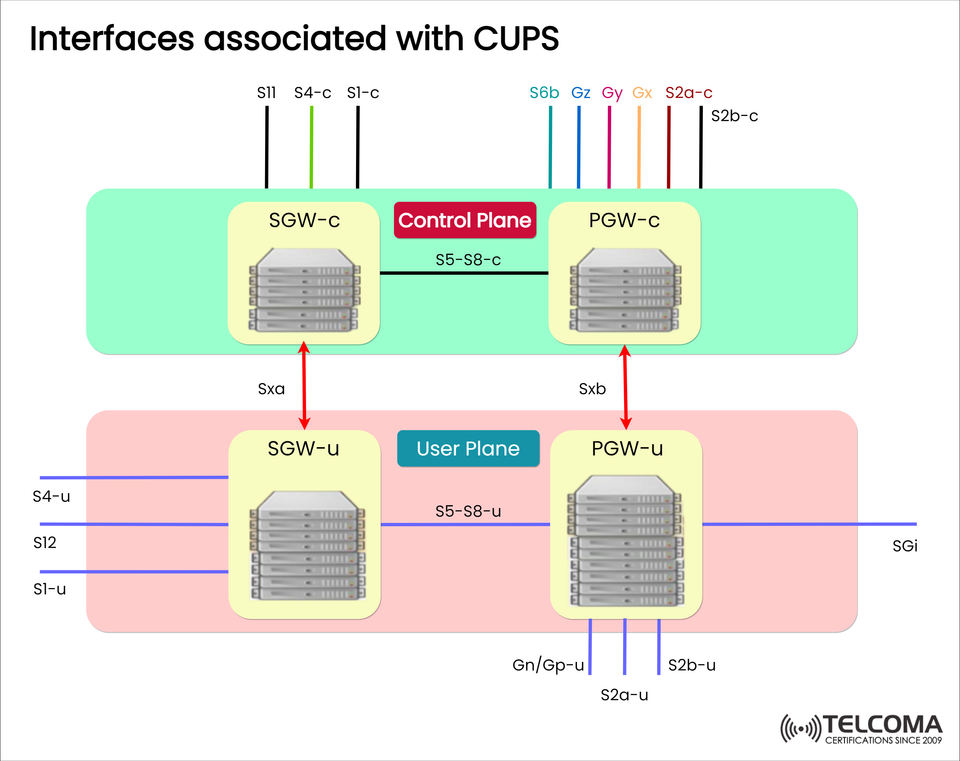
The diagram uploaded illustrates the key interfaces tied to CUPS, showing how the Serving Gateway (SGW) and the Packet Data Network Gateway (PGW) split into control-plane (SGW-C, PGW-C) and user-plane (SGW-U, PGW-U) components.
Control Plane vs. User Plane in CUPS
Control Plane (CP): This handles signaling, bearer management, policy control, and mobility management. In the diagram, you’ll see SGW-C and PGW-C as the control-plane entities.
User Plane (UP): This one takes care of forwarding user data packets. SGW-U and PGW-U are dedicated to the user plane.
The separation here lets operators deploy UPFs (User Plane Functions) nearer to the end users (hello, edge computing!), while the CP can stay centralized.
Interfaces in the Control Plane (CUPS)
These control-plane interfaces manage signaling and policy interactions. Here are the main ones:
S11 – Links MME to SGW-C for session management.
S4-c – Handles control signaling between SGSN and SGW-C.
S1-c – Connects eNodeB to MME for control signaling related to connections.
S5-S8-c – The control interface between SGW-C and PGW-C, depending on whether we’re talking roaming or local breakout.
S6b, Gz, Gy, Gx – Connect PGW-C with external policy and charging functions (like PCRF, OCS, and billing systems).
S2a-c & S2b-c – Control interfaces for trusted and untrusted non-3GPP access networks (think Wi-Fi).
Sxa (SGW-C ↔ SGW-U) – This key CUPS interface helps SGW-C control SGW-U.
Sxb (PGW-C ↔ PGW-U) – Here’s where PGW-C takes charge of PGW-U.
Interfaces in the User Plane (CUPS)
User-plane interfaces are all about handling actual data transport between the UE and external packet data networks.
S1-u – Connects eNodeB to SGW-U to carry user data.
S4-u – Between SGSN and SGW-U (for interworking with 2G/3G).
S12 – Connects RNC to SGW-U for 3G integration.
S5-S8-u – Between SGW-U and PGW-U, managing user-plane traffic.
S2a-u & S2b-u – User-plane connectivity for trusted/untrusted non-3GPP access.
Gn/Gp-u – Legacy interfaces linking PGW-U with GGSN for 2G/3G interoperability.
SGi – This connects PGW-U to external data networks (such as the internet, IMS, and enterprise networks).
Summary of Interfaces
Here's a breakdown of the interfaces in CUPS:
Interface | Plane | Function
S11 | Control Plane | Between MME and SGW-C for bearer/session management
S1-c | Control Plane | eNodeB ↔ MME (signaling)
S4-c | Control Plane | SGSN ↔ SGW-C (legacy support)
S5-S8-c | Control Plane | SGW-C ↔ PGW-C (session control)
Sxa | Control Plane | SGW-C ↔ SGW-U (CUPS-specific)
Sxb | Control Plane | PGW-C ↔ PGW-U (CUPS-specific)
Gx/Gy/Gz/S6b | Control Plane | PGW-C ↔ PCRF, billing, and policy servers
S1-u | User Plane | eNodeB ↔ SGW-U (data forwarding)
S4-u | User Plane | SGSN ↔ SGW-U (legacy interworking)
S12 | User Plane | RNC ↔ SGW-U (3G integration)
S5-S8-u | User Plane | SGW-U ↔ PGW-U (user-plane traffic)
Gn/Gp-u | User Plane | PGW-U ↔ GGSN (2G/3G backward compatibility)
SGi | User Plane | PGW-U ↔ external packet data networks
S2a-u/S2b-u | User Plane | Non-3GPP access (trusted/untrusted Wi-Fi)
Advantages of CUPS with These Interfaces
Scalability – Both control and user planes can grow independently based on signaling or data traffic needs.
Low Latency – User-plane functions (SGW-U, PGW-U) can be set up closer to end users, helping to cut latency.
Edge Computing Enablement – This supports MEC (Multi-access Edge Computing) scenarios.
Operational Efficiency – Offers flexible deployment models for centralized and distributed networks.
Future-Proofing – Sets up LTE EPC for compatibility with 5G Core’s SBA (Service-Based Architecture).
Real-World Use Cases of CUPS
5G Migration – CUPS sets the stage for a smoother transition of EPC networks to the 5G Core.
IoT Deployments – In the face of massive IoT traffic, scaling the UP ensures resources are used efficiently.
Enterprise Services – Having dedicated UPFs nearer to enterprises guarantees secure and low-latency access.
Video Streaming & Gaming – Lower latency leads to a better user experience, especially for bandwidth-heavy applications.
Final Thoughts
The interfaces tied to CUPS really play a key role in how control and user planes communicate in LTE EPC networks.
Thanks to CUPS, mobile operators can:
Centralize control-plane functions for managing policies and mobility.
Position user-plane functions closer to users at the edge to minimize latency for applications.
Achieve scalable and flexible deployments in line with the design principles of 5G Core.
As the telecom sector shifts towards cloud-native and service-based architectures, it's super important for network architects, engineers, and other professionals to truly grasp CUPS interfaces. This knowledge is crucial for creating mobile networks that are ready for the future, efficient, and dependable.
Conclusion
The interfaces tied to CUPS detail how control-plane and user-plane entities communicate within LTE EPC networks. By separating SGW/PGW control functions (SGW-C, PGW-C) from user-plane functions (SGW-U, PGW-U), operators gain flexibility, scalability, and are well-prepared for future 5G deployments.
CUPS helps networks tackle growing data demands while keeping signaling and policy control efficient. For those working in telecom, getting a grip on these interfaces is key to crafting cloud-native, scalable, and low-latency networks that can handle the challenges of 5G and what’s next.