
Intra-Band Contiguous Carrier Aggregation in LTE and 5G Explained

Intra-Band Contiguous Carrier Aggregation in LTE and 5G: Making Spectrum Use Easier
With the constant push for faster data speeds, better network efficiency, and an overall enhanced user experience, mobile communication systems are evolving beyond traditional spectrum usage. One of the key features driving this change is Carrier Aggregation (CA), which was first introduced in 3GPP Release 10 (LTE-Advanced) and has been expanded further in 5G New Radio (NR).
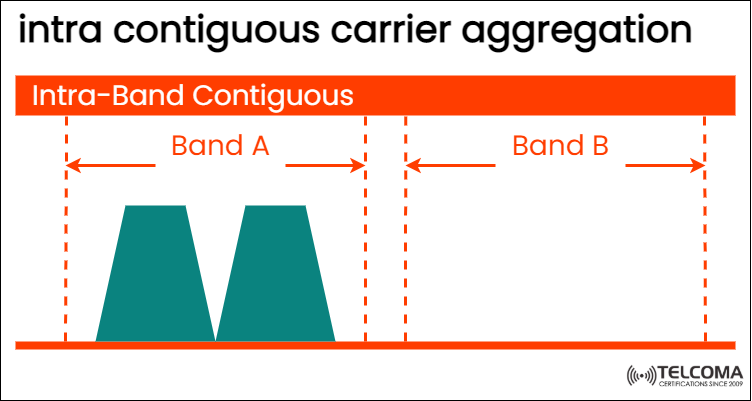
When it comes to different types of Carrier Aggregation, the Intra-Band Contiguous setup — as shown in the image attached — is the easiest and most commonly used. This method combines adjacent frequency blocks within the same band, allowing networks to achieve higher data rates with minimal hardware complexity.
Now, let’s dive into the technical fundamentals, how it works, its advantages, and its significance in the current 4G and 5G networks.
What is Carrier Aggregation (CA)?
Before jumping into intra-band contiguous CA specifically, it’s helpful to grasp the overall concept of carrier aggregation.
Carrier Aggregation lets mobile networks combine multiple component carriers (CCs) to create a single, wider channel, leading to quicker data rates and better use of the spectrum.
Each Component Carrier (CC) can have a bandwidth of up to 20 MHz in LTE (and can reach up to 100 MHz in 5G NR).
When carriers are aggregated, the total effective bandwidth can hit 100 MHz in LTE-Advanced and up to 640 MHz in 5G NR.
Carrier aggregation is categorized based on the arrangement of these component carriers within or between frequency bands.
Types of Carrier Aggregation
Carrier aggregation can be divided into three main types:
Type Description Example Intra-Band Contiguous Carriers are right next to each other within the same frequency band. Band 3: 1800 MHz (10 MHz + 10 MHz contiguous)Intra-Band Non-Contiguous Carriers are in the same band but separated by some frequency space. Band 40: 2300 MHz (20 MHz + 20 MHz with gap)Inter-Band Aggregation Carriers belong to different frequency bands. Band 3 (1800 MHz) + Band 7 (2600 MHz)
The image uploaded visually illustrates the Intra-Band Contiguous setup, where Band A merges two adjacent carriers, creating a broader effective bandwidth.
What is Intra-Band Contiguous Carrier Aggregation?
Intra-Band Contiguous Carrier Aggregation happens when two or more component carriers are placed directly next to each other within the same frequency band (without any gaps in between).
For instance:
Band A (1800 MHz) can include two adjacent carriers: 10 MHz + 10 MHz.
When these are aggregated, the user equipment (UE) sees it as a single 20 MHz channel.
This type of setup is technically and operationally the simplest form of carrier aggregation because it involves:
A single frequency band.
Side-by-side carriers.
A unified RF front-end and local oscillator.
How Intra-Band Contiguous CA Works
The way intra-band contiguous carrier aggregation works involves coordination between the base station (e Node B or gNB) and the user equipment (UE) to create a single communication channel.
Step-by-Step Process:
Identifying Component Carriers: The base station finds adjacent carriers in the same frequency band that can be aggregated.
Defining Primary and Secondary Carriers:
One carrier is set as the Primary Component Carrier (PCC), which handles control signaling and scheduling.
The other carrier(s) serve as Secondary Component Carriers (SCCs), mainly for user data.
Setting Up Aggregation: The base station communicates the aggregation setup to the UE through RRC signaling (Radio Resource Control).
Operating Combined Bandwidth: The UE treats these adjacent carriers as a single large bandwidth, allowing for simultaneous data transmission and reception across both carriers.
Scheduling and Allocating Data: The e Node B/gNB's scheduler dynamically allocates user data packets across the aggregated carriers to optimize efficiency and throughput.
Image Explanation
The uploaded image demonstrates the concept well:
The two teal-colored blocks represent adjacent carriers within Band A.
The dotted red lines mark the frequency boundaries.
Notice there’s no frequency gap between the two carriers.
Band B is separate and not part of this aggregation.
This picture emphasizes that the aggregation is within a single band (intra-band) and contiguous, making it easy to implement.
Advantages of Intra-Band Contiguous Carrier Aggregation
Intra-Band Contiguous CA comes with a mix of technical and operational benefits, especially during the early and mid-stage deployments of LTE-Advanced and 5G.
- Simplified Hardware Design
Since the carriers are contiguous and within one band, the RF hardware design for the UE is more straightforward.
It only requires one local oscillator and RF chain.
- Efficient Spectrum Usage
Lets operators combine fragmented adjacent spectrum blocks within the same band.
This maximizes the use of licensed spectrum resources.
- Lower Signaling Overhead
Makes control signaling simpler than in inter-band aggregation.
It’s easier for the UE to handle synchronization and channel estimation.
- Enhanced Data Rates
The total throughput goes up directly with the aggregated bandwidth.
For example: Combining two 10 MHz carriers can double the potential data rate compared to just one carrier.
- Cost-Effective Deployment
Requires only minimal hardware and software adjustments on both the UE and network sides.
This makes it a great option for operators looking to optimize their fragmented spectrum allocations.
Real-World Example: LTE Band 3 (1800 MHz)
Let’s take a look at a practical example within LTE-Advanced:
Band 3 (1800 MHz) supports multiple 10 MHz carriers.
An operator can aggregate two adjacent 10 MHz carriers, resulting in a total of 20 MHz bandwidth.
With 2x2 MIMO and 64QAM, you could hit peak theoretical downlink speeds around 150 Mbps.
Going for 4x4 MIMO could push that throughput over 300 Mbps.
This shows how even basic intra-band contiguous CA can greatly enhance the user experience.
Intra-Band Contiguous CA in 5G NR
While LTE was the first to introduce CA, 5G NR builds on that:
It can support up to 16 component carriers with different subcarrier spacings (ranging from 15 kHz to 120 kHz).
Allows for dynamic spectrum aggregation across TDD and FDD modes.
Keeps the intra-band contiguous aggregation for sub-6 GHz (FR1) setups because it’s simple and efficient.
5G Example:
The n78 (3500 MHz) band is capable of aggregating multiple adjacent 100 MHz channels.
This offers ultra-high throughput with support for massive MIMO and beamforming.
Challenges and Limitations
Even though intra-band contiguous CA is the simplest version, it has its limitations:
- Spectrum Availability
It needs continuous frequency blocks within the same band — which isn't always possible due to spectrum fragmentation.
- Limited Capacity Gain
Compared to inter-band CA, the total bandwidth gain can be less since all carriers come from one band.
- Bandwidth Cap
LTE limits each component carrier to 20 MHz, so even when aggregated, contiguous carriers can’t exceed certain limits.
Even with these challenges, intra-band contiguous CA remains crucial in LTE and 5G for its reliability and simplicity.
Comparison with Other CA Types
Feature Intra-Band Contiguous Intra-Band Non-Contiguous Inter-Band Aggregation Frequency Gap None Present Between bands Hardware Complexity Low Medium High Spectrum Flexibility Limited Moderate Very High Use Case Simple deployments Fragmented bands Multi-band spectrum use Example Band 3: 10+10 MHz Band 40: 20+20 MHz Band 3 + Band 7
Why Intra-Band Contiguous CA is Important Today
Operators prefer this type of CA for quick deployment and low costs.
Device manufacturers can easily accommodate it without needing major redesigns.
End users benefit from faster speeds and smoother performance, even without complex aggregation.
As 5G networks progress toward 5G-Advanced (Release 18 and beyond), intra-band contiguous CA remains a critical element for initial aggregation layers, especially in mid-band spectrum deployments (3.5 GHz and 6 GHz).
Final Thoughts
Intra-Band Contiguous Carrier Aggregation is not only the simplest but also one of the most effective methods for spectrum aggregation in LTE and 5G. By merging adjacent carriers within the same band, operators can increase data rates, boost spectrum efficiency, and improve network performance — all while keeping things less complicated and cost-effective.
In a landscape where spectrum is so valuable, this method helps mobile networks maximize every megahertz, ensuring swift connectivity and better broadband experiences for countless users.