
ISAC Use Cases and Performance Requirements in 6G Networks: High Accuracy Localization, Sensing, and Mapping
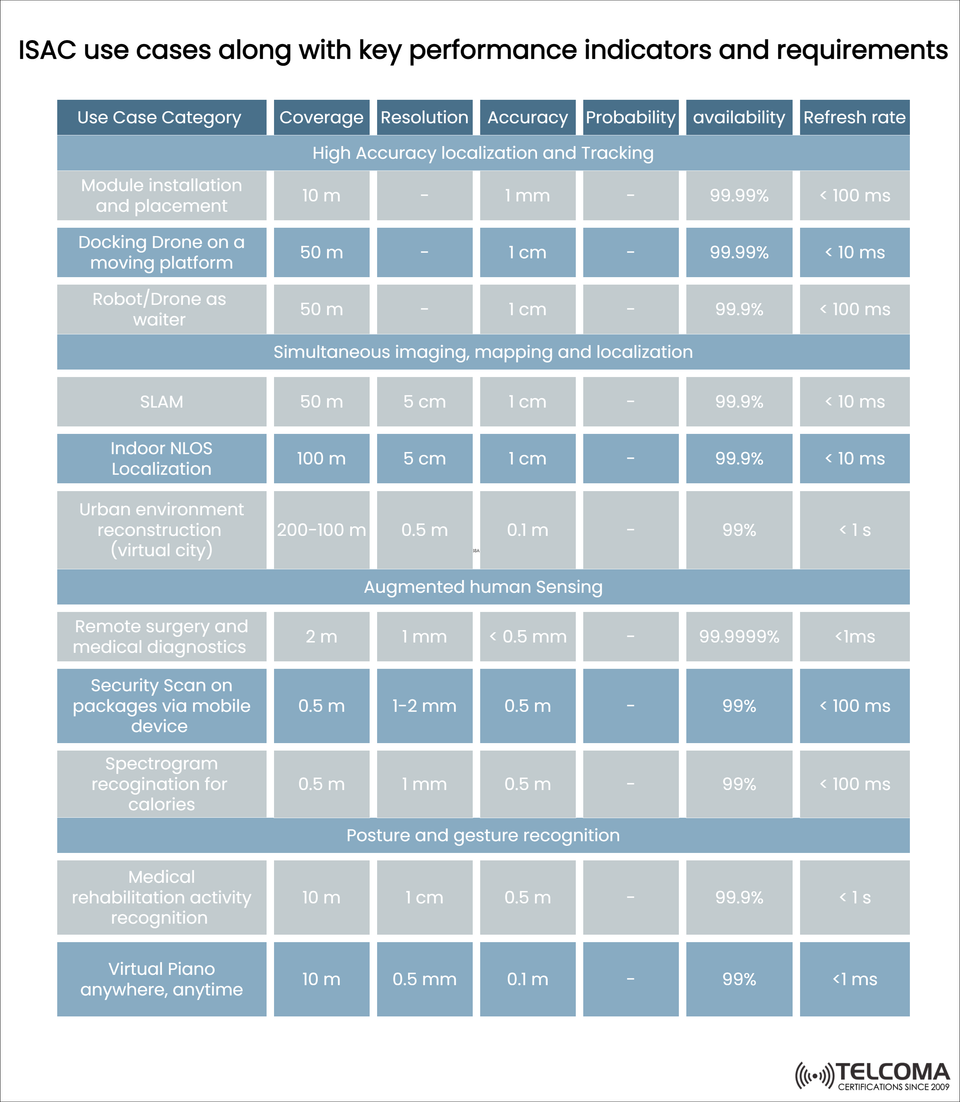

ISAC Use Cases and Key Performance Indicators in 6G Networks
As we advance towards 6G wireless systems, one of the most groundbreaking technologies on the horizon is ISAC — Integrated Sensing and Communication. This idea combines two areas that have typically been kept separate: communication and environmental sensing.
In the image, you'll find a detailed table that lays out the ISAC use cases along with key performance indicators (KPIs) like coverage, resolution, accuracy, probability, availability, and refresh rate. These metrics will shape how 6G systems can achieve ultra-precise localization, human sensing, gesture recognition, and more.
What is ISAC (Integrated Sensing and Communication)?
Integrated Sensing and Communication (ISAC) refers to a wireless system design that integrates sensing and communication, making use of the same infrastructure, spectrum, and hardware.
In the past, communication networks (like LTE or 5G) were all about data transmission, while sensing systems (basically radar or LiDAR) worked independently. ISAC connects these elements by allowing wireless signals to handle both communication and environmental perception tasks.
Key Goals of ISAC:
Achieve centimeter-level localization and tracking accuracy.
Enable real-time sensing for smart environments and robots.
Cut down on hardware redundancy by combining radio and radar systems.
Facilitate AI-driven network adaptability in 6G.
ISAC Use Case Categories
The table in the image breaks down ISAC applications into four main areas, each with its own performance needs:
High Accuracy Localization and Tracking
Simultaneous Imaging, Mapping, and Localization (SLAM)
Augmented Human Sensing
Posture and Gesture Recognition
Let’s dive deeper into each category and the KPIs that come along with them.
High Accuracy Localization and Tracking
In this area, ISAC provides accuracy from centimeter to millimeter levels, which is perfect for automation and robotics.
Use Case Coverage Accuracy Availability Refresh Rate Module installation & placement10 m1 mm99.99%< 100 ms Docking drone on a moving platform50 m1 cm99.99%< 10 ms Robot/Drone as waiter50 m1 cm99.9%< 100 ms
Key Insights:
ISAC allows mapping even in Non-Line-of-Sight (NLOS) conditions.
SLAM is fundamental for autonomous vehicles, AR/VR, and robotics.
Refresh rates under 10 ms mean real-time spatial updates.
Example Applications:
Navigating inside smart factories.
Mapping cities for digital twins and metaverse applications.
Live AR visualizations in urban settings.
Augmented Human Sensing
ISAC also facilitates biometric sensing, medical diagnostics, and security applications through radio signal-based imaging and recognition.
Use Case Coverage Resolution Accuracy Availability Refresh Rate Remote surgery & medical diagnostics2 m1 mm< 0.5 mm99.9999%< 1 ms Security scan on packages0.5 m1–2 mm0.5 m99%< 100 ms Spectrogram recognition for calories0.5 m1 mm0.5 m99%< 100 ms
Key Insights:
Medical diagnostics call for sub-millimeter accuracy and ultra-reliable low-latency communication (URLLC).
The <1 ms refresh rate is crucial for real-time control in remote surgery or haptic feedback systems.
ISAC converts radio waves into sensing tools, capable of identifying different objects, materials, and even biological parameters.
Example Applications:
Conducting real-time remote medical procedures.
Smart security systems that use RF imaging for scanning.
Non-invasive health monitoring through radio frequency sensing.
Posture and Gesture Recognition
This area showcases ISAC’s potential in human-computer interaction and rehabilitation systems.
Use Case Coverage Resolution Accuracy Availability Refresh Rate Medical rehabilitation activity recognition10 m1 cm0.5 m99.9%< 1 s Virtual piano anywhere, anytime10 m0.5 mm0.1 m99%< 1 ms
Key Insights:
Detecting gestures needs fine spatial resolution to accurately interpret movements.
Low latency (<1 ms) is great for providing immediate feedback in immersive settings.
Ideal for AI-assisted physical therapy or gesture-controlled virtual instruments.
Example Applications:
Smart rehabilitation exercises using data on body movements.
Gesture-based gaming and musical performances in AR settings.
Contactless control for industrial tasks.
Key Performance Metrics Explained
Every ISAC use case relies on specific performance metrics:
Metric Meaning Typical Range Importance Coverage Operational sensing/communication range0.5 m – 200 m Defines the area of application (medical, urban, industrial).Resolution Smallest measurable change in distance0.5 mm – 5 cm Crucial for detecting fine details. Accuracy Difference between measured and actual position0.1 mm – 1 cm Ensures precise localization. Availability Percentage of uptime reliability99% – 99.9999%Guarantees reliable performance in critical systems. Refresh Rate Time between sensing updates<1 ms – <100 ms Determines system responsiveness and real-time capability.
These metrics combined define how 6G networks will manage dynamic sensing and control tasks at the same time.
ISAC in 6G: Why It Matters
ISAC isn’t just a minor upgrade — it represents a foundational shift in how networks operate.
Benefits of ISAC Integration:
Spectrum Efficiency: Shared frequency usage for sensing and communication.
Energy Efficiency: Less hardware and transmission overhead.
Environmental Awareness: Networks gain a spatial understanding of their surroundings.
Enhanced Safety: Accurate object detection and tracking for automation.
ISAC enables context-aware networks — systems that can perceive the physical world, respond intelligently, and provide fast connectivity all at once.
Future Applications of ISAC in 6G
ISAC will change a variety of fields beyond telecommunications:
Smart Manufacturing: Robots operating autonomously with very precise movements.
Autonomous Vehicles: Real-time perception and communication among vehicles.
Healthcare: Non-invasive sensing, remote diagnostics, and digital replicas for patients.
Security: Smart surveillance systems leveraging RF imaging.
Entertainment and XR: Effortless motion tracking and spatial mapping for the metaverse.
The merging of sensing and communication will lead to a fully perceptive 6G ecosystem.
Challenges Ahead
While ISAC is promising, there are challenges to overcome:
Hardware Design: Need for antennas that can do multiple tasks and integrated signal processing.
Signal Interference: Finding a balance between sensing and communication.
Standardization: Creating global benchmarks for ISAC performance.
Data Processing: High computational demands for real-time sensing.
Research in 3GPP, IEEE, and various global 6G initiatives is working to tackle these challenges using advanced algorithms and AI-driven optimization.
Conclusion
The ISAC framework marks a major change in the development of wireless networks. By merging communication, localization, and sensing into one cohesive system, 6G is set to go beyond just connectivity — becoming context-aware, intelligent, and adaptive.
From millimeter-level localization to real-time human sensing, the ISAC use cases highlighted in the table illustrate how the next generation of networks will revolutionize industries, healthcare, robotics, and how we interact with each other.
In the age of 6G, ISAC will be the cornerstone for creating a seamless coexistence between machines and humans in an interconnected, smart world.