
ISTN Architecture Explained: Three-Layer Design of Space, Air, and Ground Networks
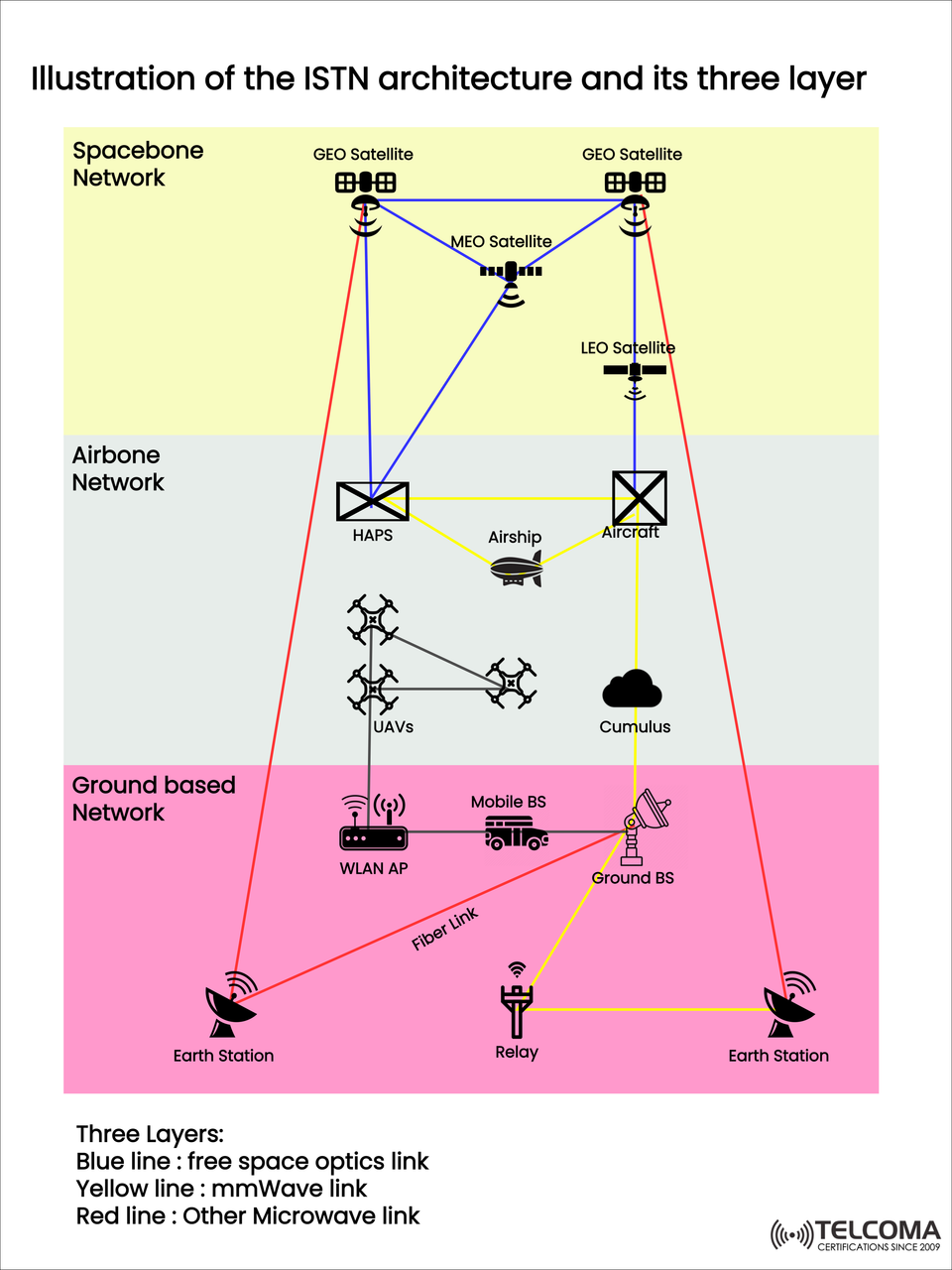

Overview of the ISTN Architecture and Its Three Layers
The Integrated Space–Terrestrial Network (ISTN) is shaping the future of global communications. This architecture brings together three key layers—spaceborne, airborne, and ground-based networks—into one integrated system. With the use of cutting-edge technologies like Free Space Optics (FSO), millimeter-wave (mmWave), and microwave links, ISTN provides fast, low-latency, and reliable connectivity worldwide.
The illustration below shows how these three layers work together to create a modern communication backbone. In this blog, we’ll break down each layer, its components, and the technologies that power ISTN.
What is ISTN?
ISTN (Integrated Space–Terrestrial Network) is a sophisticated communication structure that combines satellites, aerial platforms, and ground infrastructure. Its aim is to offer seamless global coverage, support ultra-reliable low-latency communications (URLLC), and enable new applications like 5G/6G expansion, IoT, autonomous vehicles, and emergency communication systems.
By connecting various network environments, ISTN fills coverage gaps in remote locations and guarantees strong connectivity even in tough conditions.
The Three Layers of ISTN Architecture
- Spaceborne Network Layer
The Spaceborne Network is the top layer, which includes:
GEO (Geostationary Earth Orbit) Satellites – Offer wide coverage but have higher latency.
MEO (Medium Earth Orbit) Satellites – Strike a balance between coverage and latency.
LEO (Low Earth Orbit) Satellites – Provide low-latency, high-speed connectivity, crucial for 5G/6G.
Key Role:
Ensures global coverage.
Connects to airborne and ground layers using FSO (blue lines) and microwave links (red lines).
Serves as a backbone for intercontinental communication.
Advantages of the Spaceborne Layer:
Covers oceans, deserts, and remote areas.
Vital for disaster recovery when ground infrastructure is down.
Supports broadband internet, navigation, and broadcasting.
- Airborne Network Layer
The Airborne Network acts as a bridge between the space and ground layers. It consists of:
HAPS (High-Altitude Platform Stations) – Stratospheric platforms that provide continuous coverage.
Airships – Useful for flexible deployment during disasters.
Aircraft – Offer connectivity for in-flight internet and relay signals.
UAVs (Unmanned Aerial Vehicles) – Facilitate localized coverage and mobile relays.
Cumulus Cloud Computing Nodes – Deliver edge computing capabilities closer to users.
Key Role:
Functions as a relay layer between satellites and ground stations.
Uses mmWave links (yellow lines) for high-capacity, short-range connections.
Enhances network flexibility by repositioning to meet demand spikes.
Advantages of the Airborne Layer:
Quick deployment in emergencies.
Expands coverage in rural or underserved areas.
Provides edge computing for latency-sensitive applications like self-driving cars.
- Ground-Based Network Layer
The Ground-Based Network is the most recognizable layer, consisting of traditional telecom infrastructure:
Earth Stations – Gateways between satellites and terrestrial systems.
Ground Base Stations (BS) – Direct connections with user devices.
Mobile Base Stations – Temporary coverage for events or disasters.
WLAN Access Points (APs) – Last-mile wireless connectivity.
Relay Nodes – Extend coverage and connect ground stations with airborne platforms.
Fiber Links – Serve as the backbone for high-speed data transfer on land.
Key Role:
Gives direct access to end-users.
Integrates with existing 5G and evolving 6G networks.
Connects with airborne and space layers for global interoperability.
Advantages of the Ground-Based Layer:
Reliable and established infrastructure.
High capacity and low latency thanks to the fiber optic backbone.
Essential for local services like smart cities, IoT, and enterprise connectivity.
Enabling Technologies in ISTN
The three layers of ISTN are linked through various transmission technologies, each optimized for specific conditions:
Blue Line: Free Space Optics (FSO) Links
Fast, high-capacity optical connections through free space.
Used for links between satellites and airborne platforms.
Delivers fiber-like performance without physical cables.
Yellow Line: mmWave Links
Short-range but high-capacity connections.
Perfect for airborne-to-ground and airborne-to-airborne communication.
Supports ultra-low latency applications.
Red Line: Microwave Links
Offer longer-range connectivity.
Connect satellites to ground stations.
More resilient in bad weather compared to FSO.
Benefits of ISTN Architecture
The integration of these three layers offers several advantages for telecom operators, businesses, and users:
Global Coverage: No more areas with no service, whether it's oceans, rural regions, or places hit by disasters.
Resilient Connectivity: Multi-layer redundancy keeps communications flowing.
High Capacity & Low Latency: The mix of FSO, mmWave, and microwave ensures both speed and reliability.
Scalability: Easy to expand with new satellites, UAVs, or base stations.
Support for 5G/6G Use Cases: Facilitates smart cities, autonomous transport, IoT, and crucial communications.
ISTN vs Traditional Networks
Feature Traditional Networks ISTN Architecture Coverage Limited to terrestrial areas Global (Space + Air + Ground)Latency Low (fiber), high (GEO sat)Optimized with LEO + airborne links Resilience Vulnerable to disasters Multi-layer redundancy Deployment Flexibility Fixed infrastructure Dynamic, mobile, and adaptive5G/6G Integration Partial Native support for advanced use cases
Real-World Applications of ISTN
Disaster Recovery: Quick restoration of connectivity using UAVs and HAPS.
Maritime & Aviation: Smooth broadband service over oceans and in the air.
Defense & Security: Secure, robust multi-layer communication.
Smart Cities & IoT: Enabling a lot of devices to connect with low latency.
Rural Connectivity: Affordable internet access for underserved areas.
✨ Key Technologies Behind ISTN:
Free Space Optics (FSO): Mimics fiber optic performance through space-based optical links.
mmWave Links: Provide high-capacity, low-latency relays in the air.
Microwave Links: Create dependable long-distance connections for the backbone.
⚡ Why This Matters:
Eliminates coverage gaps in rural areas and during emergencies.
Acts as the backbone for 5G/6G, IoT, and autonomous systems.
Builds a resilient and adaptable communication infrastructure.
📡 ISTN goes beyond being just a network upgrade—it’s basically the bedrock for future digital societies and a crucial step toward 6G connectivity.
👉 Telecom experts: How do you think ISTN will impact your plans for 5G, IoT, and global broadband services?
🔹 Extra SEO Keywords for Blog/Web Content
To make your blog more search engine-friendly, consider including these terms in a natural way:
6G-ready communication networks
non-terrestrial networks (NTN)
space-air-ground integrated network (SAGIN)
satellite-terrestrial integration
global broadband connectivity
low-latency communication systems
resilient telecom infrastructure
UAV communication relays
high-altitude platforms (HAPS) in telecom
Conclusion
The ISTN architecture is a game changer in communication systems, combining spaceborne, airborne, and ground-based layers. By harnessing technologies like Free Space Optics, mmWave, and microwave links, ISTN offers the backbone for global connectivity that’s ready for the future.
For professionals in telecom and tech enthusiasts alike, ISTN isn’t just an upgrade; it’s a bold leap towards 6G and what comes next. With its focus on universal coverage, resilience, and advanced applications, ISTN is setting the stage for a truly interconnected world.