
Key Implications of 5G-Era Advancements on SON and Orchestration in Modern Networks
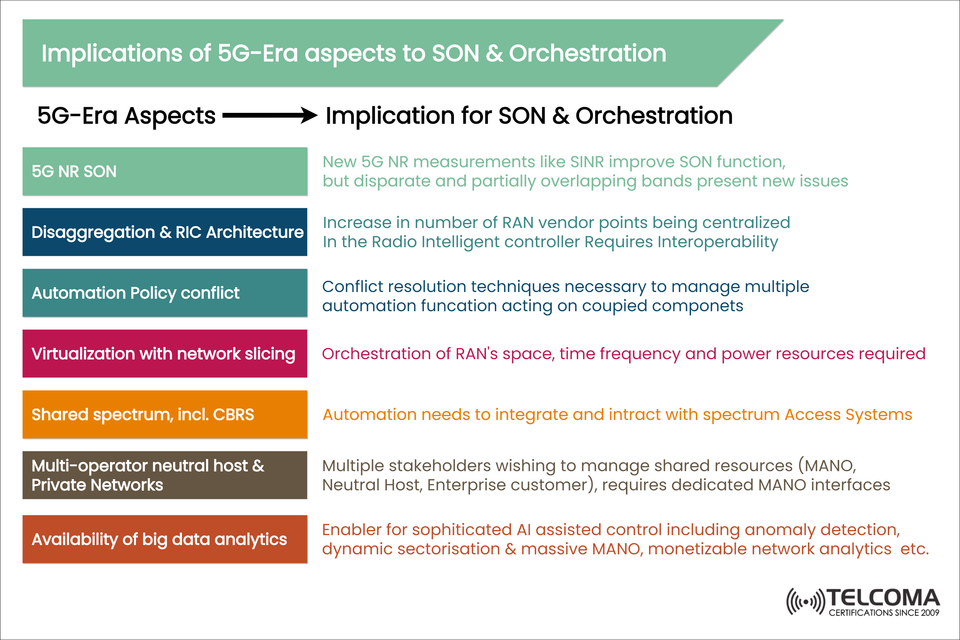

5G Era Implications for SON & Orchestration: An Overview for Telecommunications Professionals
As 5G moves from theoretical to actual use, the core components of 5G disaggregation, virtualization, RIC and shared spectrum, provide unique challenges that must be managed appropriately. This is where Self-Organizing Networks (SON) and orchestration-focused tools will now be at a premium.
The attached picture illustrates how each aspect related to 5G technologies will come into play relative to SON and orchestration. In this blog, we will break down each 5G core component in detail, focus on the implications, and how telecom networks will have to adjust their automation, control, and orchestration approaches.
📶 5G NR SON: An increase in challenges and measurements
Implication
The introduction of new 5G NR (New Radio) measurements such as Signal-to-Interference-plus-Noise Ratio (SINR), will help improve SON functionality, but overlapping and fragmented frequency bands create extremely complex radio planning and automated optimization.
Takeaways
SON algorithms for automation will work per band interference models.
Advanced RAN metrics help with handover, load balancing and interference management.
With even more radio conditions, SON tuning must be more dynamic.
🧱 Disaggregation and RIC Architecture
Implication
Now that there are many more vendors providing a singular RAN stack, with the addition of the Radio Intelligent Controller (RIC), orchestration will need to manage many various levels of interoperability and centralize many vendor functions.
⚠️ Automation Policy Conflicts
Implication: Having multiple automation agents acting on the same resource creates potential conflicts in automation policy and unintended outcomes. This is a major concern potentially caused by overlaps in automation as exists in layered Automation (SON, RIC, orchestration, edge)
Resolution Options:
Establish conflict resolution procedures in orchestration layers
Create levels of precedence for automation agents
Employ AI-based policy harmonization engines
🧩 Virtualization with Network Slicing
Implication: Network slicing creates the need to orchestrate RAN space, time, frequency and power resources, usually in real-time, and with SLAs at the per-slice (context) level
Requirements:
Per-slice orchestration policies
Slice-aware mechanisms to allocate network resources
Integrate with NFV-MANO, RIC, SMO components
📡 Shared Spectrum (incl. CBRS)
Implication: Shared spectrum environments (e.g. CBRS) involve dynamic interactions between orchestration & SON and usage of Spectrum Access Systems (SAS) to prevent network and other users' interference, and other compliance requirements
SON Extensions:
Automated spectrum request and release
Dynamic handling of priority classes
Local licensing models (generic constructs)
🏢 Multi-Operator, Neutral Host & Private Networks
Implication:
Networks are increasingly servicing multiple 'tenants', or users, as an operator, neutral host, or enterprise vertical. Orchestration systems need to add capabilities/models and approaches to enforce resource isolation and make stakeholder specific controls.
Considerations:
Tenant specific orchestration policies
Management layer for Neutral Host
Dedicated interfaces to Enterprise MANO systems.
📊 Big Data Analytics for Intelligent Control
Implication:
Large datasets from the RAN enable AI-assisted orchestration, anomaly detection, dynamic sectorisation, and monetisable intelligence.
Benefits:
Predictive maintenance and fail prevention
Real-time prediction of traffic patterns
Context-aware scaling of network functions
🧠 Summary Table:
5G Aspects & SON/Orchestration Implications
5G-Era Aspects SON & Orchestration Implications
5G NR SON Improvement in metrics for measurement and metrics metrics and complexity of bands
RIC & Disaggregation More vendors appear, but interoperability with vendor points
Policy Conflicts Even more nuance for coordination and conflict resolution
Network Slicing Orchestrate and manage multi-dimensional resources
Shared Spectrum (3.5GHz) Real-time interaction and updates with SAS
Multi-Tenant Model, e.g., CBRS Spectrum is shared, but dedicated interfaces and resource isolation.
Big Data Provides the ability to intelligently orchestrate and direct with AI.
✅ Conclusion:
Reengineering SON and Orchestration for 5G
Moving to 5G will create the need for a complete re-engineering of SON and orchestration capabilities. Monitoring the disaggregated architecture itself, policy conflict resolution and multi-tenancy both add complexity to managing a "modern" RAN, which require timing to adapt reflecting the social dynamic from console. This stresses the important role of orchestration - adaptive, intelligent, interoperable orchestration platforms are indispensable to making modern networks work and deliver value.
📈 Strategic Suggestions For 5G SON & Orchestration
Now that we have discussed the challenges created by the advances in the 5G era, it is crucial that telecom operators and vendors adopt forward-facing orchestration techniques to address them. There are a couple of suggestions provided by our panel of experts that pertain directly to the particular challenges discussed earlier:
- Invest in RIC Interoperability and Open Standards
Prioritize O-RAN compliant RIC architectures.
Promote the use of open interfaces A1, E2, and O1 to facilitate modular orchestration.
Encourage a level of vendor diversity while still supporting cohesive SON behavior. - Adopt policy-aware automated frameworks
Apply policy conflict detection and resolution mechanisms.
Utilize AI-guided policy engines that be adaptive to changing network conditions.
Develop SON policies that remain hierarchical in nature between the SON, MANO and RIC policies. - Implement slice-aware orchestration stacks
Extend the orchestration layer to be aware of slices and service level agreements (SLAs).
Automate dynamic scaling and isolation of resources per slice.
Sketch in the RAN, transport, and core slices in the perspective of orchestration. - Add a layer of Spectrum Awareness to SON
Integrate SON systems with a spectrum access system (SAS) to automate spectrum access.
Enable cognitive radio techniques to maximize the utility of shared spectrum.
Incorporate real-time spectrum awareness monitoring mechanisms into SON systems to eliminate co-channel interference. - Improve observability through big data
Utilize telemetry and tracing tools throughout the RAN and core.
Also, employ ML pattern detection to support anomaly resolution and predictive analytics.
🔮 Future View:
Moving Toward Autonomous Networks
As networks continue to grow and diversify the evolution of SON and orchestration will evolve more toward open-loop, self-evolving systems:
Autonomous networks will leverage closed-loop automation to continuously optimize.
Intent-based orchestration will allow operators to specify outcomes, rather than configurations.
Edge-native orchestration will manage latency sensitive slices at the edge of the network.
More AI/ML infusion across layers will enhance real-time decision-making and adjustment capabilities.
The above capabilities will be necessary for not only enhanced mobile broadband (eMBB), but also for critical IoT, private enterprise 5G, and network-as-a-service (NaaS) operational models.