
Key Models in 5G-FMC SD-407: Convergence and Interworking Explained
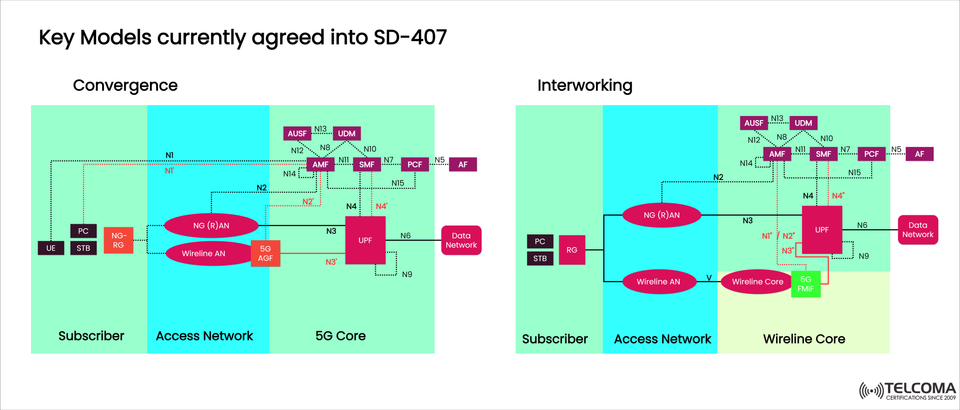

Key Models Currently Established in SD-407: Convergence and Interworking in 5G-FMC
The shift towards Fixed-Mobile Convergence (FMC) in 5G is all about making wireline and wireless networks work together seamlessly. To kick this off, SD-407, an initiative by the Broadband Forum (BBF), has laid out some models that serve as the backbone of 5G-FMC architectures. The two primary models include:
Convergence Model
Interworking Model
These models help unify subscriber access, streamline session management, and maximize resource efficiency across various access types. Let's take a closer look at each model, their technical processes, and how they contribute to creating a common 5G core network.
Understanding SD-407 in the 5G Context
SD-407 is based on 3GPP 5G specifications and works hand-in-hand with BBF’s FMC initiatives to ensure that fixed access networks, like broadband wireline, can easily connect with the 5G Core (5GC).
This results in:
Unified subscriber management for mobile and fixed access.
Consistent policies and authentication processes.
Support for advanced features such as network slicing and QoS.
Basically, SD-407 ensures a smooth experience for subscribers, whether they're using wireless (UE, NG-RAN) or wireline (RG, Access Gateway Function).
Convergence Model in SD-407
The Convergence model integrates wireline access directly with the 5G Core (5GC). Here, both wireless and wireline subscribers are treated the same at the 5G Core level.
Key Components in the Convergence Model
Subscriber Side:
UE (User Equipment): Mobile devices connecting through NG-RAN.
RG (Residential Gateway) or NG-RG: Wireline device for fixed access.
PC, STB: Other fixed subscriber devices.
Access Network:
NG-(R)AN: 5G New Radio (wireless).
Wireline AN: Fixed access nodes.
5G AGF (Access Gateway Function): Connects wireline access to the 5G Core.
5G Core:
AMF, SMF, PCF, UDM, AUSF: Core network functions for session management, authentication, and policy.
UPF: Manages user plane traffic.
Interfaces Used
N1/N2/N3: Between subscribers, access, and 5GC.
N4/N6/N9: Between UPF and SMF or data networks.
N14, N11, N12: For policy, authentication, and session management.
Advantages of Convergence
Unified core for mobile and fixed subscribers.
Simplified architecture without the need for legacy wireline cores.
Consistent end-to-end QoS, session management, and slicing.
Interworking Model in SD-407
The Interworking model takes a different approach—fixed access still depends on its traditional wireline core but works alongside the 5G Core for shared services.
Key Components in the Interworking Model
Subscriber Side:
Similar lineup as the convergence (PC, STB, RG).
Access Network:
NG-(R)AN for wireless.
Wireline AN interconnected through the existing Wireline Core.
5G FMIF (Fixed Mobile Interworking Function): Facilitates interaction between wireline and the 5G core.
Core Functions:
The Wireline Core continues to support legacy broadband services.
The 5G Core (5GC) introduces enhanced mobility, slicing, and policy features.
Interfaces Used
N2/N3/N4/N6/N9: Between access, UPF, and data networks.
N1’/N2’/N3’/N4’: For signaling specific to wireline and interworking.
V-interface: Connects Wireline AN with the Wireline Core.
Advantages of Interworking
Makes use of the current wireline infrastructure, helping to cut down on deployment costs.
Offers a gradual transition for operators moving from legacy wireline to 5G FMC.
Enables a step-by-step adoption of 5G features while keeping existing services intact.
Convergence vs Interworking: A Comparison
Feature Convergence Model Interworking Model Core Network Unified 5G Core Coexistence of Wireline Core + 5G Core Access Integration Wireline directly into 5G Core Wireline via FMIF and legacy Wireline Core Deployment Complexity Higher (requires migration to 5GC)Lower (utilizes existing wireline infrastructure)Service Consistency End-to-end uniformity Some differences between wireline & mobile Best Use Case Green field or full 5G rollout Brownfield with legacy wireline networks
Why SD-407 Models Matter for 5G FMC
The SD-407 models are essential as they offer operators two flexible routes:
A full convergence path for those looking to create a single, all-5G network.
An interworking path for those wanting to maintain legacy wireline investments while gradually moving towards convergence.
This flexibility accelerates 5G adoption, optimizes CAPEX/OPEX, and helps operators meet both immediate needs and long-term transformation goals.
Technical Benefits for Operators
Seamless Subscriber Experience: Same authentication and session management across both fixed and mobile.
Network Slicing: Ability to allocate dedicated resources for services like IoT, enterprise, or residential.
QoS Assurance: Consistent quality across a variety of access networks.
Operational Efficiency: Less complexity in managing two separate cores.
Understanding 5G-FMC for Telecom Experts
Part 1: Timeline for 5G-FMC Standardization
Focus: The growth of FMC standardization with a spotlight on the contributions from 3GPP and BBF.
Sections: * The importance of FMC for 5G. * The role of 3GPP in Phases 14–16. * Contributions from BBF (SD-406, SD-407, TRs). * Key recommendations: access gateways, network slicing, and session management. * The ultimate objective: A Unified Core Network.
Part 2: Essential SD-407 Models (Convergence vs. Interworking)
Focus: An in-depth exploration of the two main SD-407 models.
Sections: * Convergence Model (direct integration with 5GC). * Interworking Model (combining wireline, legacy, and 5GC). * Components, interfaces, and functions. * Advantages, disadvantages, and practical examples. * A quick reference table for comparison. * Real-life strategies for operator adoption.
Part 3: The Impact of Network Slicing on FMC (SD-406)
Focus: How SD-406 integrates slicing into FMC.
Sections: * What’s network slicing within FMC? * Why slicing is vital for IoT, enterprise applications, and AR/VR. * Alignment between BBF and 3GPP on slicing. * A case study: Distinctions between residential broadband and enterprise slicing.
Part 4: Challenges and Solutions in FMC Deployment
Focus: The hurdles operators face in rolling out FMC.
Sections: * Transitioning from older wireline core systems. * Security issues (authentication, RG, session management). * Ensuring QoS across various access types. * Best practices learned from initial deployments.
Conclusion
The Convergence and Interworking models of SD-407 are key frameworks for making Fixed-Mobile Convergence (FMC) a reality in the 5G landscape. They outline how wireline and wireless networks can connect with the 5G Core, providing flexibility for both greenfield and brownfield operators.
In the end, these models make the goal of a cohesive, integrated 5G network attainable, ensuring high-quality, seamless experiences for users while catering to the diverse strategies of operators.