
Key Performance Indicators (KPIs) for 6G: Typical Values and Use Cases Explained

Key Performance Indicators (KPIs) for 6G: Typical Values and Use Cases Explained
The telecom industry is gearing up for the launch of 6G networks, which are anticipated to arrive by 2030. In contrast to 5G, which prioritized enhanced mobile broadband (eMBB), ultra-reliable low latency communication (uRLLC), and massive machine-type communication (mMTC), 6G aims to set much higher performance standards.
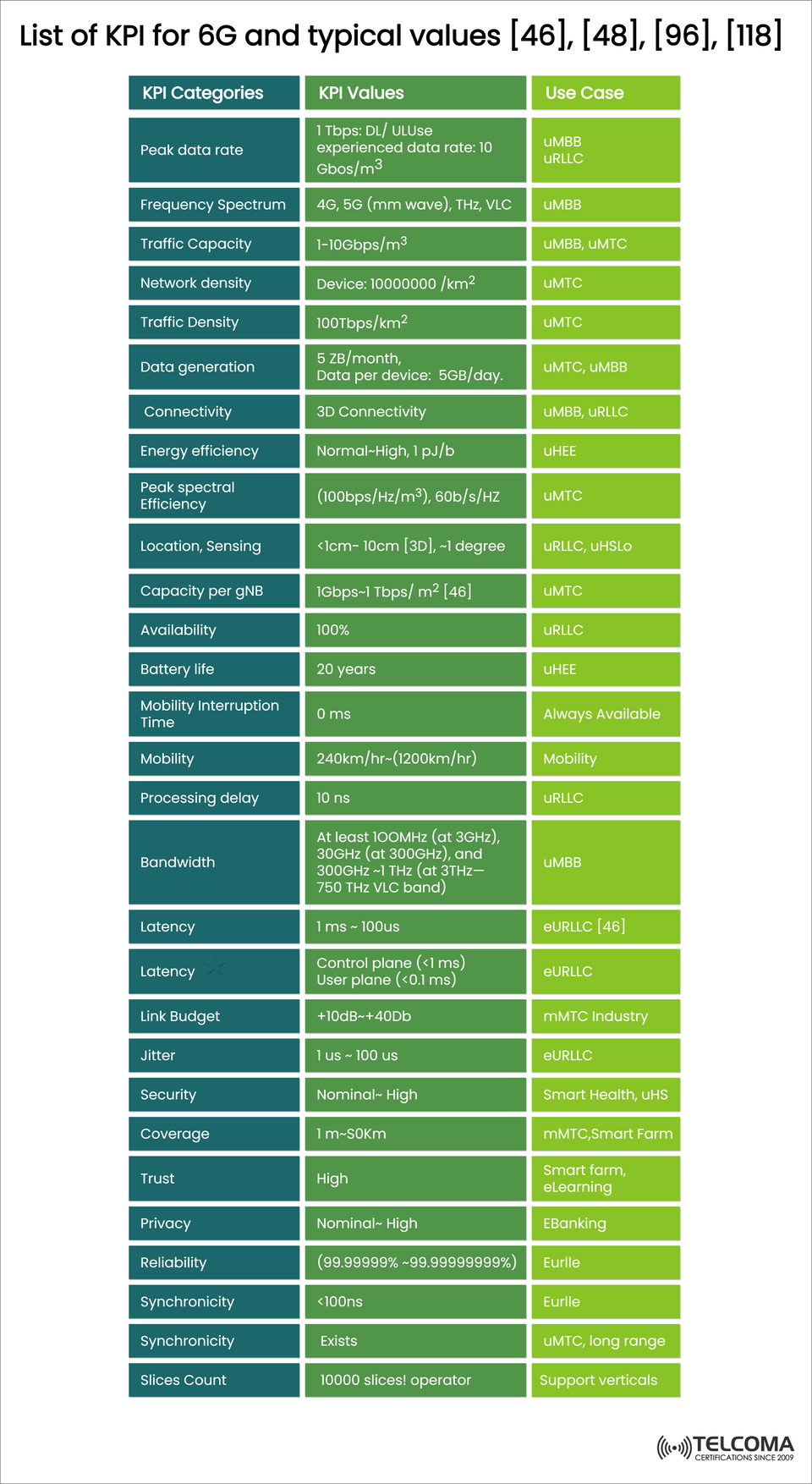
The success of 6G hinges on meeting specific Key Performance Indicators (KPIs)—these are measurable values that show how well the network achieves its intended goals. The image above presents a list of KPIs for 6G along with their typical values, covering aspects like peak data rates, latency, energy efficiency, reliability, and coverage.
Let’s take a closer look at each KPI category, its target values, and the real-world use cases it facilitates.
- Peak Data Rate
Target Value: Up to 1 Tbps (DL), user-experienced data rate: 10 Gbps/m³
Use Cases: Ultra-reliable low-latency communications (uRLLC), enhanced mobile broadband (eMBB)
With this, 6G will offer speeds almost 100 times faster than 5G, paving the way for holographic communications, immersive VR/AR, and real-time digital twins.
- Frequency Spectrum
Bands: 4G, 5G (mmWave), THz, VLC (Visible Light Communication)
Use Cases: eMBB
By expanding into Terahertz (THz) and VLC bands, 6G can achieve massive bandwidth necessary for futuristic services like wireless cognition and the tactile internet.
- Traffic Capacity
Target Value: 1–10 Gbps/m³
Use Cases: eMBB, mMTC
With the explosion of IoT devices, networks need to handle dense traffic loads. This KPI ensures that smart cities, autonomous vehicles, and Industry 5.0 systems run smoothly.
- Network and Traffic Density
Network Density: 10,000,000 devices/km²
Traffic Density: 100 Tbps/km²
Use Case: mMTC
This shows 6G’s capability to connect huge IoT ecosystems, like smart factories and precision agriculture.
- Data Generation
Target Value: 5 Zettabytes/month, 5 GB/day per device
Use Cases: uMTC, eMBB
With such enormous data flows, AI-driven analytics and edge computing will be key to efficiently process and use the information.
- Connectivity: 3D Networks
Use Case: uRLLC, eMBB
6G will provide 3D connectivity, integrating terrestrial, aerial (drones), and satellite networks. This means solid coverage in remote, rural, and disaster-affected areas.
- Energy Efficiency
Target Value: Normal–High, 1 pJ/bit
Use Case: Ultra-High Energy Efficiency (uHEE)
6G is on a quest to be sustainable, promoting longer battery life for IoT devices and a greener telecom infrastructure.
- Peak Spectral Efficiency
Target Value: (100 bps/Hz/m³), 60 b/s/Hz
Use Case: mMTC
This helps make the most out of the available spectrum, enhancing dense IoT deployments.
- Location and Sensing
Accuracy: <1 cm to 10 cm (3D), ~1° precision
Use Cases: uRLLC, ultra-high sensing low (uHSLo)
With pinpoint accuracy, 6G will boost autonomous vehicles, smart logistics, industrial automation, and healthcare monitoring.
- Capacity per gNB
Target Value: 1 Gbps–1 Tbps/m²
Use Case: mMTC
Each base station (gNB) will manage hefty traffic loads, supporting large-scale IoT clusters across industries and cities.
- Availability
Target Value: 100%
Use Case: uRLLC
For mission-critical operations like remote surgeries, defense networks, and disaster response, zero downtime is a must.
- Battery Life
Target Value: 20 years
Use Case: uHEE
This makes 6G perfect for long-term IoT deployments, such as environmental sensors or agricultural monitoring systems.
- Mobility and Interruption Time
Mobility: 240 km/h to 1200 km/h
Mobility Interruption Time: 0 ms
Use Case: Always Available
With these specs, 6G will maintain stable connections in high-speed trains, drones, and even during flights.
- Processing Delay
Target Value: 10 ns
Use Case: uRLLC
This capability supports real-time applications like brain-computer interfaces, AR/VR, and tele-robotics.
- Bandwidth
Target Value: 100 MHz (3 GHz), 30 GHz (300 GHz), 300 GHz–1 THz (3 THz–750 THz VLC)
Use Case: eMBB
Diving into THz and VLC bands offers massive broadband capacity, enabling multi-sensory XR experiences.
- Latency
Target Value: Control plane <1 ms, user plane <0.1 ms
Use Case: eURLLC
This ultra-low latency ensures instant feedback, crucial for autonomous driving, robotics, and remote surgery.
- Reliability and Jitter
Reliability: 99.999999% to 99.999999999%
Jitter: 1 μs–100 μs
Use Cases: eURLLC, mission-critical industries
Ultra-reliable low-latency communication will power defense, smart grids, and intelligent transportation.
- Security, Privacy, and Trust
Values: Nominal–High
Use Cases: Smart Health, eBanking, eLearning, Smart Farming
6G integrates end-to-end encryption, trust mechanisms, and privacy protections, ensuring resilient networks for finance, healthcare, and education.
- Coverage
Range: 1 m–50 km
Use Cases: mMTC, Smart Farms
With its adaptable coverage, 6G supports rural broadband, precision farming, and IoT in remote areas.
- Synchronization and Slicing
Synchronization: <100 ns precision
Slices per Operator: Up to 10,000
Use Case: Support Verticals
With network slicing, operators can allocate virtual networks to sectors like healthcare, defense, transport, and entertainment, all on a shared infrastructure.
KPI Comparison Table: 5G vs 6G
KPI5G Typical Value6G Target Value Impact Peak Data Rate10 Gbps1 Tbps Holographic comms, XRLatency1–10 ms<0.1 ms Remote surgery, BCIReliability99.999%99.999999999%Mission-critical apps Device Density1M/km²10M/km²Trillion IoT nodesMobility500 km/h1200 km/h Aircraft & drone comms Battery Life~10 years20 years Sustainable IoT
Conclusion
The KPIs for 6G illustrate a transformative network that surpasses 5G’s capabilities. With targets such as 1 Tbps data rates, sub-millisecond latency, nearly flawless reliability, and 20-year battery life for IoT, 6G is set to enable AI-driven industries, immersive human experiences, and sustainable telecom ecosystems.
For telecom professionals, grasping these KPIs is essential for infrastructure planning and business strategies. For tech enthusiasts, these figures shed light on a future where communication networks are faster, smarter, greener, and more focused on human needs than ever.
As we approach 2030, 6G is shaping up to be not just the next phase but a significant leap toward a more intelligent, connected, and immersive digital age.