
L1/L2 Based Inter-Cell Mobility Explained: Faster Beam Switching in 5G Networks

L1/L2 Based Inter-Cell Mobility: Quick Beam Switching for a Smoother 5G Experience
With mobile data traffic skyrocketing and more applications needing super-fast responses, managing seamless mobility is crucial in 5G network design. One effective method is L1/L2 based inter-cell mobility, which dramatically cuts down latency during beam switching compared to traditional Layer 3 (L3) mobility.
This article digs into the differences between L1/L2 mobility and L3 mobility, their impact on handover performance, and why they matter for providing a great user experience in the crowded space of 5G.
What’s L1/L2 Based Inter-Cell Mobility?
In mobile networks, user devices (UE) often move across different cells and need a way to manage this movement smoothly. Traditionally, L3-based mobility handles these transitions at the Radio Resource Control (RRC) level, but this comes with higher signaling overhead and added latency.
On the flip side, L1 (Physical Layer) and L2 (MAC Layer) based mobility brings some aspects of mobility management closer to the hardware. This results in:
Faster response times during beam or cell switches.
Lower latency compared to L3-based handovers.
Less control plane overhead since fewer signaling messages are sent.
To put it simply, L1/L2 mobility allows for quicker shifts between beams and nearby cells, while L3 mobility is saved for transitions beyond that.
Visualizing L1/L2 Mobility Coverage
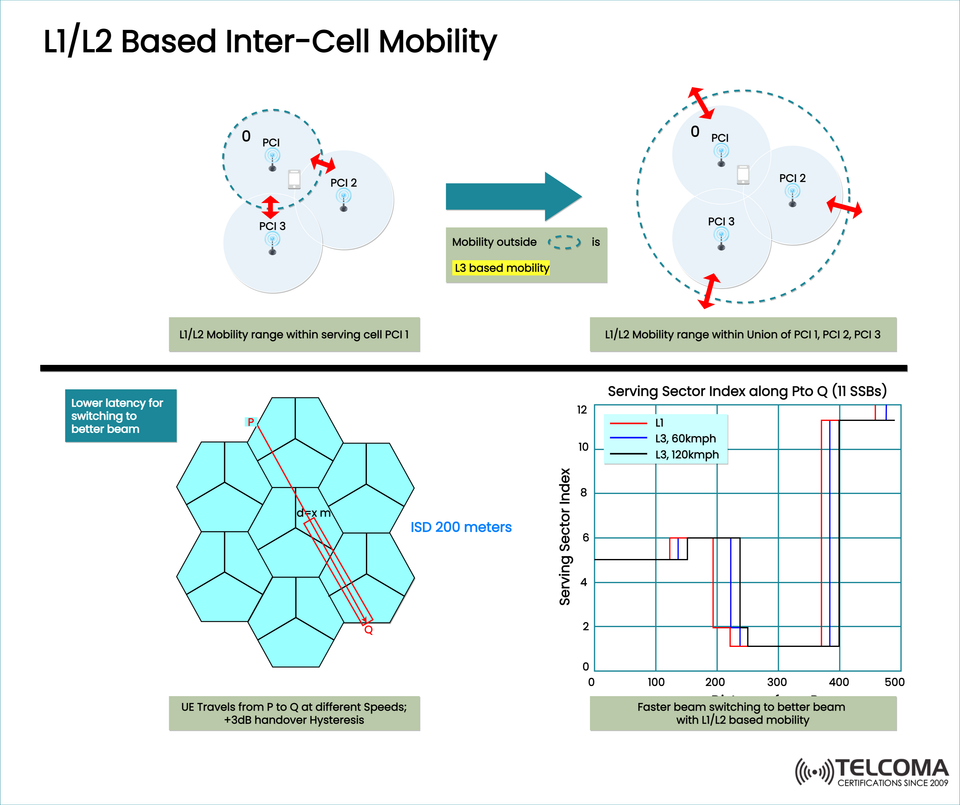
The diagram shared illustrates this concept:
L1/L2 Mobility Range – Inside a serving cell (PCI 1), the UE can swiftly switch between beams with minimal latency.
Extended L1/L2 Mobility – When cells PCI 1, PCI 2, and PCI 3 work together, the UE can move seamlessly across these areas at the L1/L2 level.
L3 Mobility – If the UE travels outside this combined area, it will need a standard L3 handover.
Key Takeaway: L1/L2 mobility is a lot better for managing mobility within a site, while L3 remains necessary for handovers between different sites.
Benefits of L1/L2 Based Inter-Cell Mobility
L1/L2 methods have several perks over traditional L3 mobility:
Lower Latency: Mobility is managed at the physical/MAC layer without the delays from RRC signaling.
Reduced Interruption Time: Faster beam switching creates a smoother experience for users.
Better Efficiency for Fast-Moving UEs: The decreased delay really helps devices moving quickly (like at 60 km/h or 120 km/h).
Scalability in Dense Areas: Networks with small cells and tight beams need quick switching, making L1/L2 mobility perfect for these setups.
Scenario of a UE Traveling from Point P to Q
The diagram also shows a case where a UE goes from Point P to Point Q across several hexagonal cells (each spaced 200 meters apart).
Beam Switching Process: As the UE moves, it goes through several serving sector changes, depicted as Serving Sector Index transitions.
Handover Hysteresis (+3 dB): To avoid unnecessary rapid switching (the ping-pong effect), a hysteresis margin is included.
Impact of Speed: * At 60 km/h, L3 mobility is slower to react to sector changes. * At 120 km/h, the delays with L3 mobility become even more noticeable. * In contrast, L1 mobility manages quicker sector switches across all speeds.
Comparison of Serving Sector Index
The graph on the right compares Serving Sector Index vs. Distance traveled (P → Q) for various mobility strategies:
L1 Mobility (Blue): Adapts to beam changes the quickest.
L3 Mobility at 60 km/h (Black): Has noticeable delays in sector switching.
L3 Mobility at 120 km/h (Red): Even slower, leading to worse performance.
Conclusion from the Graph: L1/L2 mobility allows for faster beam switching to better beams, cutting down latency and improving user satisfaction compared to L3 mobility.
Technical Insights: Why L1/L2 Mobility is Quicker
Here’s a breakdown of why L1/L2 handovers outshine L3:
FeatureL1/L2 MobilityL3 Mobility Layer of Execution Physical (L1) & MAC (L2)RRC (L3)Latency Low (microseconds to milliseconds)Higher (milliseconds to tens of ms)Control Plane Over head Minimal Significant Best Use Case Intra-site, beam switching, dense areas Inter-site, larger mobility zones Support for High-Speed UEs Better adaptation Slower response
By shifting a portion of the handover logic to lower layers, UEs spend less time waiting for signaling, which makes the process far more responsive.
Real-World Effects of L1/L2 Mobility in 5G
Better User Experience: Those in high-mobility situations (like cars or trains) face fewer dropouts and enjoy smoother connections.
Efficient Small Cell Use: In cities with overlapping beams, L1/L2 mobility aids in making transitions smoother.
Support for New Tech: * Autonomous driving * AR/VR streaming * Industrial IoT needing ultra-low latency
Less Signaling Strain on Networks: With reduced dependence on L3 signaling, the control plane gets less congested, making the overall system work better.
Main Points
L1/L2 mobility = speedier handovers within a serving cell or group of cells.
L3 mobility = necessary for inter-site movement, but it's slower.
Graph Insights: L1 mobility beats L3 mobility, especially when it comes to higher speeds.
Practical Benefit: Enhanced user experience and lower latency for 5G users.
Wrap-Up
L1/L2 based inter-cell mobility is a key advancement in managing 5G mobility. By relocating some mobility tasks to the physical and MAC layers, networks can provide faster beam switching, lower latency, and a smoother experience—especially in crowded areas and for users on the move.
While L3 mobility still has its place for inter-site transitions, combining L1/L2 mobility ensures users stay connected seamlessly even when beam changes are frequent. For telecom operators and network engineers, balancing L1/L2 and L3 mobility is essential for maximizing the benefits of 5G.