
Life-cycle of a Network Slice Instance Explained for Telecom Professionals

Now that 5G networks are here, telecom companies are really changing how they provide connectivity. A big part of this shift is something called network slicing, which lets different logical networks operate over the same infrastructure. Each slice is tailored to meet various needs like latency, reliability, or throughput.
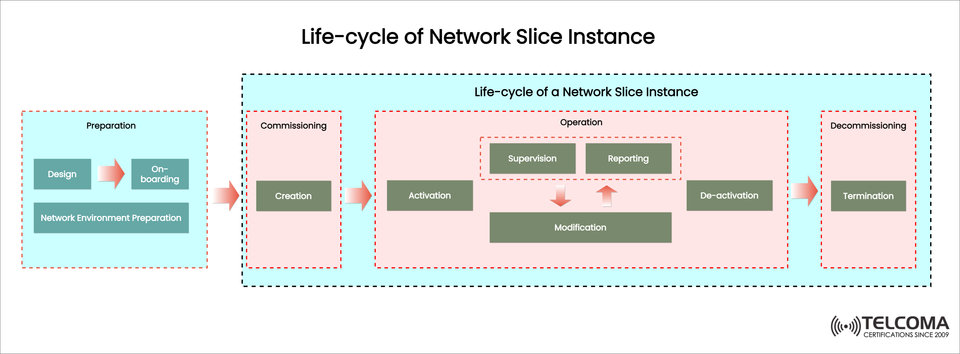
To keep things running smoothly and automate processes, the life-cycle of a network slice follows a specific structure. In the diagram we've included, you can see how this life-cycle unfolds, from preparation and commissioning to operation and decommissioning.
In this post, we’ll dive into each step of the life-cycle, discuss what each part does in the context of network slicing, and show how operators can use automation to deliver services without needing manual input.
Overview of the Network Slice Life-Cycle
The life-cycle of a network slice instance has four key phases:
Preparation
Commissioning
Operation
Decommissioning
Each phase has its own set of tasks, responsibilities, and results. Together, they make sure that a network slice is designed, deployed, managed, optimized, and eventually shut down when it’s no longer needed.
Phase 1: Preparation
The preparation phase sets the stage for a successful network slice deployment. It includes design, onboarding, and getting the network environment ready.
- Design
Identify what the slice needs based on customer or industry demands.
For example:
URLLC (Ultra-Reliable Low Latency Communications) for self-driving cars.
mMTC (Massive Machine-Type Communications) for IoT devices.
eMBB (Enhanced Mobile Broadband) for fast video streaming.
Determine performance standards like latency, bandwidth, coverage, and reliability.
- Onboarding
Add service templates, network functions, and settings into the system.
This makes it ready for automation by registering slice descriptors in orchestration systems.
- Network Environment Preparation
Get the physical and virtual infrastructure set up.
Assign resources such as computing power, storage, and network capacity.
Make sure it works well with the underlying NFV (Network Function Virtualization) and SDN (Software-Defined Networking) platforms.
Outcome: After preparation, the system is primed to create and activate a new network slice.
Phase 2: Commissioning
Commissioning is where the network slice actually comes to life through creation and activation.
- Creation
Set up the network slice instance (NSI).
Launch necessary VNFs (Virtual Network Functions) and CNFs (Cloud-Native Functions).
Create logical separation of resources to ensure SLA (Service Level Agreement) compliance.
- Activation
The slice goes live and is ready for use.
Network paths, policies, and QoS (Quality of Service) features are activated.
Tests are conducted to ensure SLA compliance.
Example: A smart factory requests a private 5G slice for automation. During commissioning, the slice is created and turned on, providing low-latency links between robots and control systems.
Phase 3: Operation
This is the longest and most crucial phase, where the slice needs to meet its performance targets throughout its life.
- Supervision
Continuously track key performance indicators (KPIs) like latency, throughput, and reliability.
Monitor for faults and conduct health checks to keep the slice stable.
AI/ML-driven supervision helps in predictive maintenance.
- Reporting
Regular reports are created for both customers and operators.
These reports show slice usage, SLA compliance, and performance trends.
They also assist with billing, audits, and regulatory checks.
- Modification
Make changes to the slice during its active period.
For instance:
Scale resources up or down based on demand.
Update VNFs/CNFs for new features.
Reconfigure policies for better traffic management.
This ensures flexibility in multi-tenant environments.
- De-activation
Temporarily turn off the slice without shutting it down.
This is helpful for seasonal services or special events.
Resources are freed up for other uses but can be reactivated later.
Outcome: The slice operates efficiently while adapting to changing needs, maximizing business value.
Phase 4: Decommissioning
When the slice is no longer needed, it moves into the decommissioning phase.
- Termination
The network slice instance is permanently removed.
All resources (compute, storage, and network) are released.
Any associated data is archived or deleted following regulatory guidelines.
Example: A temporary slice set up for a sports event is terminated after the event is over, freeing up resources for other applications.
Closed-Loop Automation in Slice Life-Cycle
One of the key things in managing a slice life-cycle is closed-loop automation.
Monitoring systems identify performance issues as they occur.
Analytics engines find root causes and forecast failures.
Orchestration platforms automatically take corrective actions, like scaling or rerouting traffic.
This ensures zero-touch operation, which means less manual work and better efficiency.
Benefits of Structured Slice Life-Cycle Management
Benefit Description Agility Fast creation and modification of slices for new services. Efficiency Best use of resources through dynamic scaling. Reliability SLA compliance ensured through ongoing monitoring. Flexibility Ability to adapt to different use cases (IoT, AR/VR, Industry 4.0).Cost-effectiveness Resource reuse and timely decommissioning save costs.
Real-World Applications
Smart Cities
Multiple slices for IoT sensors, emergency services, and public Wi-Fi.
Industry 4.0
Low-latency slices for automation in factories.
Healthcare
Secure and reliable slices for remote surgeries and telemedicine.
Entertainment
High-bandwidth slices for live streaming and AR/VR experiences.
Challenges in Slice Life-Cycle Management
Complex Orchestration: Handling multiple slices across different infrastructures can be tricky.
Interoperability Issues: Multi-vendor setups need standard APIs to function well together.
Security Concerns: Ensuring slices are isolated from one another is crucial to prevent data breaches.
OPEX Considerations: Keeping up with monitoring and automation tools involves ongoing investment.
Conclusion
The life-cycle of a network slice instance outlines the journey of a slice from design to termination. By following the structured phases—preparation, commissioning, operation, and decommissioning—operators can provide agile, reliable, and effective network services.
As AI, automation, and closed-loop control become more common, network slicing is set to be a key player in 5G and beyond, helping industries and enterprises explore new opportunities.
For telecom professionals, mastering the slice life-cycle is crucial for building the next generation of flexible, customer-focused networks.