
Logged MDT in 5G Networks: Detailed Example and Technical Insights
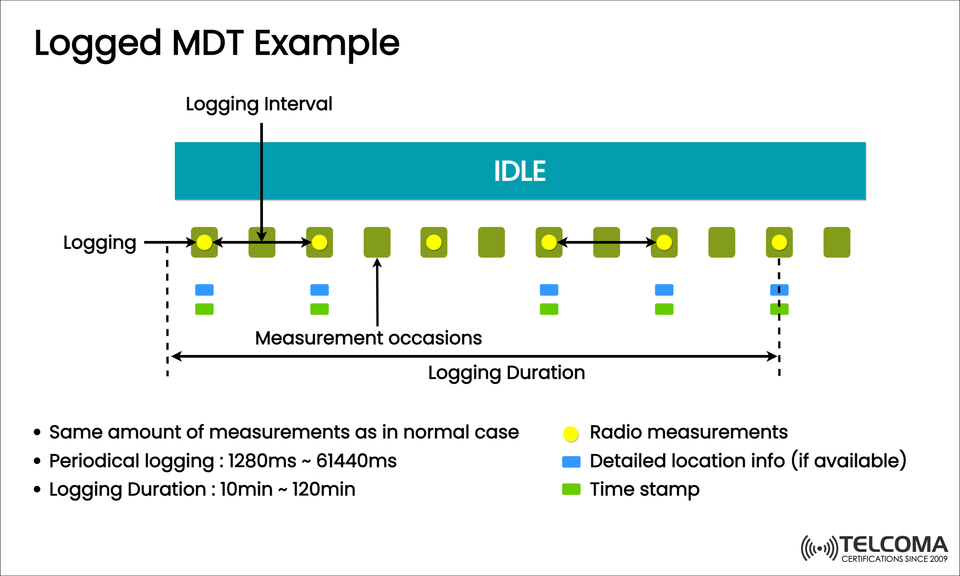

Logged MDT Example: Understanding Its Function and Importance in 5G Networks
In today's cellular networks, optimizing performance is an ongoing task. A key element that makes this possible is Minimization of Drive Tests (MDT), a standard set by 3GPP that lets User Equipment (UE) send network measurement data back to the operator. MDT helps cut down on expensive manual drive testing since it utilizes data from real users.
Out of the different types of MDT, Logged MDT stands out because it operates even when the UE is in idle mode. It gathers measurements over a certain timeframe and relays that information later when the UE shifts back to connected mode. This article delves into Logged MDT, using an example shown in the accompanying image.
What is Logged MDT?
Logged MDT is a UE-initiated feature designed to gather performance data while the device is idle. Unlike immediate MDT (which happens in connected mode), Logged MDT saves measurement results in the UE's memory and sends them later, minimizing the impact on the UE's battery life and network resources.
Key Components of Logged MDT
The image outlines the crucial elements of how Logged MDT functions:
Logging Interval: The time between two successive measurement events.
Logging Duration: The total time the UE will log data before it stops.
Measurement Occasions: The specific times when the UE will take radio measurements.
Symbols in the Example
Yellow Circle: Radio measurements (like RSRP, RSRQ, SINR, etc.)
Blue Square: Detailed location info (if available – GPS, OTDOA)
Green Square: Time stamp for each measurement.
How Logged MDT Works
Here’s a breakdown of the process for Logged MDT:
Network Configuration * The network sends the UE its MDT settings (like logging interval, logging duration, and measurement types). This setup happens via RRC signaling before the UE enters idle mode.
Logging While Idle * The UE wakes up at set logging intervals. At each measurement occasion, it collects: * Radio measurements (signal quality, cell ID, PLMN) * Location info (GPS/OTDOA if available) * Time stamp
Storage in UE Memory * Measurements are kept locally until either the logging time runs out or the memory fills up.
Reporting Upon Reconnection * When the UE goes back to connected mode (like during a data session or signaling), it sends the stored measurements to the network.
Technical Parameters from the Example
The image shows typical parameter ranges for Logged MDT:
Parameter Typical Range Purpose
Logging Interval1280 ms – 61440 ms How often measurements are taken Logging Duration10 min – 120 min How long the UE continues logging Measurements Taken Same as in connected mode Consistency in KPIs Stored Info Radio + Location + Times tamp Helps with optimization
This flexibility gives operators the ability to find a balance between data granularity (shorter intervals) and UE power consumption (longer intervals).
Importance of Logged MDT in Network Optimization
Logged MDT is vital for network quality management because it captures the user experience in real-world conditions, even when the UE is idle.
Benefits for Operators:
Better Coverage Analysis: It helps spot coverage gaps and areas with poor quality.
Reduced Drive Tests: Cuts operational costs by lessening the need for manual drive tests.
Efficient Optimization: The data comes with timestamps and geo-tags, making troubleshooting more precise.
Real-World Data: It shows actual user experiences rather than hypothetical scenarios.
Benefits for Users:
Enhanced Quality of Experience (QoE): Operators can proactively address coverage and mobility challenges.
Minimal Battery Impact: The measurements are lightweight and occur during idle DRX periods.
Challenges and Considerations
Even with its advantages, Logged MDT has some challenges:
UE Memory Limitations: Data may get lost if the memory fills up before it can be reported.
Accuracy of Location Information: Sometimes, location data isn’t available, particularly indoors.
Privacy and Security: Operators need to anonymize data to follow regulations like GDPR.
Use Cases of Logged MDT in 5G Networks
Coverage Optimization: Identifying areas with low RSRP/RSRQ.
Mobility Analysis: Looking into cell reselection and idle-to-connected transitions.
Capacity Planning: Finding high-traffic areas based on measurement frequency.
QoE Monitoring: Observing user experiences in rural, urban, and indoor areas.
Comparison: Logged MDT vs Immediate MDT
Aspect Logged MDT Immediate MDT
UE State Idle Connected
Measurement Storage Saved in UE memory Reported instantly**
Battery Impact Low Moderate
Network Load Minimal Higher
Use Case Coverage, long-term analysis Real-time troubleshooting**
Infographic-Style Summary: Logged MDT vs Immediate MDT
Here’s a quick comparison that you can use in your blog to make it easier for your readers to grasp the differences right away:
Feature Logged MDT 📝Immediate MDT ⚡UE State Idle mode Connected mode Measurement Reporting Stored and sent later Reported instantly Battery Consumption🔋 Low (efficient)🔋 Moderate Network Load📉 Minimal📈 Higher Best Use Case Long-term coverage analysis, mobility data Real-time trouble shooting Example Applications Coverage gap detection, QoE mapping Handover failure debugging
This table not only boosts SEO because of its structured format but also enhances reader engagement by clearly showing the key differences at a glance.
Best Practices for Logged MDT Implementation
If you're an operator or a network engineer, keeping these best practices in mind will help you get the most out of Logged MDT:
Optimize Logging Interval: Adjust intervals based on your environment:
Dense Urban: Shorter intervals (1–5 seconds) to catch variations
Suburban/Rural: Longer intervals (30–60 seconds) to conserve UE battery
Use Geolocation Wisely:
Lean towards OTDOA or cell-based positioning when GPS isn’t an option
Mix in crowd-sourced mobility data for better accuracy
Ensure Data Privacy:
Strip subscriber identifiers before processing
Use encryption during reporting to comply with GDPR/CCPA
Leverage Big Data Analytics:
Send MDT logs to SON platforms
Automate the detection of weak coverage areas and interference zones
Conclusion
Logged MDT is a valuable tool for achieving data-driven network optimization without imposing extra signaling demands or affecting UE performance. By collecting radio measurements, timestamps, and location data over adjustable intervals, operators gain comprehensive insights into the network experience of idle users.
In a 5G environment with high user expectations, Logged MDT is crucial for ensuring smooth coverage, fewer dropped calls, and improved network quality. When paired with analytics and AI-driven optimization, it truly becomes essential for self-organizing networks (SON) and preparing for future network planning.