
Logged vs Immediate MDT in LTE and 5G: Key Differences Explained

Logged vs Immediate MDT in LTE and 5G Networks
In mobile networks, providing uninterrupted coverage and maintaining top-notch performance is always a bit of a juggling act. For a long time, operators relied on drive tests, which meant engineers would actually have to drive around to measure how the network was performing. This method worked, but it was pretty expensive, took a lot of time, and wasn’t the most scalable approach.
To tackle these issues, Minimization of Drive Tests (MDT) came on the scene in LTE and got even better with 5G. MDT lets user equipment (UE) take network measurements and send those back to operators, making it easier to analyze coverage and overall quality.
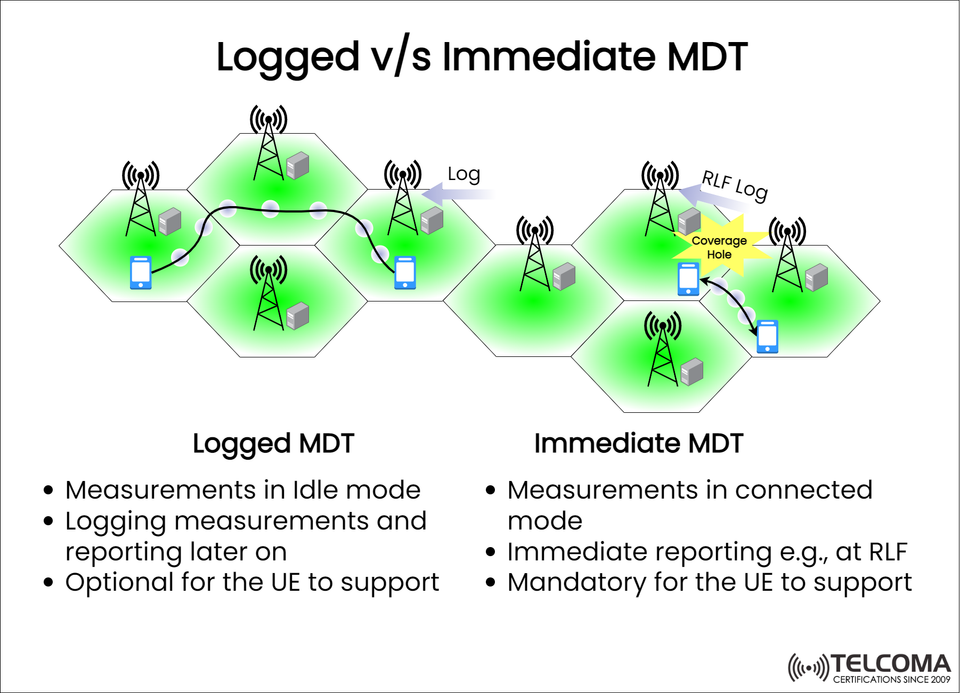
The diagram above shows the two types of MDT: Logged MDT and Immediate MDT. Both have their own roles in helping operators spot coverage gaps, dropped calls, and chances for network improvements.
What is MDT?
Minimization of Drive Tests (MDT) is a standard feature set by 3GPP to cut down the need for those pricey drive tests. With MDT, operators can gather network performance data straight from users’ devices while they're in the real world.
Objectives of MDT:
Find coverage gaps and spots with weak signals.
Evaluate handover performance and how well the system handles mobility.
Gather info on Radio Link Failures (RLFs) and service outages.
Enhance the Quality of Experience (QoE) for users.
Lower operational costs by cutting down on manual field testing.
Logged MDT: Post-Processing Measurement
How it Works:
Logged MDT kicks in when the UE is in Idle mode.
The device records measurement data (like signal strength, cell ID, and location).
Reports are sent to the network later, when the UE switches back to connected mode.
Characteristics:
Mode: Idle mode.
Reporting: Delayed (data stored in logs and sent later).
UE Support: Optional (devices may or may not have this feature).
Advantages:
Gathers data during real-world use, even when users aren’t on calls or using sessions.
Helps operators find coverage holes over a broader area, since idle UEs are spread out everywhere.
Offers long-term, passive monitoring of the network's health.
Limitations:
Reports are not real-time, so operators can’t respond immediately to issues.
Relies on the UE coming back to connected mode for the logs to be sent.
Immediate MDT: Real-Time Reporting
How it Works:
Immediate MDT functions when the UE is in Connected mode.
Measurements are reported instantly to the network.
It’s often triggered by specific events, like a Radio Link Failure (RLF).
Characteristics:
Mode: Connected mode.
Reporting: Immediate (real-time).
UE Support: Mandatory for all devices.
Advantages:
Offers real-time insights into network performance.
Important for assessing dropped calls, failed handovers, and overall session quality.
Allows quicker responses to service issues.
Limitations:
Data is only collected when the UE is active and connected.
Might not pick up idle-mode coverage problems as effectively as Logged MDT.
Key Differences Between Logged and Immediate MDT
Feature Logged MDT Immediate MDTUE Mode Idle Mode Connected Mode Reporting Delayed (logs uploaded later)Immediate (real-time reporting)Support Optional for UEs Mandatory for UEs Best For Coverage mapping, long-term analysis Call drops, RLFs, handover failures Response Time Delayed Instant
Role of MDT in Network Optimization
Both Logged and Immediate MDT go hand in hand to offer a complete picture of network performance.
- Coverage Analysis
Logged MDT finds coverage gaps by studying logs from idle-mode.
It helps operators refine cell boundaries and plan new sites.
- Mobility and Handover Analysis
Immediate MDT gives real-time feedback on failed handovers or RLFs.
Operators can use this information to tweak handover thresholds and mobility settings.
- QoE Enhancement
MDT data showcases user experience in real conditions.
Logged MDT picks up idle scenarios, while Immediate MDT guarantees the quality during active sessions.
- Cost Reduction
Less need for manual drive testing.
Scales up across millions of UEs, providing richer data at a lower cost.
Practical Example: Coverage Hole Detection
The diagram shows a coverage hole scenario picked up by Immediate MDT:
A UE in connected mode faces a Radio Link Failure (RLF).
The issue gets logged and reported right away to the network.
Operators use this info to locate weak spots and adjust the network settings.
Meanwhile, Logged MDT adds to this by recording weak signals in idle mode from different areas for later upload. Together, they create a comprehensive map of network coverage.
Benefits of MDT for Operators
Network Planning – Real data from UEs aids in better capacity planning.
Customer Experience – Quicker issue resolution leads to increased satisfaction.
OPEX Savings – Cuts costs on field tests.
Regulatory Compliance – Many regulators require proof of coverage and QoE, which MDT provides efficiently.
MDT in 5G Networks
In 5G NR, MDT features get a boost:
NR-specific measurements (like beam-level reporting, NR RLF events).
Support for dual connectivity setups (LTE + NR).
More use in network slicing and QoS monitoring.
Better geolocation data for finding weak signals.
As 5G expands to support advanced applications like IoT, AR/VR, and mission-critical services, MDT becomes even more vital for maintaining a consistent QoE.
Challenges in MDT Implementation
Even with all its benefits, operators do deal with some hurdles:
Data volume – Managing large quantities of logs calls for advanced analytics.
UE dependency – Not all devices may support Logged MDT.
Privacy concerns – Keeping location data safe needs strict adherence to data protection laws.
Energy consumption – Constant measurements can drain device batteries.
Future Outlook
Looking ahead, MDT is set to grow along with AI and automation:
AI-driven analysis – Machine learning will help predict and resolve issues before users notice them.
Automated network tuning – Closed-loop systems will adjust parameters dynamically using MDT data.
Integration with SON (Self-Organizing Networks) – MDT will provide essential data for self-optimizing networks in 5G and beyond.
Key Takeaways
Logged MDT operates in idle mode, collects data, and reports later – optional for devices.
Immediate MDT functions in connected mode, reports instantly – mandatory for devices.
Both methods work together to give a clear view of network coverage and performance.
MDT aids operators in cutting costs, boosting QoE, and optimizing coverage.
Future 5G and 6G networks will use MDT with AI and automation for smarter optimization.
Conclusion
Looking at Logged vs Immediate MDT shows how both modes play a crucial part in creating effective and user-focused LTE and 5G networks. Logged MDT sheds light on coverage and idle performance, while Immediate MDT provides real-time diagnostics for issues like RLFs and handover failures.
Together, they help operators reduce the need for drive tests, improve network planning, and ensure a steady user experience. As mobile networks evolve towards 5G and beyond, MDT will continue to be a key player in network monitoring and optimization, all while benefiting from AI, automation, and real-time analytics.