
LTE Advanced Mobile Categories Explained: From Cat 6 to Cat 12
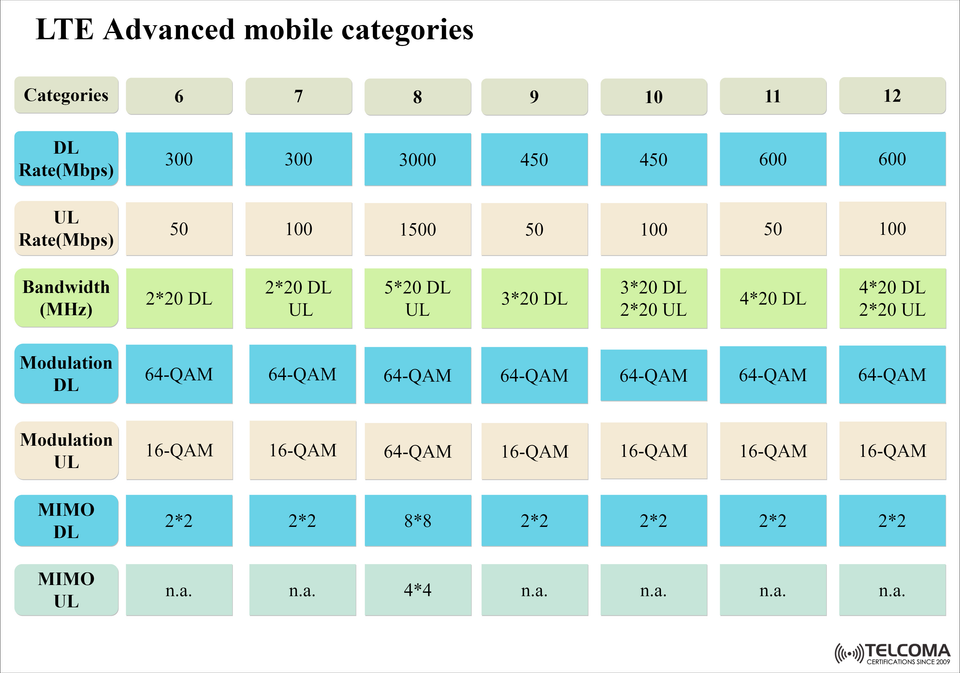

LTE Advanced Mobile Categories: Cat 6 to Cat 12 Explained
LTE Advanced is a major enhancement of LTE (Long Term Evolution) technology that provides much higher data rates, higher efficiency, and better user experience. The mobile categories (Cat 6 - Cat 12) are a way to indicate the capabilities of LTE Advanced devices in terms of DL/UL speeds, uplink bandwidth, modulation scheme and MIMO configurations.
The table below enumerates the categories depicted in the image:
- LTE Advanced Category Summary Table
- LTE Advanced Parameters Explained
a. Download (DL) and Upload (UL) Rates
The DL Rate is defined to indicate the maximum potential speed of download.
The UL Rate is designed to indicate the maximum potential speed of upload.
The top speeds will only be achieved through Carrier Aggregation (CA) and/or MIMO techniques.
b. Bandwidth
Bandwidth, expressed in terms of the carriers (e.g. 2×20 MHz means there are 2 carriers of 20 MHz combined).
This enables a higher potential bandwidth for data throughput.
(1) Modulation methods 64-QAM (quadrature amplitude modulation).
It currently provides the highest spectral efficiency for downlink. 16-QAM is still used for uplink, except in Cat 8 where 64-QAM is used to achieve higher uplink speeds.
(2) MIMO (multiple input multiple output).
For downlink MIMO, it is used to increase spectral efficiency by sending different segments of data to different layers simultaneously. For uplink MIMO, varying degrees of deployment. For Cat 8 there is a 4×4 MIMO support.
3. LTE Advanced: category threshold Cat 6 and 7 LTE advanced cat 6 is entry-level LTE advanced with 2×20 MHz carrier aggregation supporting DL rates up to 300 Mbps. Cat 7 LTE advance doubles the uplink rates to 100 Mbps. Cat 8 LTE advanced provides extreme performance up to 3 Gbps DL and 1.5 Gbps UL using 5×20 MHz carrier combinations with high-order MIMO. Cat 9 to 12 LTE advanced categories are mid to high tier LTE-A categories that maintain high speeds due mainly to higher carrier aggregation options (3×20 or 4×20 MHz) and enhanced scheduling capability.
4. Real World Applications Cat 6 & 7 LTE Advanced, current entry-level categories for most commercial LTE network deployments, allow for HD streaming and playing online games while using VoLTE. Cat 8 LTE advanced can be found in specialized network deployments, most commonly for enterprise/commercial or fixed wireless and in high density urban coverage. Cat 9-12 LTE advanced categories are usually used in urban hotspots and stadium deployments to manage the heavy data loads presented by multiple carrier aggregations.
5. Network Optimization Issues Operationally: Operators need to consider the following, Carrier Aggregation Efficiency: Proper planning of frequency bands will affect DL/UL rates. MIMO Deployment: higher orders of MIMO can affect optimization in terms of antenna placements and interference mitigation. Modulation Control: Adaptive modulation ensures appropriate selection of the MCS in the correct way.
On the service provider side, although the rules apply generally and practice with different markets, operational networks will typically find deployments in Capex spaces - Cat 11 and higher in urban density times with its confirmed frequency resources.
- Real World Consideration on Speed
Note that even when a device is rated for Cat 12, the real world speed is likely to be much lower due to:
Carrier aggregation limitations in the network;
Less than ideal radio propagation conditions;
Backhaul limitations;
Scheduling and congestion in the network.
- Future Steps Toward 5G
The LTE Advanced Pro and initial deployments of 5G NR (New Radio) have similarities with, among other things:
Higher order MIMO (up to 64×64 massive MIMO in 5G);
Carrier aggregation across LTE and 5G Bands (EN-DC mode);
Higher modulation schemes (like up to 256-QAM in LTE-A Pro and 1024-QAM with 5G lab trials).
Throughout the transition, LTE-A Categories will still serve as a fallback and capacity layer for non-5G coverage, and will exist clearly into the next decade.
Key Takeaways
Existing LTE-A mobile categories defines the capability at the device level, which can affect user experience in the real world.
The higher number categories will provide users with faster speed, but its mainly then provide because higher categories require a higher level of carrier aggregation and complexity of MIMO involved.
Even if the Cat 8 is a technically impressive standard option, it is generally impractical to expect to see a widespread deployment due to hardware and spectrum issues.
LTE-A is still the primary coverage architecture for global coverage and 5G will require deployments of LTE-A for a very long time.
Scenario-based Examples of how LTE Advanced Categories is putting these standards into practice
Cat 6 & Cat 7 - Mainstream LTE-A overarching deployment
Example Scenario: A metropolitan LTE-A deployment with 40 MHz of spectrum across two carriers.
Cat 8 – Enterprise-Grade & Fixed Wireless Access (FWA)
Scenario: Business park with fiber backhaul and wide spectrum allocation.
Performance: 2–3 Gbps DL under optimal conditions.
Use Case: 4K/8K video transmission, large file transfers, and replacement for broadband in rural environments.
Deployment Limitation: Requires large amounts of spectrum (100 MHz) and sophisticated antennas.
Cat 9–12 – Urban Hotspots & Event Venues
Scenario: Stadium deployment with dense small cell coverage.
Performance: High throughput supported for thousands of concurrently connected users.
Use Case: Live video stream from spectators, AR/VR experience, and high-speed social media sharing.
Why works: Carrier aggregation across multiple bands and load balancing keeps the capacity level high.
- Downside of Deploying Higher LTE-A Categories
Spectrum Availability
Multi-carrier aggregation needs a lot of wide clean spectrum blocks; it is common to struggle obtaining these in fractured spectrum markets.
Device Hardware Limitations
Higher levels of MIMO means more antennas on the device, which increases the device size and decreases battery life.
Backhaul Capacity
Multi-gig LTE needs fiber backhaul or equivalent as able; microwave links can end up being bottlenecks.
Signal Quality Requirements
High-order modulation, such as 64-QAM UL in the case of Cat 8, requires excellent SINR; this is not always attainable in real-world situations.
Network Complexity
CA, MIMO, and QoS management requires more planning and optimization of the network.