
LTE and Wi-Fi Carrier Aggregation: Functional Architecture Explained

🔍 Introduction – Why Carrier Aggregation is Important
With demand for fast uninterrupted connectivity increasing, network operators are looking to carrier aggregation (CA) to help maximize the usage of its spectrum resources when using LTE in the unlicensed bands. LTE and Wi-Fi (WLAN) aggregation architectures are designed to treat the licensed LTE bands as well as the unlicensed spectrum as the same entity, thus increasing throughput and offloading the network.
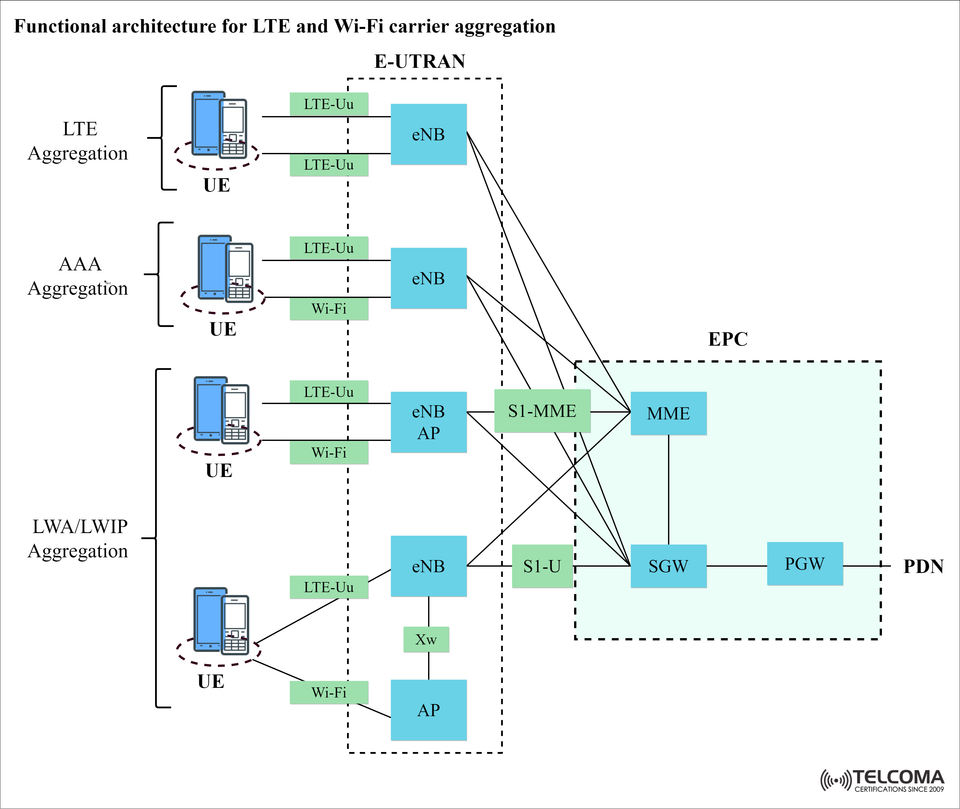
The graphic displays three fundamental methods:
LTE Aggregation
AAA Aggregation (Authentication, Authorization, Accounting)
LWA/LWIP Aggregation (LTE and WLAN Aggregation / LTE and WLAN Radio Level Integration with IPSec Tunnel)
📶 LTE and Wi-Fi Aggregation Modes
1️⃣ LTE Aggregation
This is the basic LTE aggregation mode where the UE (User Equipment) connects the eNodeB (eNB). This is done over the LTE-Uu interface.
This mode has no Wi-Fi and no use of unlicensed spectrum.
This single-RAT (Radio Access Technology) mode as all of the traffic traverses the LTE network.
Use case: the traditional LTE aggregation mode of high-reliability mobile broadband connections.
2️⃣ AAA Aggregation
This includes LTE above the scope of Wi-Fi.
The UE connects using Wi-Fi as a separate path, both LTE and Wi-Fi operate at the same time and have no integration.
Since both are managed independently of each other, there is a policy control through the AAA server, which provides policy control and authentication.
Use case: Because of the usage of the UE in the unlicensed bands, It allows for data offload on a non-critical basis for certain services.
3️⃣ LWA and LWIP Aggregation
These are the more tightly-coupled aggregations of LTE-Wi-Fi that are defined and supported in 3GPP Release.
🔸 LTE-WLAN Aggregation (LWA)
Integrates LTE and Wi-Fi at the PDCP (Packet Data Convergence Protocol) layer.
Requires support from both eNB and Wi-Fi AP (Access Point).
Data can be split over LTE and Wi-Fi channels on the same session.
🔸 LTE WLAN Integration with IPSec Tunnel (LWIP)
Utilizes IPSec tunneling to integrate LTE and Wi-Fi.
Does not require an alteration to Wi-Fi AP.
Tunneling occurs via a Xw interface from eNB to AP.
✅ Use Case: Data can be aggregated hundreds of ways using existing Wi-Fi infrastructure (LWIP) or modern integrated deployments (LWA).
🗺️ Architectural Deconstruction: Essential Elements
Component Derivative
UE Device that supports LTE/Wi-Fi aggregation
eNB LTE base station performing traffic management and bearer splitting
Wi-Fi AP Access point to offload traffic
S1-MME / S1-U Interfaces to EPC for control and user data
MME Mobility/session management
SGW/PGW Core gateways (CP) that route to the PDN
Xw Interface Loosely couples the eNB and Wi-Fi AP in a LWA/LWIP use case
📊 Comparison Table: LTE Aggregation vs LWA vs LWIP
Feature LTE Aggregation LWA LWIP
Wi-Fi ❌ ✅ ✅
IPsec Tunnel ❌ ❌ ✅
PDCP split ❌ ✅ ❌
Requires change to Wi-Fi AP ❌ Required Not required
Requires change to UE No Required Required
Deployment Flexibility High Medium Very High
🚀 The Benefits of LTE-Wi-Fi Aggregation
✅ Increased Throughput: Aggregate Bandwidth from licensed and unlicensed spectrums
✅ Improved Coverage: Fill in indoor gaps with existing Wi-Fi
✅ Low-Cost Offloading: Wi-Fi for non-essential data
✅ Network Flexibility: Tight or loose couples integration models
🧠 Expert Recommendations & Best Practices
LWA is still best suited to operators who can exercise end-to-end control on both LTE and Wi-Fi infrastructure.
LWIP is better for faster implementations where the operator will leverage off third-party Wi-Fi.
Always check UE compatibility before undertaking more advanced aggregation schemes.
Being able to define QoS mapping and Traffic Steering policies in a multi-access environment is always beneficial.
📚 Conclusion
LTE and Wi-Fi carrier aggregation is key to maximizing spectral efficiency, enabling gigabit experiences via LTE, and supporting new use cases such as AR / VR and dense deployments IoT. As we progress toward 5G these foundational architectures have a role to play, offering operators a competitive advantage when planning for extra capacity and user satisfaction.
No matter your role - network planner, R&D engineer or wireless systems designer - understanding the aggregation models presented in this paper will leave you well-positioned for both current LTE deployments and, more importantly, future 5G-ready solutions.
🌐 LTE and Wi-Fi Aggregation in the Wild
These aggregation techniques are already being deployed in networks around the world today. Cisco Wireless demonstrates the various ways aggregation can address real-world situations.
🏙️ Urban Deployments
LWA and LWIP can be particularly effective in densely populated urban areas where licensed spectrum is often heavily congested. By offloading some data to Wi-Fi, overall capacity and user experience can improve.
🏢 Enterprise Networks
For enterprise campus networks with existing Wi-Fi networking, LWIP gains the ability for mobile data performance improvements with little to no impact to the existing enterprise network infrastructure.
📶 Public Hotspots
Aggregation enables consistency in user experience when accessing public Wi-Fi hotspots commonplace in airports, stadiums and malls.
📡 5G Non-Standalone (NSA) Networks
Inherently LTE-WLAN integration is useful in early 5G NSA deployments, where it serves as a bridge until complete coverage exists for all 5G New Radio (NR) coverage.
🔮 Looking Ahead: 5G Plus!
While it's true that 5G (and beyond) has native dual connectivity; the value of LTE and Wi-Fi aggregation concepts remain incredibly relevant for:
Private 5G networks looking to leverage Wi-Fi for specific enterprise use cases.
Low-latency edge computing where bearer paths can be split to create better routing effects.
IoT solutions with infrastructure that depend on LTE licensed access for value additions; as well as, unlicensed Wi-Fi availability for other use cases.
With Wi-Fi 6 and 6E receiving more attention, there are even greater possibilities for LTE/Wi-Fi.
✅ Main Points
LTE-Wi-Fi aggregation can be a financially smart and scalable solution to enhance throughput.
LWA incorporates strong integration at PDCP layer; LWIP uses IPsec tunneling and normally requires few changes to the associated infrastructure.
Ultimately, the interest in adoption is contingent on device capabilities, operator control, and deployment scenarios.
It has a large place in optimizing 4G and initial deployments of 5G.