
LTE Flow Chart Explained | Step-by-Step LTE Call Flow for Telecom Engineers

Introduction: Why LTE Call Flow Matters
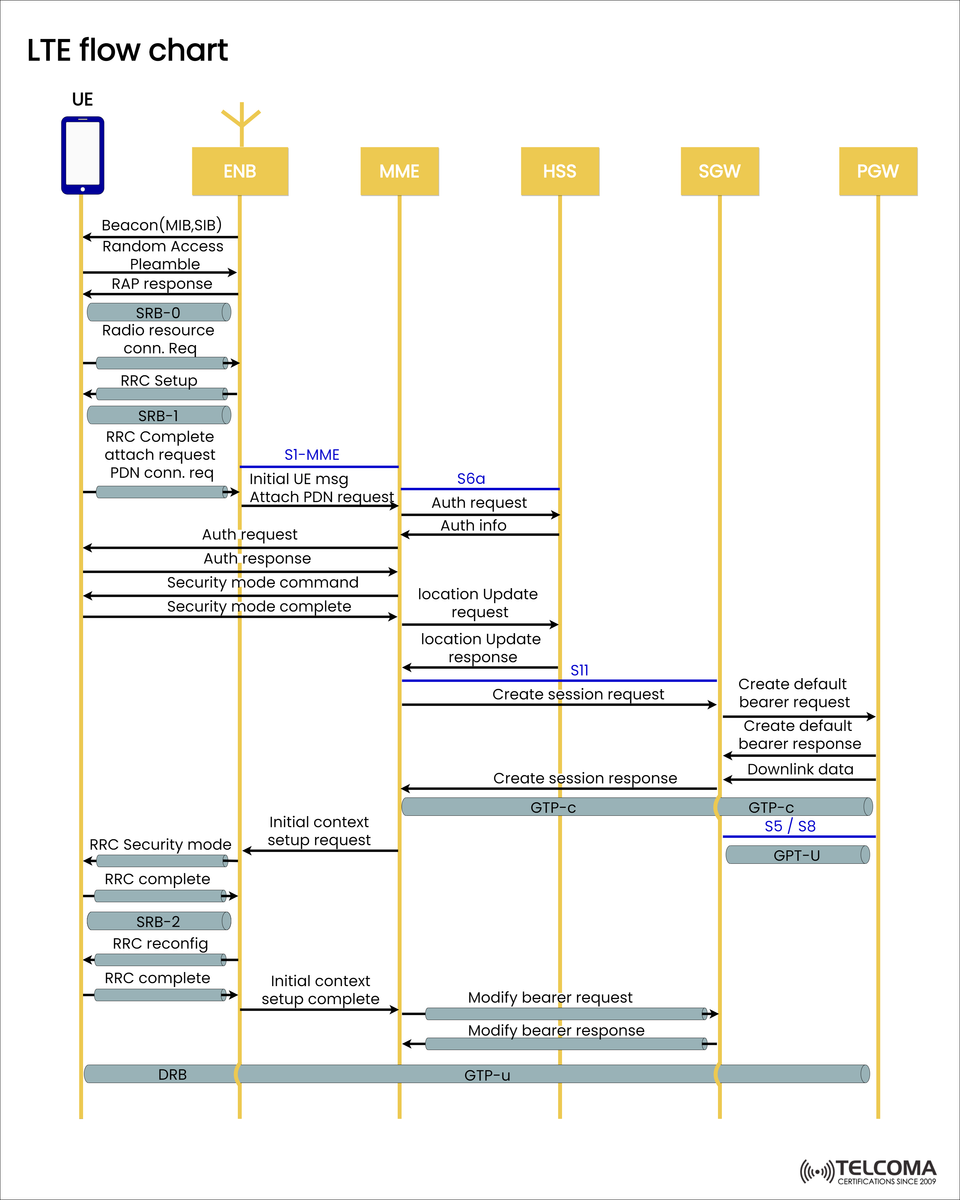
Long Term Evolution (LTE) is the backbone of 4G technology, offering fast data speeds and dependable mobile connectivity. If you're in telecom or just a tech enthusiast, getting a grip on the LTE flow chart is pretty important. It visually lays out how a device, referred to as User Equipment (UE), connects to the network and sets up secure communication with the core network.
The image above shows the LTE attach and session setup process, highlighting the interactions between key LTE components:
UE (User Equipment): This is your mobile device.
ENB (eNodeB): The base station that manages the radio connection.
MME (Mobility Management Entity): The control center for LTE signaling.
HSS (Home Subscriber Server): This holds subscriber and authentication data.
SGW (Serving Gateway): Directs traffic within the LTE core.
PGW (PDN Gateway): Connects the LTE core to outside networks, like the internet.
By looking at this flow, you can see how LTE ensures authentication, security, session establishment, and data transfer.
LTE Flow Chart: Step-by-Step Call Flow
Let's break down the LTE call flow into major phases:
- Initial Network Access (UE ↔ ENB)
Before a mobile device can chat it up, it needs to sync with the network and ask for resources.
Beacon Messages (MIB, SIB): The eNodeB sends out the Master Information Block (MIB) and System Information Blocks (SIBs), helping the UE find and understand the cell.
Random Access Procedure (RACH):
UE sends a Random Access Preamble.
ENB responds with a RACH response.
This step sets up timing and initial communication.
Radio Resource Control (RRC) Setup:
UE sends an RRC Connection Request.
ENB replies with an RRC Setup message.
Attach Request:
UE sends an Attach Request + PDN Connectivity Request.
This shows the UE wants to link up with the LTE network and access data services.
- Authentication and Security (MME ↔ HSS ↔ UE)
Securing the connection is crucial to keep out unauthorized users.
Authentication:
MME sends an Authentication Request to HSS over the S6a interface.
HSS provides authentication vectors in response.
MME challenges the UE, which then replies correctly.
Security Mode Command:
MME kicks off security with encryption and integrity protection parameters.
UE responds with Security Mode Complete to confirm everything's secure.
- Location Update and Subscriber Information
Once the security is set, the MME updates where the subscriber is located.
Location Update Request: MME sends this to HSS.
Location Update Response: HSS sends back user profile and subscription details.
This process keeps the network informed about the subscriber’s location and available services.
- Session Creation (MME ↔ SGW ↔ PGW)
Now it’s time to establish a session for data communication.
Create Session Request (S11 interface):
MME sends a request to SGW.
SGW passes it along to PGW.
Create Default Bearer Request: The PGW starts setting up the default bearer, which is the channel for basic internet access.
Create Session Response: This is sent back from PGW to SGW and then to MME.
At this point, the default bearer is all set, so the UE can get online once everything is finalized.
- Context Setup (UE ↔ ENB ↔ MME)
This step makes sure the UE is fully connected.
Initial Context Setup Request: MME sends this to ENB, including bearer parameters.
RRC Security Mode & Reconfiguration: ENB sets up the radio bearers (SRB-2, DRB).
Context Setup Complete: UE confirms it's ready to go.
- Bearer Modification and Dedicated Bearers
Some services, like VoLTE, need dedicated bearers to ensure Quality of Service (QoS).
Modify Bearer Request: MME/SGW can send updates to alter bearer settings.
Modify Bearer Response: This one confirms the changes.
Dedicated Bearer Setup (optional): This guarantees QoS for voice or video calls.
- User Data Transfer (GTP-U)
Lastly, the data plane is set up using GTP-U tunnels:
UE ↔ ENB ↔ SGW ↔ PGW
All user data, whether browsing the internet, streaming videos, or making VoLTE calls, travels through these tunnels.
LTE Flow Chart Summary Table
| Phase | Action | Entities Involved | Protocol/Interface |
| 1. Network Access | UE ↔ ENB | RRC |
| 2. Authentication | MME ↔ HSS ↔ UE | S6a |
| 3. Security Setup | MME ↔ UE | NAS/RRC |
| 4. Location Update | MME ↔ HSS | S6a |
| 5. Session Creation | MME ↔ SGW ↔ PGW | S11, S5/S8 |
| 6. Context Setup | MME ↔ ENB ↔ UE | S1-MME |
| 7. Bearer Modification | SGW ↔ PGW ↔ ENB | GTP-C |
| 8. Data Transfer | UE ↔ ENB ↔ SGW ↔ PGW | GTP-U |
Importance of LTE Flow Chart
Getting a handle on the LTE flow chart is useful for both network engineers and telecom students:
Troubleshooting: Helps pinpoint problems in attaching processes, bearer creation, or data transfers.
Optimization: Engineers can streamline signaling and cut down on latency.
Interoperability Testing: Ensures smooth connections between different vendors (like ENB from one company and EPC from another).
5G Readiness: LTE serves as a fallback in 5G Non-Standalone (NSA) mode, so this knowledge is essential.
Practical Example: What Happens When You Switch On Your Phone?
Your smartphone boots up and finds the LTE cell using MIB/SIB broadcasts.
It performs random access and submits an attach request.
MME verifies your SIM information with the HSS.
Security gets established, and the network updates your current location.
A default bearer is created through SGW and PGW to enable internet access.
If you initiate a VoLTE call, a dedicated bearer is set up with QoS guarantees.
Finally, user data flows smoothly between the UE and the internet.
Conclusion
The LTE flow chart outlines the entire process of how a mobile device connects to the LTE network, authenticates itself, secures its connection, sets up sessions, and prepares bearers for data transfer. Every step—from that initial random access to finally establishing the data plane—is vital for ensuring secure and reliable communication.
For anyone in telecom, getting to know this flow chart is more than just theoretical—it's crucial for network troubleshooting, optimization, and gearing up for a transition to 5G. LTE continues to be the backbone of global mobile connectivity, and its call flow will remain central to the next generation of networks.