
LTE Handover Explained: X2 and S1 Interface-Based Mobility Management
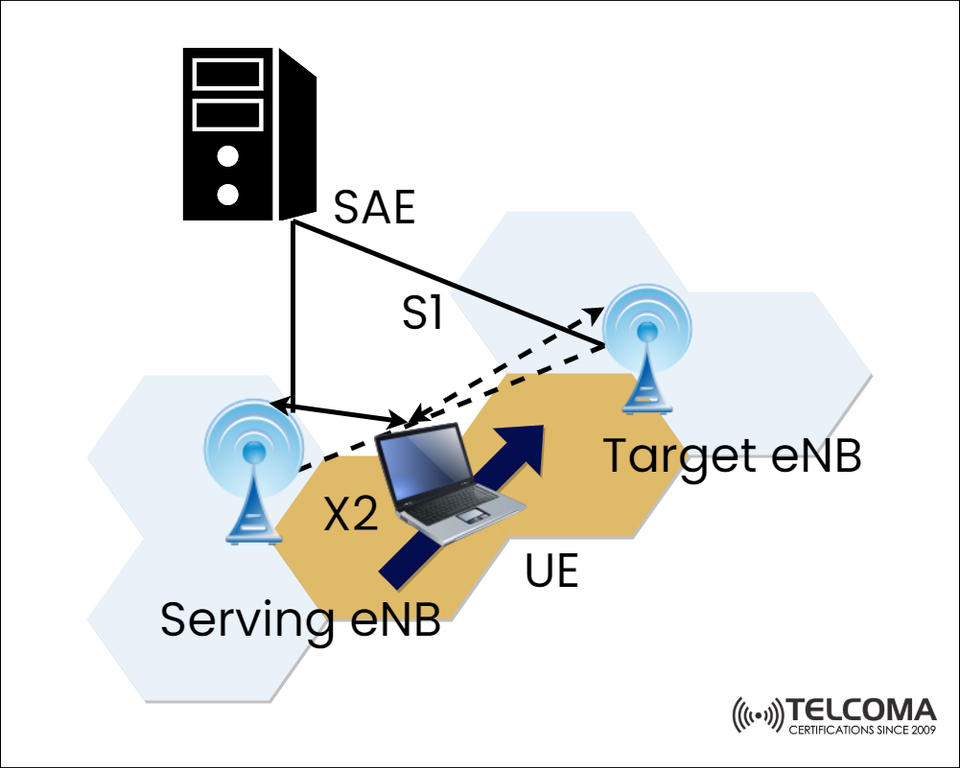

📶 LTE Handover Overview
Handover is a key component in LTE (Long Term Evolution) for keeping the services associated with the User Equipment (UE) intact as it moves (in various directions) between cells and is represented in the image. It points to important elements of LTE mobility, since movement is not only the direct interplay occurring between the serving eNB, target eNB, and the pair (SAES) via X2 and S1 to the core engine.
🔁 Handover Types
- X2-Based Handover in LTE (source eNB to target eNB)
This is the fast and efficient intra-LTE handover, where the two eNBs know each other directly via the X2 interface.
Eliminates usage of core network resources.
Provides reduced latency to UE and lower user signaling load. - S1-Based Handover in LTE (source eNB to target eNB)
The S1 handover is used for mobility when the X2 interface is not available. Examples where the X2 interface is not available typically involve the migration between different vendors of eNBs, furthermore situations where local interconnectivity does not exist. This method relies on the involvement of the SAE-GW via the S1 interface to make successful movement occur.
In general, the S1 can be time-consuming and slower than X2-based handovers because the core will utilize signaling overhead per moving user.
📊 LTE Handover Procedures in Simplified Form
Step Description
1️⃣ UE sends measurement reports to the serving eNB.
2️⃣ Serving eNB selects a target eNB.
3️⃣ Handover Request sent (via X2 or S1).
4️⃣ Target eNB prepares resources.
5️⃣ Handover Command sent to UE.
6️⃣ UE switches to target eNB and resumes service.
🔑 Key interfaces in LTE Handover:
Interface Function
X2 Direct interface between two eNBs for local handover only.
S1 Interface between eNB and SAE core (MME + SGW).
SAE Core network architecture.
🧠 The Importance and Value of Handover Optimization
Timely and optimized handover is critical for
- Continuous voice/video sessions
- Better user experience associated with high-speed mobility
- Appropriate utilization of radio resources
- Less dropped calls and packet loss
🧩 LTE Handovers Best Practice Options
- Use X2 handover where possible to allow lower latency handover
- Set appropriate handover thresholds and hysteresis
- Monitor Key Performance Indicators (KPI) such as handover success rate, failures, and ping-pong.
- Make sure neighbor cell list is optimized in eNB configuration
✅ Use Case Scenarios to Take Advantage of Fast Handover
- Urban mobility (trains, buses, highways)
- VoLTE (Voice over LTE) continuity
- Real-time gaming and streaming
- Enterprise LTE private networks with users moving fast.
🔍 Real-World LTE Handover Scenarios
🏙️ Urban Deployment
With dense eNB deployments comes the need for frequent handovers.
When handover's occur utilizing X2, traffic does not need to be routed to the core network.
Setting the handover margin prevents the ping-pong effect between overlapping cells.
🚄 High-Speed Mobility (e.g. trains)
Fast Handover execution time and optimal measurement reporting is required.
S1-based handover will delay the handover path leading to service interruptions. Therefore, the macro-to-macro X2 handover should be preferred in this mobility scenario.
🏭 Industrial/Private LTE
In industrial use cases or (private LTE) with closed-loop control in a factory or distribution warehouse, seamless handover is absolutely critical for low-latency applications and services.
In industrial LTE, incoming reports are received from the UE measured using customized neighbor relation lists for decision making.
🧪 LTE Handover KPIs to Monitor
KPI Description
HO Success Rate Percentage of handover processes that completed successfully from a UE perspective
HO Failure Rate Any failures that occured during HO, typically due to poor timing or lack of resources
Ping-Pong Rate May occur from eNB A → B → A repeatedly, may indicate thresholds are misconfigured
HO Preparation Time Time taken to prepare the target cell for service
HO Execution Time Time from the service command from any source before the UE successfully attaches to the target eNB
📈 These LTE Handover KPIs will be important for SON (Self-Organizing Network) functions for automatic optimization.
🤖 LTE Handover and Self-Organizing Networks (SON)
Self-Organizing Network aspects have been introduced into next generation LTE networks and are now being exploited, specifically for:
• Automatic Neighbor Relations (ANR), which manages the automatic updates of neighbor cell information.
• Mobility Load Balancing (MLB), which manages the balancing of user load across eNBs during handovers.
• Mobility Robustness Optimization (MRO), which minimizes and lightens the unnecessary handovers and ping-pongs.
🧠 SON systems can use intelligence to switch X2 and S1 handovers in a smooth manner, based on the health of the network, the load of the cells, and the availability of paths.
📎 LTE Handover in the Transition to 5G
As the roll-out of 5G happens in non-standalone (NSA) networks, LTE is managing control-plane services. The handover of:
• LTE eNB ↔ 5G gNB (inter-RAT)
• LTE ↔ LTE (intra-RAT)
...needs to be seamless in order for the dual connectivity (EN-DC) and handover anchoring to function correctly.
Operators need to make arrangements for:
• Confirming that the LTE eNBs have been upgraded with the latest firmware to support the Xn interfaces.
• Using the same site tools for LTE and 5G RAN planning.
📘 Summary Table:
X2 vs S1 Handover
Feature X2 Handover S1 Handover
Path Direct eNB ↔ eNB MME (through core)
Latency Lower Higher
Use Case Intra-LTE with neighbor eNBs Only if no X2
Dependency Neighbor relation config MME and core signaling
Advantage Fast, efficient Universal
🏁 Final Thoughts
The ability to hand over UEs between cells in a seamless manner is the heart of high performance LTE service delivery. Whether X2 or S1 is used in handover; the intention is to minimize disruption and optimize the handover process.
🔧 Common Reasons for Handover Failures
Faulty Neighbor Relations (ANR not updated)
X2 Interface misconfigured or missing
Target eNB does not have enough radio resources
Timing advance or TA does not match (UE moves too quickly)
Handover parameters or thresholds not compatible
Core network S1 Interface is blocked or congested