
LTE Interfaces and Protocols Explained: S1, X2, S11, S5/8, and Their Role in 4G Networks

LTE Interfaces and Protocols – The Ultimate Guide
Long Term Evolution (LTE) has become the backbone of mobile broadband, allowing for high-speed data, VoIP, and smooth mobility. At the core of LTE are specific interfaces and protocols that link the user equipment (UE), radio access network (eNB), and important elements of the core network like MME, SGW, and PGW.
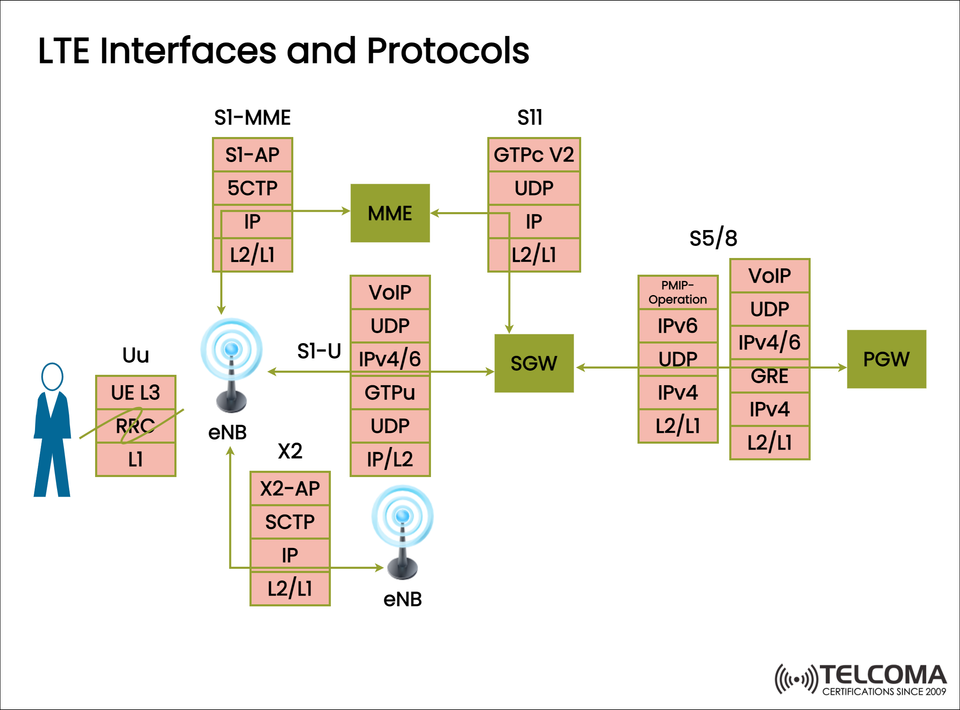
The diagram provided gives a comprehensive view of these interfaces, such as S1-MME, S1-U, S11, S5/8, and X2, along with the protocols in play at each layer. Knowing how these connections work is essential for telecom experts, engineers, and anyone interested in mastering LTE architecture.
Overview of LTE Architecture
LTE consists of three main parts:
User Equipment (UE): This includes smartphones, IoT devices, or any terminal that supports LTE.
E-UTRAN (eNB): The radio access network linking UEs to the core.
EPC (Evolved Packet Core): The core network made up of MME, SGW, and PGW.
These components communicate through reference points (interfaces) carrying both control plane and user plane data, making sure session management, mobility, and data forwarding are handled properly.
Understanding LTE Interfaces
- Uu Interface (UE ↔ eNB)
The Uu interface serves as the radio interface between the UE and the eNodeB.
Protocols Used:
RRC (Radio Resource Control): Manages signaling for cell selection, handover, and bearer setup.
PDCP, RLC, MAC, PHY: These handle tasks like header compression, segmentation, retransmission, and physical layer modulation/coding.
Role: Enables wireless communication, supports mobility, and establishes bearers.
- S1 Interface (eNB ↔ EPC)
The S1 interface has two parts:
a) S1-MME (Control Plane)
Connects the eNB to the Mobility Management Entity (MME).
Protocols Used:
S1-AP (S1 Application Protocol): Manages UE context, bearer setup, paging, and handovers.
SCTP (Stream Control Transmission Protocol): Ensures reliable transport for signaling messages.
IP (IPv4/IPv6): Used for network layer addressing.
b) S1-U (User Plane)
Links the eNB to the Serving Gateway (SGW) for user data transfer.
Protocols Used:
GTP-U (GPRS Tunneling Protocol - User plane): Encapsulates user data packets.
UDP/IP: Provides transport and addressing.
Role: This is where the actual user data traffic flows between the UE and the core network.
- X2 Interface (eNB ↔ eNB)
The X2 interface allows direct communication between eNBs, facilitating smooth handovers and load balancing.
Protocols Used:
X2-AP: Handles signaling for handover requests, load information, and interference coordination.
SCTP/IP: Ensures reliable transport for signaling.
With this interface, network performance improves since neighboring eNBs can communicate directly, which cuts down on signaling delays during handovers.
- S11 Interface (MME ↔ SGW)
The S11 interface connects the MME to the SGW for signaling in the control plane.
Protocols Used:
GTP-C (GPRS Tunneling Protocol – Control plane): Used for session creation, bearer modifications, and releases.
UDP/IP: Underlines transport and network addressing.
This interface plays a key role in managing bearers, making sure UEs receive the appropriate Quality of Service (QoS).
- S5/8 Interface (SGW ↔ PGW)
The S5/8 interface manages both user-plane and control-plane communication between the Serving Gateway (SGW) and the PDN Gateway (PGW).
Protocols Used:
GTP-U/GTP-C or PMIPv6 (Proxy Mobile IPv6): Used for tunneling and mobility management.
UDP/IP: For the transport layer.
Difference between S5 and S8:
S5: Used when both SGW and PGW are in the same network (non-roaming).
S8: Used when they’re in different networks (roaming scenario).
Details on the Protocol Stack
Each interface uses a layered protocol stack that guarantees reliable communication.
Interface Control Plane Protocols User Plane Protocols UuR RCPDCP/RLC/MAC/PHYS1-MMES1-AP, SCTP, IPN/AS1-UN/AGTP-U, UDP/IPX2X2-AP, SCTP, IP Optional GTP-U for data forwardingS11GTP-C, UDP/IPN/AS5/8GTP-C (or PMIPv6), UDP/IPGTP-U, UDP/IP
This separation allows the control and user plane functions to scale independently, keeping LTE flexible and efficient.
Why These Interfaces Matter
Grasping LTE interfaces is crucial for several reasons:
Managing Mobility: Smooth handovers need coordination across S1 and X2 interfaces.
Quality of Service (QoS): Bearer establishment through S11 and S5/8 ensures proper handling of QoS.
Working Together: Protocols defined by 3GPP let different vendors' equipment operate together.
Roaming Support: The S8 interface allows for global roaming with PGW anchoring.
Troubleshooting Networks: Knowing these interfaces helps engineers quickly analyze packet traces and fix network problems.
Challenges and Considerations
Latency Issues: If S1 or X2 interfaces aren’t configured right, handover delays can increase.
Scalability Problems: SCTP and GTP tunnels need to expand as UE density grows.
Securing Communications: IPsec is sometimes utilized to secure S1, S11, and S5 interfaces.
Roaming Complexities: The S8 interface must work with multiple partner networks.
Real-World Uses
VoLTE (Voice over LTE): Depends on S1-MME signaling and S1-U bearers for delivering VoIP packets.
Carrier Aggregation: X2 signaling between eNBs helps in resource coordination.
IoT over LTE: Simple signaling ensures communication for low-power devices.
Handover Optimization: X2 handovers help minimize call drops during high-speed movement.
Final Thoughts
The LTE framework relies on clear interfaces and protocol stacks to enable speedy, low-latency communication. From the Uu radio interface to the S1, S11, and S5/8 core network interfaces, each component is vital for maintaining connectivity, mobility, and service quality.
For those in telecom, getting a solid grip on these interfaces is essential for designing, optimizing, and troubleshooting LTE networks. As we move toward 5G, these fundamental concepts will continue to play a key role — laying the groundwork for NG interfaces in the 5G core.