
LTE Network Architecture Explained: Terminals, RRH, eNodeB, and Core Connectivity
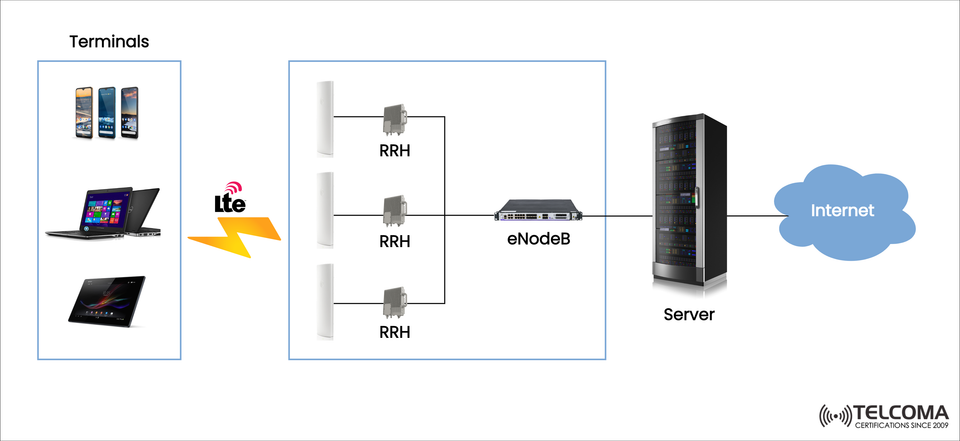

LTE Network Architecture: Terminals, RRH, eNodeB, and Internet Connectivity
Long Term Evolution, or LTE, is what powers today’s 4G networks, enabling high-speed mobile internet and quick communication. If you’re in telecom or just curious, grasping LTE’s setup is key for understanding how devices hook up to the network and get online.
The diagram shared shows the main parts of LTE architecture — from user devices (UEs) to Remote Radio Heads (RRHs), eNodeBs, servers, and all the way to the internet. Let’s take a closer look at each piece.
LTE Terminals (User Equipment)
LTE terminals, often called User Equipment (UE), are the devices that connect to the LTE network. This category includes:
Smartphones (the main users of LTE)
Laptops with LTE dongles or built-in modems
Tablets and IoT gadgets
UEs are responsible for several tasks:
Radio Communication: They hook up to the nearest LTE cell via radio signals.
Mobility Management: They manage the handovers between cells as users move around.
Session Management: They keep data sessions active and maintain IP connectivity.
Radio Access Network (RAN): RRH and eNodeB
The RAN is the part of the LTE network that connects UEs to the core network. The image points out two crucial elements within the RAN:
- Remote Radio Head (RRH)
The RRH is a radio unit that’s placed close to antennas, typically on towers or rooftops.
Function: It handles converting analog signals to digital, boosting radio frequency (RF), and transmitting/receiving LTE signals.
Benefits: * Minimizes signal loss by being nearer to the antenna. * Supports centralized baseband processing in C-RAN setups.
- eNodeB (Evolved Node B)
The eNodeB acts as the main processing hub for the LTE RAN.
Key Responsibilities: * Radio Resource Management (RRM): Allocates resources for data transmission. * Scheduling: Determines which user receives which resources in each time block. * Handover Control: Ensures smooth transitions between cells. * Security: Encrypts and protects user data.
The eNodeB connects to the core network (EPC) through the S1 interface and communicates with other eNodeBs via the X2 interface for managing handovers.
Backhaul Connectivity and Core Network
Once the user traffic reaches the eNodeB, it’s sent to the server (the core network part) and then on to the internet.
S1-U Interface: This carries user data packets to the Serving Gateway (SGW).
S1-MME Interface: It handles signaling between the eNodeB and MME (Mobility Management Entity).
The server depicted represents the core functions of the Evolved Packet Core (EPC):
MME (Mobility Management Entity): Manages attaching/detaching, authentication, and bearer setup.
SGW (Serving Gateway): Routes user data from eNodeB to the core.
PGW (Packet Gateway): Links LTE users to external networks, including the internet.
End-to-End LTE Data Flow
The diagram illustrates the entire data flow:
User Device (UE): Starts the data request.
RRH: Sends the request to the eNodeB via the air interface.
eNodeB: Processes the request, allocates resources, and sends data to the EPC.
Server (Core Network): Routes the traffic to the right external network.
Internet: The final destination or source for the requested data.
This whole process allows for seamless streaming, browsing, and communication over LTE.
Key Advantages of LTE Architecture
High Data Rates: Can support speeds up to 300 Mbps with LTE-Advanced.
Low Latency: Offers round-trip times as short as 10 ms.
All-IP Design: Simplified structure using packet switching for all services, including voice (VoLTE).
Scalability: Easy to upgrade to LTE-Advanced and 5G NR.
Flexibility: Can work with multiple frequency bands and carrier aggregation.
Comparison: LTE vs Legacy Networks
FeatureLTE3G (UMTS)Core Network All-IP EPC Circuit + Packet CoreLatency~10 ms~100 ms Peak Data Rate100–300 Mbps2–14 Mbps Architecture Flat (eNodeB connects directly to EPC)Hierarchical (NodeB → RNC → Core)Voice Service Vo LTE (packet-switched)Circuit-switched
This comparison highlights why LTE became the universal choice for mobile broadband before moving into the 5G era.
LTE Network Challenges
Even with its perks, LTE networks do come with a few hurdles:
Spectrum Availability: Limited spectrum can create congestion in cities.
Backhaul Capacity: The high demand for data needs solid fiber or microwave backhaul.
Interference Management: Essential in crowded areas with overlapping cells.
Smooth Migration to 5G: Operators need to ensure that LTE and 5G can work well together.
LTE’s Role in the 5G Era
Though 5G is rolling out, LTE remains a cornerstone technology:
5G NSA (Non-Standalone) Mode: Leverages LTE for signaling and mobility functions.
Fallback Option: Steps in to provide coverage in places lacking 5G.
IoT Connectivity: Technologies like LTE-M and NB-IoT are crucial for large-scale IoT deployments.
Diagram Overview – LTE Network Setup
The image above gives us a clear but simple look at how LTE networks work from start to finish. Let’s dive into each part:
- Terminals (User Equipment – UE)
This section features smartphones, laptops, and tablets. These gadgets are all LTE-enabled and connect to the mobile network through radio signals. Depending on their chipset, they fall into different LTE categories, which affects their maximum data speed.
What UE does:
Starts the connection with the network.
Checks signal quality and sends that info to the eNodeB.
Uses LTE protocols, like RRC (Radio Resource Control).
- LTE Radio Link (Wireless Access)
In the diagram, the LTE logo with a lightning bolt symbolizes the wireless link between user devices and the network. This is where LTE’s OFDM (Orthogonal Frequency Division Multiplexing) technology steps in, allowing for fast, low-latency communication.
Conclusion
The architecture of LTE networks is crafted to offer high-speed, low-latency connectivity, all while being scalable and cost-effective. From user devices to RRHs, eNodeBs, and core servers, each part works in harmony to provide dependable communication and easy internet access.
As the telecom landscape shifts toward 5G and beyond, LTE continues to be a crucial fallback and a reliable layer for both voice and data coverage. For telecom engineers and industry professionals, a strong grasp of LTE architecture is vital for effectively planning, optimizing, and managing modern mobile networks.