
LTE Release 12 and Beyond: Mobile Downlink Categories 13–20 Explained
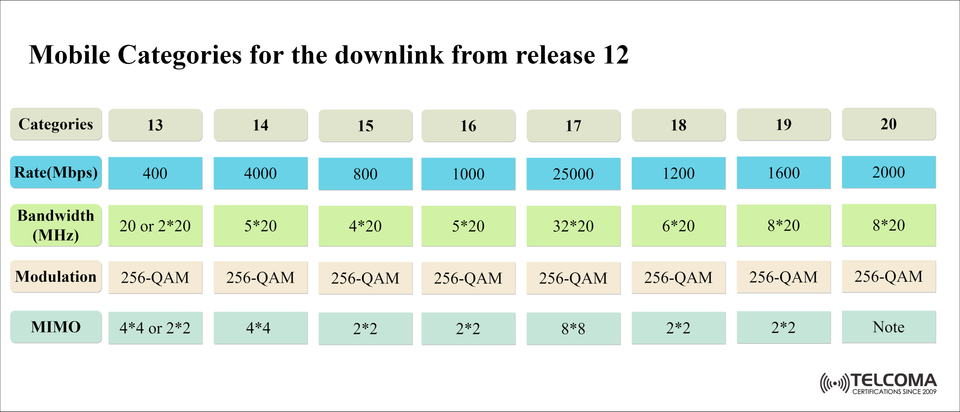

Mobile Downlink Categories from LTE Release 12 (Cat 13 to Cat 20)
With LTE Release 12 and subsequent releases from the 3GPP, there were significant enhancements in downlink speed, spectral efficiency and antenna technology. These categories - Cat 13 to 20, are designed for high-performance mobile broadband intended for certain use cases that need the very high throughput.
The table below summarizes the key technical attributes of each of these categories against the image provided.
- LTE Release 12+ Downlink Category Table
Category Rates (Mbps) Bandwidth (MHz) Modulation MIMO
Cat 13 400 20 or 2x20 256-QAM 4x4 or 2x2
Cat 14 4000 5x20 256-QAM 4x4
Cat 15 800 4x20 256-QAM 2x2
Cat 16 1000 5x20 256-QAM 2x2
Cat 17 25,000 32x20 256-QAM 8x8
Cat 18 1200 6x20 256-QAM 2x2
Cat 19 1600 8x20 256-QAM 2x2
Cat 20 2000 8x20 256-QAM Note
Key Technical Aspects
a. Data Rates
Cat 13 starts at 400 Mbps as designed for the majority of LTE-A Pro deployments.
Cat 17 offers a mind blowing 25Gbps. LTE technologies on steroids, approaching its theoretical limits.
Cat 20 offers 2Gbps offering gigabit capable mobile broadband for commercial purposes.
b. Bandwidth
Bandwidth ranges from 20MHz (Cat 13) to a massive 640MHz (32x20 MHz in Cat 17).
Your speed and capacity grow with your bandwidth, but wider bandwidth requires a lot of spectrum.
c. Modulation
256-QAM being the only modulation in all cases - so theoretically a lot more environmentally friendly, because it gives a higher spectral efficiency, by fitting more bits with each symbol than 64-QAM.
All scenarios require very good SINR for the systems to consistently work properly.
d. MIMO Configurations
The higher categories utilize sophisticated MIMO (multiple input multiple output) for spatial multiplexing.
The 8x8 MIMO in Cat 17 is capable of a massive number of parallel data streams and achieves extremely high throughput.
In lower-end configurations, for example 2x2 MIMO, performance is also good with lower hardware complexity.
- Real-World Use Cases
Cat 13-16: Great for high-speed mobile data, enterprise connectivity, and HD video streaming.
Cat 17: Best for specific applications including large volume broadcasting, mission-critical communications, and testing new networks.
Cat 18-20: For urban hotspots and very-dense venues where LAA connects to the spectrum that enjoys gigabit-class throughput and fixed wireless access.
- Engineering Considerations for Deployment
Spectrum Strategy: When using multi-carrier aggregation technology, large contiguous spectrum blocks, or well-defined spectrum blocks, are ideal.
Signal Quality: 256-QAM has lower data rates for first-order non-orthogonal MA, requiring RF planning to ensure appropriate separation and minimize interference.
Backhaul Infrastructure: Applying multi-gigabit downlink speeds beyond the RAN generally requires fibre-grade backhaul to avoid bottlenecks.
Device Subscriptions: Not every device has been engineered for the specify higher category being illustrated in this paper; backwards compatiblility is critical planning.
- 5G Future Considerations
Although 5G NR is now in the spotlight, LTE Release 12+ categories remain meaningful because they will:
Provide automatically fall-back layers in NSA (Non-Standalone) 5G deployement.
Provide continuity of coverage where adequate 5G spectrum is not available.
Support the devices for IoT, rural broadband, and high-reliability LTE.
6. Scenario Based Deployments LTE Release 12+
Cat 13-15: High-Capacity Urban LTE-A Pro
Scenario: Within the core of a city, I am brandishing a LTE-A Pro array of numerous 20MHz LTE carriers aggregated together.
Performance: Under these optimum conditions, I can attain 400-800 Mbps speeds.
Conclusion
LTR release 12+ downlink categories Cat 13 to Cat 20 cap out the LTE-A Pro capabilities—delivering theoretical downlink speeds between 400Mbps to 25Gbps, through advanced modulation using 256-QAM, and configured with various MIMO configurations. While very few network operators will deploy the categories commercially, the definitions of these specifications will be important for telecom professionals, engineers, and analysts who are involved in network planning, spectrum planning and next generation design/build connectivity.
Use Case(s): HD video streaming, enterprise VPN access, and public Wi-Fi offload.
Deployment Advantage: I could achieve this condition with average spectrum holdings and infrastructure.
Cat 16 and Cat 18-20: Gigabit-Class MM
Scenario: Advanced LTE-A Pro deployment with 5-8 carriers already deployed (100-160 MHz total)
Performance: Under lab conditions achieve 1-2Gbps downlink speeds; 800 Mbps in real-world dense areas.
Use Case(s): 4K live streaming, VR/AR applications, mobile broadband replace for fixed internet.
Deployment Advantage: Great base network to develop a strong 5G NSA anchor network to run from; ideal option for premium subscribers.
Cat 17: Experimental, and Ultra-High Capacity Networks
Scenario: College testbed (experimental) or specialized industrial deployment with 32 aggregated 20MHz carriers.
Performance: Theoretical peak of 25Gbps—not practical in commercial use.
Use Case(s): Military communications, national broadband research, or infrastructure for mass event broadcasting.
- Limitations & Challenges for LTE Release 12+ Categories
Spectrum Shortage
Even a 5×20 MHz aggregation (Cat 16) is an uphill battle in markets with fragmented allocation.
Device Support
First line devices may support Cat 18–20, however mid-market devices typically peak at Cat 12–16.
Infrastructure Investment
Higher categories will require to upgrade from an existing eNodeB, with improved baseband units, RF modules, and antenna systems.
Signal Quality Requirements
256-QAM, and higher MIMO uses require a strong SINR which may be problematic in situations where mobility is high, or interference occurs.
Backhaul Bottlenecks
If you do not have fiber backhaul then the multi-gigabit throughput will never reach the end user consistently.
- Professional Closing Summary
LTE Release 12+ categories (Cat 13–20) are pushing LTE Advanced Pro to the technical limits and making solid connections bridging toward full 5G capable features. They implement wide carrier aggregation, 256-QAM modulation, and high order MIMO to give operators unparalleled levels of improved downlink performance - 400 Mbps in Cat 13, potentially 25 Gbps in Cat 17 as the theoretical level.
While not all categories will practically be available for commercial deployment, they are extremely important for:
Finding LTE relevance for 5G as a persistent anchor in NSA.
Delivering gigabit class speeds in urban/enterprise settings.
Ensuring that there is a fallback network that has robust coverage with reasonable capacity.
As a telecom planner or engineer, understanding the categories is key to paradigm shift in planning spectrum strategy, network modernization, and device certification in.