
LTE Release 8 vs Release 13: Beamforming and Transmission Evolution Explained
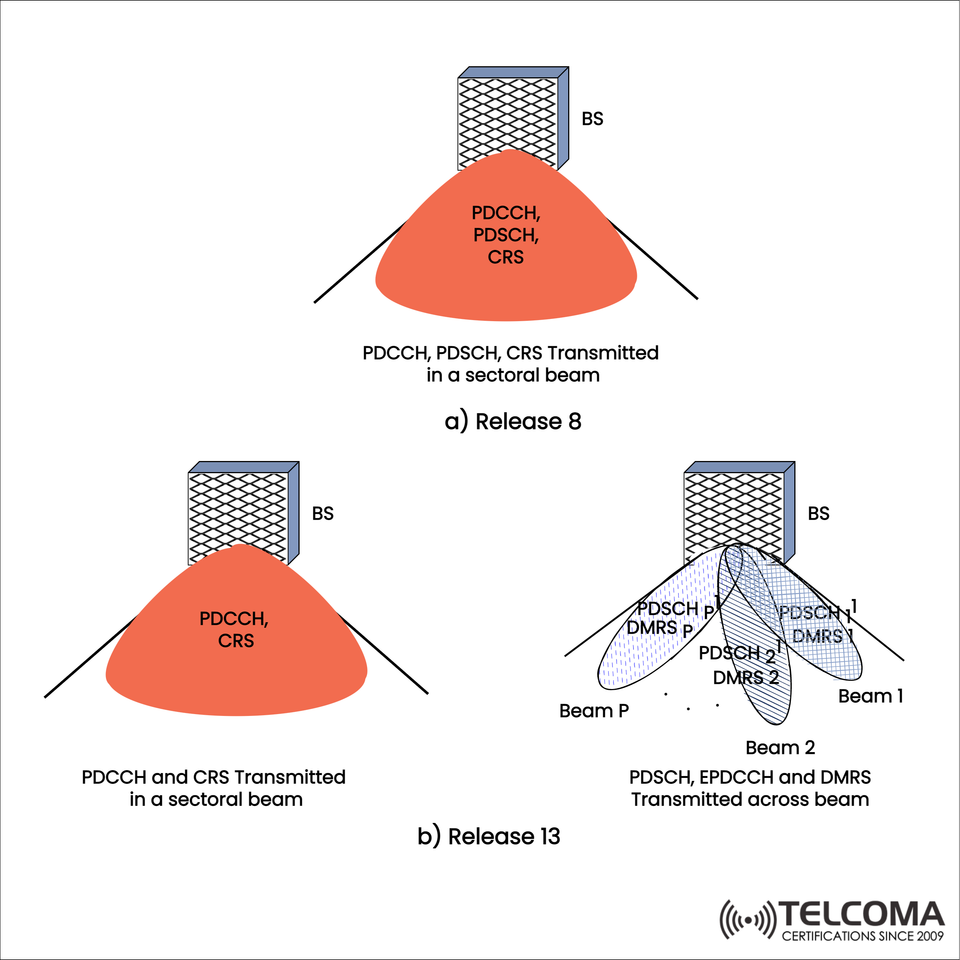

Long-Term Evolution (LTE) has come a long way, mainly because there's been a steady demand for things like better efficiency, a smoother user experience, and overall improved network performance. A big leap forward from LTE Release 8 to Release 13 can be seen in how control and data channels are sent out.
Check out the image uploaded for a side-by-side look at the two releases:
Release 8: Used sector-based transmission for control and data signals.
Release 13: Introduced advanced beamforming that allows for better separation between control and data channels.
This blog post dives into what makes the two releases different, why these updates were made, and what benefits they bring to operators and users alike.
LTE Release 8 Transmission (Sectoral Beams)
In Release 8, LTE rolled out Orthogonal Frequency-Division Multiple Access (OFDMA) for downlink and Single Carrier-FDMA (SC-FDMA) for uplink. However, it used a sectoral beam for the downlink physical channels and reference signals, leading to some limitations.
Features of Release 8:
Channels transmitted together:
PDCCH (Physical Downlink Control Channel)
PDSCH (Physical Downlink Shared Channel)
CRS (Cell-specific Reference Signal)
Transmission mode:
Broadcasted in a wide sectoral beam, covering all users in the cell sector.
Limitations of Release 8:
Energy Inefficiency: Sending control and data channels to everyone in the sector drains power.
Interference: Broad transmissions lead to inter-cell interference issues.
Scalability Issues: In crowded environments, sector beams aren't very efficient.
Limited Beamforming: Only basic techniques were there, lacking the ability for user-specific beams.
To sum it up, while Release 8 set the stage for LTE, its sector-wide broadcast model wasn't optimal for advanced beamforming or effective spectrum use.
LTE Release 13 Transmission (Beam-based)
Fast forward to Release 13, and LTE had made some serious strides. It added advanced beamforming and flexible channel transmission methods for better coverage, efficiency, and user-focused optimization.
Features of Release 13:
Separated control and data transmission:
PDCCH & CRS: Still sent broadly in a sectoral beam for backward compatibility.
PDSCH (Physical Downlink Shared Channel), EPDCCH (Enhanced Physical Downlink Control Channel), and DMRS (Demodulation Reference Signals): Sent in narrow, user-specific beams.
Beamforming:
Multiple narrow beams (like Beam 1, Beam 2, etc.) can service different users at the same time.
This means stronger signals for each user without sending out a wide broadcast.
Benefits of Release 13:
Higher Spectral Efficiency: Narrow beams cut down on interference and make the best use of available spectrum.
Energy Efficiency: Power is directed only toward the intended user, so there's no waste.
Better Coverage and Capacity: Gives stronger signals to users at the edge of coverage and handles busy urban areas much better.
Advanced Beam Management: The new EPDCCH allows for flexible scheduling, while DMRS enhances decoding accuracy, especially useful in MIMO setups.
With its beam-based approach, Release 13 marks a significant step toward making LTE more like 5G, paving the way for future networks.
Comparative Analysis: Release 8 vs Release 13
Parameter | Release 8 | Release 13
Control Channels | PDCCH, CRS | PDCCH, CRS (sectoral); EPDCCH (beam-specific)
Data Channels | PDSCH (sectoral) | PDSCH (beam-based, user-specific)
Reference Signals | CRS (sector-wide) | DMRS (beam-based) + CRS
Beamforming | Sectoral beam only | Multiple narrow beams (beamforming enabled)
Efficiency | Lower spectral and energy efficiency | Higher efficiency with reduced interference
User Experience | Limited coverage optimization | Improved throughput, better edge-user performance
Technical Deep Dive: EPDCCH and DMRS in Release 13
Two major upgrades in Release 13 are:
- EPDCCH (Enhanced Physical Downlink Control Channel)
This one’s all about beam-specific control signaling.
Unlike the sector-wide broadcast of PDCCH, EPDCCH can be sent via narrow beams.
This change leads to better link adaptation, scheduling, and managing interference.
- DMRS (Demodulation Reference Signals)
Replaces the sector-wide CRS for more accurate user-specific channel estimation.
Supports beamformed transmission, ensuring accurate decoding for PDSCH.
Key for massive MIMO and advanced beamforming techniques.
Together, EPDCCH and DMRS have shifted LTE Release 13 from a sectoral broadcast system to one that's beam-based, setting the stage for future 5G networks.
Why the Shift Was Necessary
The change from Release 8’s sectoral model to Release 13’s beam-based model was driven by several industry demands:
Growing Data Demand: As more devices come online and need higher throughput, better spectrum efficiency became a must.
Urban Deployments: Busy cities with lots of users need to cut down on interference.
IoT and Enterprise Services: There's a need for precise, energy-efficient transmissions.
5G Readiness: The beamforming in Release 13 sets the groundwork for 5G NR, which relies heavily on beam-centric designs.
Use Cases Enhanced by Release 13
Dense Urban Networks:
Narrow beams help reduce interference between users in crowded areas.
Cell Edge Users:
Focused beams boost SINR, which increases throughput for users who are farther away from the base station.
Massive MIMO Systems:
Release 13 lays the groundwork for advanced MIMO techniques that enhance spatial multiplexing.
Energy-Conscious Networks:
Operators save energy by only transmitting where it’s needed.
Conclusion
The leap from LTE Release 8 to Release 13 is a big deal in the evolution of wireless transmission techniques.
Release 8 used a sector-wide broadcasting approach, which was simple but not very efficient.
Release 13 brought in beam-specific transmission with innovations like EPDCCH and DMRS, leading to better efficiency, coverage, and spectrum utilization.
These advancements haven’t just improved LTE's performance but also laid a solid foundation for 5G NR, where beamforming and narrow-beam transmissions are key.
For those in the industry, getting a grip on this evolution is crucial to understanding how LTE is moving toward next-gen mobile networks.