
M-Health System Model Explained: Wireless Body Area Networks in Healthcare
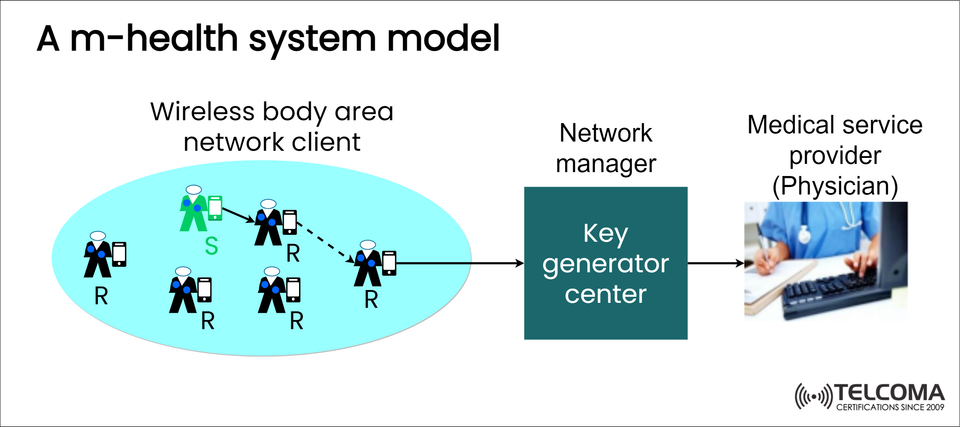

M-Health System Model: Changing the Game in Healthcare with Wireless Body Area Networks
The healthcare sector is experiencing a huge shift thanks to mobile health (m-health) systems. These systems blend wireless tech, body sensors, and secure communication channels to allow for real-time monitoring and medical care. The image included shows a m-health system model, illustrating how patients, wireless body area networks (WBANs), network managers, and healthcare providers interact with one another.
This blog post breaks down the model step-by-step, making it easier for tech enthusiasts and telecom professionals to grasp its architecture, technical layers, and what benefits it brings to the future of healthcare.
What is M-Health?
M-health (mobile health) is all about using mobile devices and wireless technologies to back up healthcare services. It goes further than telemedicine by enabling continuous patient monitoring via smart sensors and real-time data transfer.
Some key elements of m-health are:
Wireless Body Area Networks (WBANs): These are sets of sensors that can be worn or implanted in the body.
Secure Data Transfer: Keeping sensitive health info safe using encryption methods.
Remote Medical Services: Allowing doctors to diagnose, prescribe, and monitor patients without needing to be in the same place.
Understanding the M-Health System Model
The image outlines a typical m-health system model, which breaks down into four main parts:
Wireless Body Area Network Client (WBAN)
Network Manager
Key Generator Center
Medical Service Provider (Physician)
Let’s dive into each of these components.
- Wireless Body Area Network Client
The WBAN client consists of sensors that are either attached to or implanted in the body. These sensors continuously gather real-time physiological data, including:
Heart rate
Blood pressure
Blood glucose levels
Oxygen saturation
Body temperature
In the image, you can spot several patients (marked as “R” for receivers) along with a source node (marked as “S”). Data from these clients flows to the network manager.
Functions of WBAN:
Sensing: Continuously collects biological signals.
Communication: Uses short-range wireless technologies such as Bluetooth Low Energy (BLE), ZigBee, or UWB (Ultra-Wideband).
Energy efficiency: Sensors need to use minimal power while sending crucial data.
- Network Manager
The network manager serves as the middle layer connecting WBAN clients to backend systems. Its duties include:
Data aggregation: Gathers data from multiple sensors.
Routing: Finds the best way to send medical info.
Error detection: Makes sure the data is reliable during transfer.
By overseeing traffic and managing packet flows, the network manager ensures that medical data is sent efficiently and without delay.
- Key Generator Center
Security is super important in m-health systems since patient data is sensitive. The key generator center ensures confidentiality, integrity, and authenticity using cryptographic techniques.
Security Functions:
Key Generation: Produces secure encryption keys for communication between WBAN devices and healthcare providers.
Authentication: Confirms that the data is coming from the right patient and reaching the correct medical provider.
Data Privacy: Blocks unauthorized access or tampering with medical records.
Without this crucial layer, healthcare systems could easily fall prey to cyber threats, data leaks, and unwanted surveillance.
- Medical Service Provider (Physician)
At the end of the line, the physician or healthcare provider gets the patient data in a secure and easy-to-access format. The physician can then:
Analyze health metrics in real-time.
Offer remote consultations.
Suggest personalized treatment plans.
Spot early warning signs of diseases.
This stage turns raw data into actionable medical insights, paving the way for timely healthcare.
Technical Flow of the M-Health System
The overall process of the m-health system can be summed up like this:
Data Collection: WBAN sensors track physiological signals.
Transmission: Data is sent to the network manager.
Security Layer: The key generator center encrypts and secures the data.
Medical Access: The physician goes over patient data for diagnosis and treatment.
Benefits of the M-Health System Model
Rolling out this model has several perks for patients, doctors, and healthcare systems:
For Patients:
Ongoing monitoring of vital signs.
Early identification of health issues.
Fewer hospital visits needed.
For Physicians:
Access to real-time data on patients.
The ability to provide remote healthcare.
Better decision-making thanks to accurate data.
For Healthcare Systems:
Lower operational costs.
Scalable setup for widespread health monitoring.
Potential integration with AI for predictive healthcare analytics.
Applications of M-Health Systems
M-health systems are already making significant strides in various healthcare fields:
Chronic Disease Management: Keeping tabs on diabetes, hypertension, and heart conditions.
Elderly Care: Ensuring safety through fall detection and emergency alerts.
Fitness and Wellness: Monitoring daily activities, sleep patterns, and calorie intake.
Emergency Response: Giving paramedics patient data before arriving at the hospital.
Challenges in M-Health Implementation
Despite its advantages, the m-health system does face some hurdles:
Data Security: We need stronger encryption methods to fend off cyber threats.
Interoperability: Devices from different brands need to work together without a hitch.
Power Constraints: Wearable sensors have to strike a balance between performance and battery life.
Scalability: It’s a challenge to support millions of patients without sacrificing service quality.
Future of M-Health Systems
With advances in 5G, AI, and IoT, the outlook for m-health seems bright. 5G technology guarantees ultra-low latency and massive connectivity, which means faster, more reliable data transmission. AI analytics could help identify health issues before they arise, while blockchain might further enhance data security.
The combination of these technologies aims to make personalized, real-time healthcare a global reality.
Conclusion
The m-health system model marks a major step forward in digital healthcare. By bringing together wireless body area networks, secure key generation, and insights from physicians, it offers a strong framework for real-time patient monitoring and care.
For telecom professionals and tech enthusiasts, getting to grips with this model is key, as it blends wireless communication, network security, and healthcare delivery into one ecosystem.