
MAC Carrier Aggregation in 5G/6G: Boosting Network Capacity and User Experience

MAC Carrier Aggregation in 5G/6G Networks
The push for faster data speeds, uninterrupted connections, and better use of available spectrum is picking up pace with the rise of 5G and the upcoming 6G networks. A key player in this transformation is Carrier Aggregation (CA), which operates at the MAC (Medium Access Control) layer.
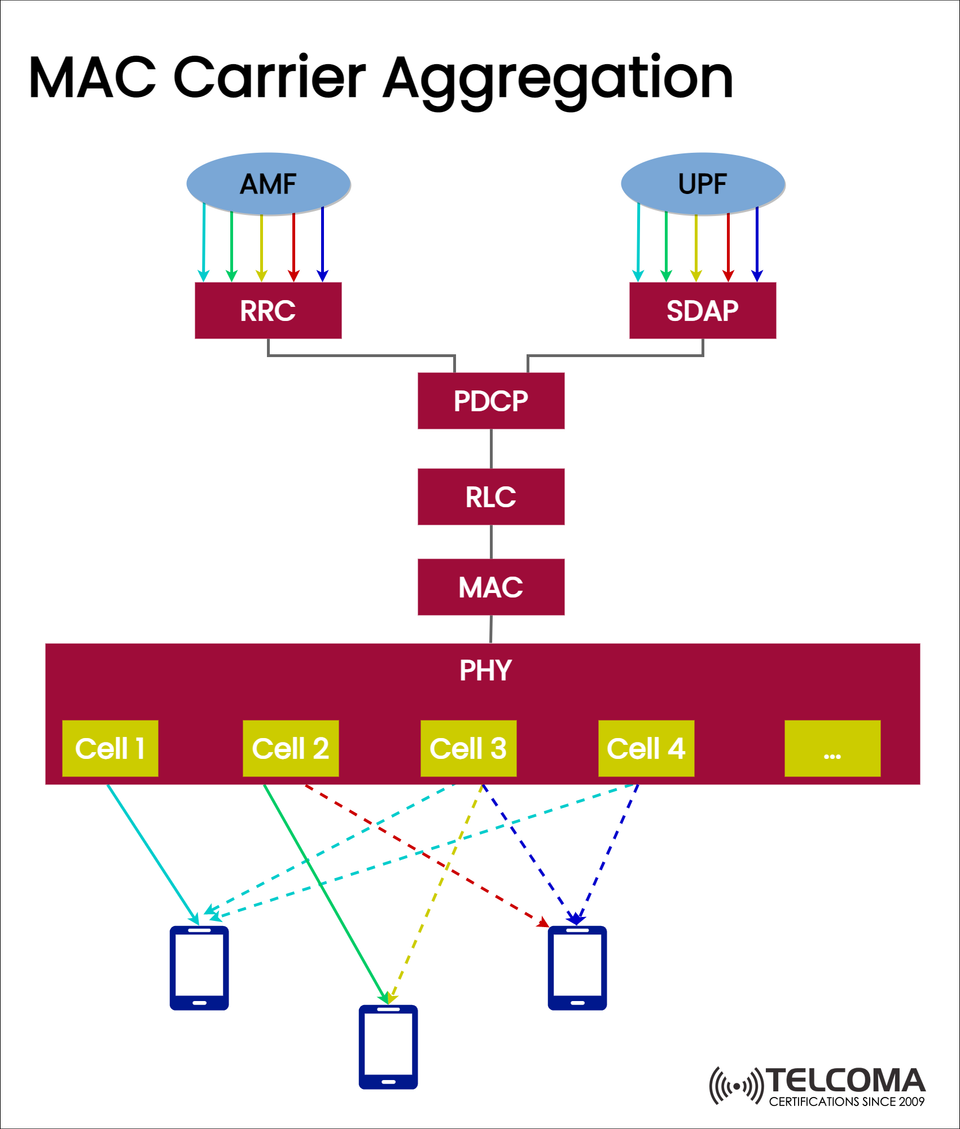
The diagram included shows how different frequency carriers from various cells come together at the MAC layer, coordinating with upper layers like PDCP (Packet Data Convergence Protocol), RLC (Radio Link Control), and RRC (Radio Resource Control). This setup enables devices to utilize multiple carriers at once, boosting bandwidth and overall performance.
What’s Carrier Aggregation?
Carrier Aggregation (CA) is a method that combines two or more component carriers (CCs) to enhance the effective bandwidth available for a user device (UE).
In 4G LTE-Advanced, CA made its debut.
In 5G NR, CA has evolved to offer greater flexibility across various frequency ranges (FR1 and FR2) and different inter-cell setups.
Looking to 6G, CA will go even further, incorporating terahertz bands, non-terrestrial networks (NTN), and dynamic spectrum sharing.
By pooling carriers together, operators can:
Boost peak data rates.
Improve spectral efficiency.
Ensure a more consistent user experience across different coverage zones.
The Role of the MAC Layer
The MAC layer is in charge of multiplexing data from upper layers and figuring out how to best use the carriers together.
In the diagram, you can observe the flow:
Control Plane: * AMF (Access and Mobility Management Function) connects with RRC to handle mobility and session management.
User Plane: * UPF (User Plane Function) interacts with SDAP (Service Data Adaptation Protocol) to manage QoS flows.
Common Layers: * PDCP takes care of header compression, security, and reordering. * RLC is responsible for segmentation, retransmission, and error correction. * MAC handles carrier aggregation, scheduling, and multiplexing. * PHY transmits the aggregated carriers over the air interface.
The MAC layer’s capability to manage multiple carriers across different cells is what facilitates Carrier Aggregation.
Types of Carrier Aggregation
There are a few deployment options for CA:
Intra-Band Contiguous CA * Carriers are side-by-side in the same frequency band. * Easiest to set up with low hardware complexity.
Intra-Band Non-Contiguous CA * Carriers exist in the same band but have a frequency gap between them.
Inter-Band CA * Carriers come from different frequency bands. * More complex but allows combining low-band (for coverage) with high-band (for capacity).
Inter-Cell CA (Cross-Cell CA) * Combines carriers from different cells, as illustrated in the diagram (Cell 1, Cell 2, Cell 3, Cell 4). * Crucial for network densification in 5G and future networks.
Benefits of MAC Carrier Aggregation
Carrier Aggregation brings notable performance enhancements:
Higher Peak Data Rates * Merging carriers can achieve gigabit-level speeds.
Better Spectrum Utilization * Makes efficient use of fragmented spectrum resources.
Enhanced User Experience * Smooth connectivity, even at the edges of cell coverage.
Improved Load Balancing * Spreads traffic across multiple carriers and cells.
Increased Reliability * Multiple carriers provide backup, lowering the chance of disconnection.
Example of User Experience with CA
Picture a user streaming 8K video on a 5G smartphone:
Without CA: The device connects to just one carrier (like 20 MHz), which limits the speed.
With CA: The device can use multiple carriers at the same time (like 4 x 20 MHz = 80 MHz).
Result: It leads to way higher speeds, smoother streaming, and less buffering.
In 6G, CA will accommodate multi-THz channels, resulting in even more incredible data rates and ultra-low latency applications like holographic telepresence.
Carrier Aggregation in 5G vs. 6G
Feature 5G CA | 6G CA (Projected)
Frequency Ranges | Sub-6 GHz (FR1), mmWave (FR2) | Sub-6 GHz, mmWave, THz, NTN
Component Carriers (CCs) | Up to 16 CCs (each 100 MHz) | >32 CCs, larger bandwidth (up to GHz)
Inter-Cell Aggregation | Supported (multi-TRP, cell groups) | Expanded to UAVs, satellites, NTNs
Spectrum Flexibility | Licensed + unlicensed spectrum | Full dynamic spectrum sharing
Latency Optimization | ~1 ms (URLLC) | <0.1 ms for ultra-reliable services
Challenges in Carrier Aggregation
Even though CA has obvious advantages, some hurdles exist:
UE Complexity: Devices need to support multiple RF chains and antennas.
Power Consumption: Managing several carriers can drain the battery quicker.
Network Coordination: It requires sync across cells and spectrum bands.
Spectrum Fragmentation: Operators might lack enough continuous spectrum for effective aggregation.
Future of Carrier Aggregation in 6G
As we look towards 6G, Carrier Aggregation is set to see even more progress:
AI-Driven Spectrum Allocation * AI will foresee traffic patterns and dynamically assign carriers accordingly.
Integration with Non-Terrestrial Networks (NTNs) * Satellites and UAVs will contribute carriers for aggregation.
Multi-Dimensional Aggregation * This will happen across frequency, time, space, and even among different network providers.
Ultra-Low Latency Aggregation * Supporting digital twins, extended reality (XR), and holographic communication.
Real-World Uses of Carrier Aggregation
- Verizon (USA)
Verizon is rolling out 5G NR Carrier Aggregation by combining C-band (3.7 GHz) with mmWave spectrum (28 GHz).
This mix offers broad coverage from C-band along with super-fast speeds from mmWave.
As a result, users enjoy multi-gigabit speeds, even in crowded city areas.
- NTT DoCoMo (Japan)
DoCoMo was among the first to experiment with 5G Carrier Aggregation using Sub-6 GHz and mmWave bands.
Their tests showed speeds over 4 Gbps thanks to CA with multiple component carriers.
This is key for Japan’s goal of developing 6G smart cities and integrating robotics.
- SK Telecom (South Korea)
SK Telecom is leading the way with quadruple carrier aggregation (4CC) in its 5G network.
By combining several 100 MHz carriers, they're providing highly reliable 5G services for both consumers and industries.
Their focus is on establishing autonomous driving lanes, which need low latency and high reliability.
Conclusion
MAC Carrier Aggregation stands out as a major asset in both 5G and 6G, enhancing user experience and increasing network capacity. By enabling devices to draw on multiple carriers across bands and cells at the same time, CA boosts throughput, spectrum efficiency, and service dependability.
While challenges such as device complexity and power consumption still pose concerns, the shift towards AI-driven, multi-dimensional CA in 6G promises seamless connectivity for future innovations, from immersive XR to autonomous technologies.
Carrier Aggregation showcases how the MAC layer is more than just scheduling—it’s the powerhouse behind bandwidth expansion in next-gen networks.